




• Nvis Technology
  • Nvis Technology
  • Nvis Technology
  • Nvis Technology
  • Nvis Technology
  • Nvis Technology
Nvis Technology

Head Office

141-A, Electronic complex, Pardesipura,Indore - 452010 India

Phone: +91 73899 00887 , +91 98932 70303

Email:info@nvistech.com

Request a Quote

Looking for a quality and affordable builder for your next project?


    Nvis Technology

    Toll Free

    +91 73899 00887

    We are happy to meet you during our working hours. Please make an appointment.

    • Monday-Saturday: 9:00 AM - 5:30 PM (IST)
    • Sunday: Closed

    Power Meter in Microwave Systems: Why Accurate Power Measurement Matters

    • A power meter in microwave systems is essential for accurate, reliable power measurement at high frequencies.
    • Microwave power meters directly measure RF and microwave power, making them more reliable than voltage-based methods.
    • Accuracy affects system performance, safety, efficiency, and regulatory compliance.
    • Different sensor types (thermal, diode, peak) suit different applications.
    • Proper setup, calibration, and handling are critical to avoid measurement errors.

    In high-frequency applications, accurate measurements are essential to every successful engineering system. In microwave and RF design, even minor measurement errors can lead to degraded performance, safety risks, and costly design mistakes. It is due to this reason that the power meter used in the microwave systems is such a critical factor in the laboratories, production floors, and field installations.

    The microwave power meter is among the most reliable tools in the measurement of microwave activities, whether it is in validating the transmitter output or in terms of regulatory compliance. This article provides a professional explanation of the working mechanism of a  power meter microwave system, the importance of accuracy, and how one of the engineers can get reliable results when using a power meter in the real world.

    Understanding Power Measurement in Microwave Systems

    Microwave systems typically operate at frequencies above 300 MHz and extend into the gigahertz (GHz) range. At such frequencies, low-frequency methods of measurement are no longer adequate. Changes in signal behavior, growth in losses and parasitic effects gain relevance.

    A microwave power meter has been made to cope with these challenges. It quantifies the actual power of a microwave source, amplifier or transmitter and gives the engineer one straightforward and reliable parameter with which to assess the performance of the system.

    Contrary to the measurement of voltages or currents, power is one of the most stable and repeatable quantities in high-frequency microwave systems, and the microwave power meter is a staple of RF test systems.

    What Is a Microwave Power Meter?

    A microwave power meter is an instrument used to measure the average or peak power of microwave signals. It typically consists of two main parts:

    • A power sensor, which interacts directly with the microwave signal
    • A display or processing unit, which converts the sensor output into a readable power value

    Depending on the design of the sensor, a power meter microwave system has the potential to measure power over a wide range of frequencies extending between a few megahertz and tens of gigahertz.

    Since the measurement of power is independent of the shape of the waveform or complexity of the modulation of digital signals, the power meter of microwave systems is highly applicable both to simple continuous-wave (CW) signals and more complex digitally modulated signals.

    Why Accurate Power Measurement Matters?

    1. System Performance and Efficiency

    In the microwave systems, coverage, signal quality, and efficiency are directly proportional to the output power. A faulty result of a microwave power meter can make engineers think that a system is working when it is not.

    A power underestimation may lead to inadequate performance of the system whereas overestimation can cause system overheating, distortion or breaking of components. The correct power meter microwave system is important for accurate power measurements to ensure that amplifiers, transmitters and antennas are working according to their specifications.

    2. Safety in High-Power Microwave Applications

    High-power microwave systems are widely used in radar, satellite communication, and industrial heating applications. The wrong power values can be life-threatening to the equipment and human life.

    A trustworthy power meter in a microwave system will assist avoid unnecessary overexposure, destruction of components and unsafe operation environments, as it will give assurance of measured power.

    3. Compliance with Standards and Regulations

    Several wireless and microwave networks are required to meet stringent regulatory restrictions on the power radiated. The government defines the maximum allowable power to prevent interference and allow safe operation.

    It is necessary to show compliance by using a calibrated microwave power meter. Certification and approval processes can be considered to be unreliable and dangerous without proper power measurements.

    Working Principle of a Power Meter in Microwave Systems

    The working principle of a power meter within the microwave systems is grounded in the fact that the conversion of the high frequency microwave power energy into something that is measurable and traceable is done accurately. Microwave signals cannot be accurately measured using conventional voltmeters or ammeters, making direct power measurement essential at high frequencies.Rather, a microwave power meter is used to measure the actual power picked up by the microwave signal, and thus it is one of the most reliable measurements in RF and microwave engineering.

    In this effort, a basic power meter microwave system will be composed of a power sensor and a display unit or a processing unit. They combine to convert the microwave energy to useful power readings, usually in the form of watts or dBm.

    Basic Measurement Concept

    1. The microwave signal is applied to a power sensor
    2. The sensor absorbs part or all of the microwave energy
    3. This energy is converted into heat or an electrical signal
    4. The meter processes this signal and displays power in watts or dBm

    Because the power meter in microwave systems measures actual energy rather than inferred values, it provides high accuracy across wide frequency ranges.

    Types of Microwave Power Meters

    Microwave systems are used with a high level of frequencies, power and signal formats. Different kinds of microwave power meter have been developed in order to cover these diverse needs. None of the types is universal, as each of them relies on a different principle of measurement and is designed to be applied in a particular application. Knowledge of these kinds can assist engineers to choose the appropriate power meter in the microwave systems so as to make precise and dependable measurements.

    Thermal Power Meters

    • Measure power by detecting heat generated by microwave energy
    • Known for excellent accuracy and stability
    • Ideal for calibration and reference measurements

    Thermal sensors make the power meter microwave extremely reliable for average power measurements.

    Diode Detector Power Meters

    • Use semiconductor diodes to detect microwave signals
    • Faster response time than thermal sensors
    • Suitable for low-power and modulated signals

    These sensors are widely used in modern power meters in microwave instruments due to their versatility.

    Peak Power Meters

    • Designed to capture fast, high-power pulses
    • Essential for radar and pulsed microwave systems
    • Measure peak, average, and pulse parameters


    Components of a Microwave Power Measurement Setup

    The power meter alone does not guarantee reliable microwave power measurement.Proper connection of the components and their selection are the keys to the right results. Every component of the system has a direct effect on the quality and consistency of measurements as well as their safety. To make good use of a power meter in microwave systems, it is important to understand these components.

    A complete power meter microwave setup typically includes:

    • Power sensor: The most critical component determining accuracy
    • Meter or display unit: Processes and displays measured power
    • Interconnects: Coaxial cables or waveguides for signal delivery

    Every component affects the overall accuracy of the microwave power meter, making careful selection and handling essential.

    Factors Affecting Accuracy in Microwave Power Measurement

    Measurement of microwave power is very critical to assure proper performance, safety, and compliance with regulations of a system. Although a power meter of high quality appears in the microwave systems, there are a number of external and internal factors that may affect the accuracy of measurements. The knowledge of these considerations assists the engineers to reduce mistakes and to get reliable results of a microwave power meter.

    Even the most precise microwave power meter can produce inaccurate results if key influencing factors are ignored.

    a) Frequency Response

    Sensors have specified frequency ranges. Using a sensor outside its rated band can introduce significant errors.

    b) Mismatch and VSWR

    Impedance mismatches between the source and sensor cause reflected power, reducing measurement accuracy. High-quality sensors are designed to minimize these effects.

    c) Temperature Effects

    Thermal drift can affect readings, especially in long-duration measurements. This is why stable environments and warm-up times are important for microwave power meter accuracy.

    D) Calibration Uncertainty

    Every power meter microwave system must be calibrated against traceable standards. Skipping calibration leads to unreliable data.

    Applications of Microwave Power Meters

    Microwave power meters are important tools where microwave and RF energy is produced, transmitted or measured. The power meter has become very common in microwave systems due to the repeatability and reliability of power which is one of the most reliable parameters at high frequencies. The following are the critical areas of application of a microwave power meter.

    The power meter microwave is used across a wide range of industries:

    Communication Systems

    • Cellular base stations
    • Satellite uplinks and downlinks
    • Microwave backhaul systems

    Radar and Defense

    • Transmitter power validation
    • Pulse power measurement
    • System diagnostics

    Research and Education

    • University laboratories
    • Microwave component characterization
    • Experimental RF systems

    Manufacturing and Production Testing

    • Quality assurance
    • End-of-line testing
    • Compliance verification

    In all these cases, the power meter in microwave systems ensures repeatability, reliability, and confidence in results.

    Common Mistakes to Avoid When Using a Microwave Power Meter

    A high-quality instrument may not give the correct result despite the instrument being of high quality unless the appropriate measurement practices are applied. The microwave power meter is not the cause of many of the errors in microwave testing, but improper setup, poor handling, or lack of understanding of the measurement limits. To a great extent, preventing the following widespread errors will help to enhance the accuracy, safety, and reliability of any power meter in microwave systems.

    Even experienced engineers can encounter errors when using a microwave power meter:

    • Selecting the wrong sensor for frequency or power level
    • Ignoring cable and connector losses
    • Overloading the sensor
    • Skipping warm-up and zeroing procedures

    Avoiding these mistakes significantly improves the reliability of power meter microwave measurements.

    Conclusion

    Precision in power measurement is not only a technical specification, but a base of performance in microwave engineering, safety and compliance.Microwave systems rely on power meters to provide a direct, reliable, and trusted method for gauging microwave signal power. in industries and applications.

    With the knowledge on how a microwave power meter operates, the factors influencing its precision and the proper use of the meter, engineers are able to know that their systems are functioning as they expected. The power meter microwave has also been one of the most critical equipment in the modern RF and microwave measurement, in a field where precision is a critical factor.

    Frequently Asked Questions (FAQs)

    1. What is a power meter in microwave systems?
      A power meter in microwave systems is an instrument used to measure the actual power of microwave and RF signals accurately, typically in watts or dBm.
    2. Why is a microwave power meter preferred over voltage measurements?
      At microwave frequencies, voltage and current are difficult to measure directly. A microwave power meter provides stable, direct, and repeatable power measurements independent of waveform shape.
    3. What types of microwave power meters are commonly used?
      Common types include thermal power meters, diode detector power meters, and peak power meters, each designed for specific power levels and signal types.
    4. What affects the accuracy of a power meter microwave measurement?
      Accuracy is influenced by sensor frequency range, calibration, mismatch (VSWR), cable losses, temperature, and proper sensor selection.
    5. Where are microwave power meters used?
      Microwave power meters are widely used in wireless communication, radar, satellite systems, R&D labs, manufacturing, aerospace, and educational institutions.

    Related Blogs:

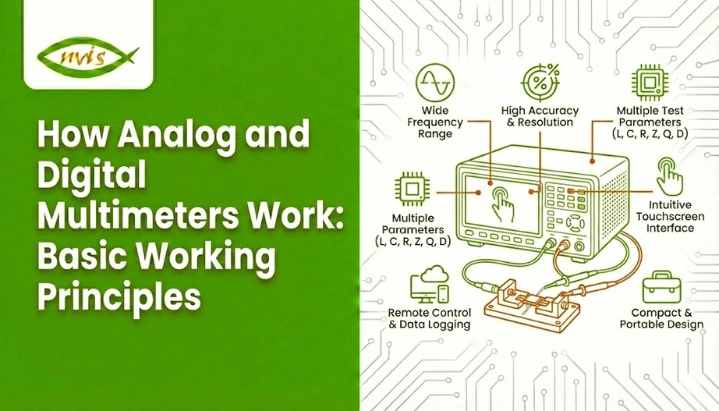
    How Analog and Digital Multimeters Work: Basic Working Principles


    • This blog targets students, technicians, and engineers learning electrical measurements.
    • A multimeter measures voltage, current, and resistance in electrical circuits.
    • Analog multimeters work on the PMMC principle using needle deflection.
    • Digital multimeters use ADCs and digital processing for high accuracy.
    • Digital multimeters dominate modern applications, while analog meters remain useful for learning and trend observation.

    The foundation of electrical and electronics engineering is the ability to measure electrical quantities accurately. The analog and digital multimeter is one of the tools you will always find in your toolbox, whether you are a student learning basic circuit principles, a technician troubleshooting a system, or an engineer verifying system performance.

    Despite the extensive use of digital technologies in the modern laboratories and field settings, the knowledge of the principles of work of an analog multimeter and a digital multimeter helps to gain a better idea of the working principles of electrical measurements and how they are measured, interpreted, and believed in.

    This paper describes the working principle of analog and digital multimeters, their internal mechanisms, main distinctions, and the conditions under which each of them is most appropriate.

    What Is a Multimeter?

    A multimeter is a flexible electrical measuring device that is utilized to measure various electrical parameters in a single device. It is among the most important tools in electrical and electronics work that is commonly used among students, technicians, engineers, and maintenance workers.

    At a basic level, a multimeter combines the functions of three instruments:

    • Voltmeter – measures electrical voltage (AC and DC)
    • Ammeter – measures electrical current
    • Ohmmeter – measures electrical resistance

    Modern multimeters can also measure additional parameters such as continuity, capacitance, frequency, temperature, and diode characteristics, depending on the model.

    Multimeters are available in two main types:

    • Analog multimeters, which use a moving needle and scale to display readings
    • Digital multimeters, which display measurements as precise numerical values on a screen

    Whether analog or digital, the primary purpose of a multimeter is to help users test, diagnose, and verify electrical circuits safely and accurately, making it a fundamental instrument in both learning environments and real-world applications.

    Basic Working Principle of an Analog Multimeter

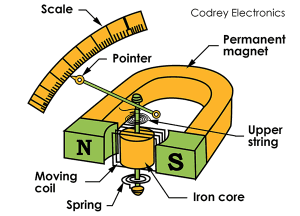
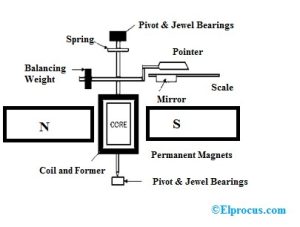
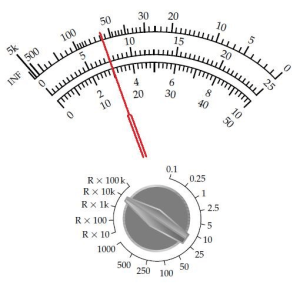
    The fundamental mechanism of working of an analog multimeter is the Permanent Magnet Moving Coil (PMMC) mechanism. This principle transforms electrical quantity into mechanical movement which can be observed graphically on a scale.

    An analog multimeter operates on the Permanent Magnet Moving Coil (PMMC) principle. A force is created by passing electric current through a coil in a magnetic field which causes the coil and pointer attached to it to move.

    Electrical quantities can be measured because the deflection of the pointer is proportional to the current. The same mechanism is used to measure voltage using a series resistor, current using a shunt resistor, and resistance using an internal battery.

    A calibrated scale is used to read the reading and the reading gives a real-time and continuous reading of the value being measured.

    Basic Working Principle of a Digital Multimeter

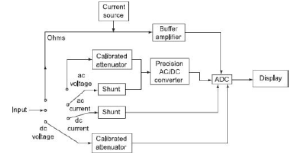
    The principle of operation of a digital multimeter (DMM) is rooted in electronic signal processing and analog-to-digital conversion and analog-to-digital conversion. A digital multimeter, unlike an analog multimeter, does not need the movement of a mechanical aspect; this is because it measures the electrical activity and converts it to digital data which can be properly read on a screen.

    1. Input Signal Conditioning

    • The measured voltage, current, or resistance is first conditioned using resistors and protection circuits.
    • This ensures the signal is within a safe and measurable range.

    2. Analog-to-Digital Conversion (ADC)

    • The conditioned analog signal is converted into a digital value using an ADC.
    • This is the heart of the digital multimeter.

    3. Digital Processing

    • A microcontroller processes the digital data.
    • Mathematical calculations are performed to display the final measurement.

    4. Digital Display

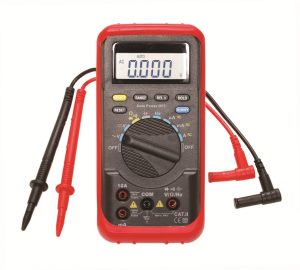
    • The processed value is shown on an LCD or LED display as a precise numerical reading.

    How an Analog Multimeter Measures Different Quantities

    An analog multimeter operates on the Permanent Magnet Moving Coil (PMMC) principle to measure different electrical quantities but in measuring various electrical quantities. The instrument is able to measure voltage, current and resistance with the help of the change of internal circuit configuration using range selectors and resistors.

    Voltage Measurement

    • A high-value series resistor is added to limit current.
    • The voltage applied causes a proportional current through the coil, resulting in pointer deflection.

    Current Measurement

    • A low-resistance shunt is connected in parallel to handle higher currents safely.
    • Only a small fraction of the current flows through the moving coil.

    <h3class=”margin_top_10px”>Resistance Measurement

    • An internal battery supplies current.
    • Resistance is calculated based on how much current flows through the unknown resistor.
    • The scale is nonlinear, requiring careful reading.

    How a Digital Multimeter Measures Different Quantities?

    A digital multimeter (DMM) measures electrical quantities using electronic circuits, signal conditioning, and an Analog-to-Digital Converter (ADC). Unlike an analog multimeter, a digital multimeter converts electrical signals into numerical values and displays them on an LCD or LED screen. By changing the internal circuitry through a rotary switch or buttons, the same instrument can accurately measure voltage, current, and resistance.

    Voltage Measurement

    • The input voltage is first applied to a high-input-impedance voltage divider to reduce it to a safe level.
    • This scaled-down voltage is fed into the ADC.
    • The ADC converts the analog voltage into a digital number.
    • The microcontroller processes this value and displays the voltage directly on the screen.
    • High input impedance (typically 10 MΩ or more) ensures minimal loading on the circuit under test.

    Current Measurement

    • Current is measured by allowing it to pass through a precision low-value shunt resistor.
    • The voltage drop across the shunt resistor is proportional to the current flowing through it (Ohm’s Law).
    • This small voltage drop is amplified, sent to the ADC, and converted into a digital value.
    • The multimeter displays the calculated current in amperes, milliamperes, or microamperes.
    • Separate input terminals are often used for high and low current ranges for safety.

    Resistance Measurement

    • An internal battery supplies a known, small current through the unknown resistor.
    • The DMM measures the resulting voltage drop across the resistor.
    • Using Ohm’s Law, the microcontroller calculates the resistance value.
    • The result is displayed on a linear digital scale, making it easier to read than analog resistance scales.
    • Accuracy is high, but the circuit under test must be powered off during resistance measurement.

    Accuracy and Precision in Digital Multimeters

    Two of the most significant performance attributes of a digital multimeter (DMM) would be accuracy and precision. They identify the extent to which the measurements that have been shown can be relied upon and repeated in the real world.

    Digital multimeters provide:

    • Higher resolution
    • Minimal human reading error
    • Stable and repeatable results

    This makes digital multimeters more suitable than analog multimeters in most professional environments.

    Key Differences Between Analog and Digital Multimeter

    AspectAnalog MultimeterDigital Multimeter
    Display TypeNeedle and scaleNumeric digital display (LCD/LED)
    Working PrincipleBased on PMMC (Permanent Magnet Moving Coil) principleUses electronic circuits and Analog-to-Digital Converter (ADC)
    AccuracyModerate accuracyHigh accuracy and precision
    Reading ErrorProne to parallax errorNo parallax error
    ScaleNonlinear (especially for resistance)Linear and easy to read
    Input ImpedanceLow to moderateVery high (typically 10 MΩ or more)
    SensitivityLower sensitivityHigh sensitivity
    Power RequirementRequired only for resistance measurementRequired for all measurements
    Response to FluctuationsGood for observing signal variations and trendsLess effective for fast fluctuations
    Ease of UseRequires careful interpretationSimple and user-friendly
    Extra FunctionsLimited to basic measurementsSupports continuity, diode test, frequency, capacitance, etc.
    Modern UsageMainly for learning and trend observationWidely used in labs, industry, and fieldwork


    Advantages of Analog Multimeter

    • Real-time response: The moving needle shows continuous changes, making it easy to observe fluctuations and trends in signals.
    • Better for tuning: Ideal for adjustment, alignment, and balancing tasks where gradual changes must be monitored.
    • No sampling delay: Instant pointer movement reflects actual signal behavior without digital sampling lag.
    • Simple operation: Easy to understand working principle, useful for learning basic electrical concepts.
    • Low power requirement: Does not rely heavily on batteries, except for resistance measurement.

    Advantages of Digital Multimeter

    • High accuracy: Provides precise and reliable measurements with minimal error.
    • Easy readability: Clear numeric display eliminates parallax and reading errors.
    • High resolution: Detects very small changes in voltage, current, and resistance.
    • Auto-ranging feature: Automatically selects the correct measurement range, improving convenience and safety.
    • Advanced functions: Supports features like data hold, continuity test, diode test, and sometimes frequency and temperature measurement.

    Safety Considerations When Using Multimeters

    Safety should always be kept in mind when working with a multimeter to avoid electric shock or equipment damage. Before connecting the probes, always select the correct measurement function and range and when you do not know what the value is then always start with the highest range. Make sure that the test leads are correctly attached to the appropriate terminals (particularly in determining current). Do not measure resistance and continuity on an active circuit because this may harm the meter and is dangerous. The correct safety rating of multimeters employed with insulated probes also provides safe and reliable measurements.

    Safety is critical regardless of whether you use an analog and digital multimeter.

    Applications of Analog and Digital Multimeters


    In educational laboratories, one can learn fundamental electric principles with analog and digital multimeters, in electronics debugging to measure circuits and components, and in electrical maintenance to measure wiring, voltage, and continuity. They are also typically applied in automotive testing to test batteries and sensors and in industry to test, calibrate, and perform routine maintenance.

    Conclusion

    Learning the principles of work of analog and digital multimeter instruments is not just reading the numbers on a display. The analog multimeter is used to learn the basics of electromagnetism by its moving coil system, whereas the digital multimeter is used to learn the latest digital signal processing and digital conversion methods.

    Although digital multimeters are the modern standard due to their accuracy and convenience in the workplace, analog multimeters still have a place in learning and practical observation. Whether to use an analog multimeter or a digital multimeter is always a matter of choice based on what one wants to measure and how precise he or she wants the reading to be as well as the type of signal that he or she intends to measure.

    Learning the operating principles of each, the engineers and technicians will have a better understanding of the electrical measurement and be more confident and informed in making decisions in a real-life testing situation.

    FAQs

    1. What is the main difference between an analog and a digital multimeter?
      An analog multimeter uses a moving needle and scale, while a digital multimeter displays readings numerically on a digital screen.
    2. Which multimeter is more accurate?
      Digital multimeters are generally more accurate and precise than analog multimeters.
    3. Can an analog multimeter measure AC and DC?
      Yes, analog multimeters can measure both AC and DC voltage and current with proper settings.
    4. Why are digital multimeters more popular today?
      They offer higher accuracy, easy readability, auto-ranging, and additional measurement features.
    5. Are analog multimeters still useful?
      Yes, they are useful for learning fundamentals and observing rapid signal fluctuations.

    Related Blogs: