




• Nvis Technology
  • Nvis Technology
  • Nvis Technology
  • Nvis Technology
  • Nvis Technology
  • Nvis Technology
Nvis Technology

Head Office

141-A, Electronic complex, Pardesipura,Indore - 452010 India

Phone: +91 73899 00887 , +91 98932 70303

Email:info@nvistech.com

Request a Quote

Looking for a quality and affordable builder for your next project?


    Nvis Technology

    Toll Free

    +91 73899 00887

    We are happy to meet you during our working hours. Please make an appointment.

    • Monday-Saturday: 9:00 AM - 5:30 PM (IST)
    • Sunday: Closed

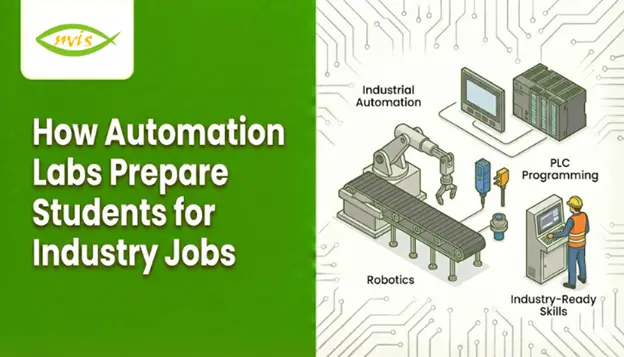
    How Automation Labs Prepare Students for Industry Jobs

    TL;DR

    1.  The blog targets engineering students, technical institutions, trainers in industries and education decision-makers seeking to align academic programs with the emerging industrial demands in the field of lab automation and smart manufacturing.
    2. Automation labs, in contrast to the traditional labs, replicate real industrial conditions with the help of high-quality lab automation systems and lab automation software, allowing the students to acquire the real-world, job-oriented experience.
    3.  Automated lab training creates opportunities to work as Automation Engineer, Control Systems Engineer, Robotics Technician, and Process Automation Specialist, all of which are in increasing demand.
    4.  Investment in the contemporary lab automation systems will improve industry relationships, increase the placement rate, research innovation, and institutional reputation in the competitive education world.


    Lab automation systems are at the core of this transformation Manufacturing plants are transforming into smart factories. Accurate robotics and smart surveillance are essential to pharmaceutical businesses. Experimentation that is data-driven is taking place in research institutions. Lab automation is at the core of this transformation.

    As organizations adopt advanced technologies, the demand for professionals skilled in lab automation systems, robotics, control engineering, and intelligent software platforms continues to grow. However, there is a significant gap between what traditional academic laboratories teach and what modern industries expect from graduates.

    In contrast to traditional laboratories where the emphasis is laid on theory and manual processes, automation laboratories mimic the industrial real-life situations. They equip students with practical skills in lab automation software, programmable systems, robotics, and integrated control technologies aligned with industry demands.

    Industry-leading equipment providers such as Nvis support automation training by offering logic analyzers, LCR meters, IC testers, and data acquisition systems that enhance diagnostics and decision-making capabilities. The company also provides customized industrial automation solutions, which incorporate sensors and control systems to streamline processes and optimize productivity.Nvis provides industries with the power to establish operational excellence and growth sustainability through innovation and quality-based solutions.


    Related Articles

    1. Choosing the Right Power Supply for Your Lab: A Beginner’s Guide to Bench, Programmable & Variable Units
    2. How Practical Labs Make Technical Education and Skilling Industry-Driven
    3. Why Your Electrical Training Lab Needs Safety Earthing Training Work Bench Today


    Understanding Lab Automation in Industry Education

    Automation labs are advanced learning environments that bridge the gap between academic theory and real industrial practice. These labs are equipped with integrated lab automation systems that closely replicate modern industrial operations, unlike traditional labs, which primarily involve manual processes and isolated experiments.

    Automation labs replicate real-world production and research environments to provide students with practical exposure to the tools, workflows and technologies that they will experience in their professional settings. This hands-on method greatly enhances readiness to work, and equips students with the ability to operate in a full framework of a lab automation system.

    In a well-equipped automated lab, students develop the ability to:

    • Design and set up automated workflows- Students learn how to map processes, define operational sequences, and develop structured automation logic. This involves knowing about the flow of materials, incorporation of sensors and real-time monitoring in integrated lab automation systems.
    • Program control systems- Students gain practical experience in programming with PLCs, HMIs, and industrial controllers, which would be relevant in using the lab automation systems. They create, debug, and maintain control logic which controls machines and production processes.
    • Use robotics and intelligent equipment – Robots that are frequently used in automation laboratories are robotic arms, conveyors, smart inspection, and collaborative robots. Learners gain experience in configuration, calibration, safety protocols, and motion programming – competencies that are highly demanded in manufacturing and technology-driven sectors.
    • Analyze process data – The current lab automation environment produces large amounts of operational data. Students get to know how to analyze system metrics, identify areas of inefficiency, and implement data-driven approaches to process optimization.
    • Integrate hardware with lab automation software – One of the critical industry competencies is the ability to connect physical equipment and soft platform of advanced lab automation software. Students are trained on how to set up communication protocols, how to manage data acquisition systems and how to provide smooth integration of software applications and hardware components.

    Automation Labs Prepare for Industry Jobs

    Automation laboratories equip students with skills aligned directly with current industry requirements. Using the real systems of lab automation and sophisticated lab automation software, students can obtain practical experience in programming, system integration, robotics, and process monitoring.

    They simulate real industrial conditions, enabling students to design automated workflows, troubleshoot system faults, and optimize performance within a complete automation ecosystem.

    Consequently, graduates come into the workforce with employment-related experience, skills, and competence in solving problems and the self-confidence to make an impact right away in automation-related fields.

    Practical Skills Developed in Automation Labs

    The true strength of automation labs lies in skill development.

    1. Systems Thinking

    Students learn to see automation not as isolated machines but as interconnected ecosystems. This systems-level understanding prepares them for roles involving integration and process optimization.

    2. Technical Programming Proficiency

    Working with lab automation software, students become proficient in:

    • PLC programming
    • HMI design
    • Communication protocols (Modbus, Ethernet/IP, Profibus)
    • Industrial networking

    Employers highly value these practical programming skills.

    3. Troubleshooting and Diagnostics

    Automation systems are complex. Learning to identify and resolve issues is critical.

    Students practice:

    • Debugging control logic
    • Sensor calibration
    • Fault analysis
    • System performance evaluation

    This builds confidence and job readiness.

    4. Project Management and Collaboration

    Automation labs typically use project-based learning models. Students work in teams to design and implement complete automation projects.

    This fosters:

    • Communication skills
    • Documentation practices
    • Time management
    • Cross-disciplinary collaboration

    These soft skills are equally important in industry.

    Career Opportunities After Automation Lab Training

    Graduates trained in automation labs gain practical experience in lab automation systems, robotics, and lab automation software, which will be very competitive in the job market. The practical experience that they get in dealing with real-time industrial systems equips them with a variety of technical jobs, such as:

    • Automation Engineer – Designs, develops, and maintains advanced lab automation systems for manufacturing and research facilities.
    • Control Systems Engineer – Programs and optimizes PLCs, HMIs, and integrated lab automation system architectures.
    • Robotics Technician – Configures, operates, and maintains robotic equipment within automated production environments.
    • Process Automation Specialist – Improves operational efficiency by implementing intelligent lab automation solutions.
    • Manufacturing Systems Engineer – Integrates hardware and lab automation software to streamline smart factory workflows.
    • Quality Control Automation Analyst – Uses automated inspection systems and data analytics to ensure product consistency and compliance.

    Employers highly value candidates with hands-on experience in automated labs because they require minimal onboarding, understand industrial processes, and can adapt quickly to production environments. This hands-on exposure significantly improves employability and long-term career growth.

    The Competitive Advantage of Automation Labs

    Automation-based labs give students a strong advantage in today’s competitive job market by aligning academic training with real industry requirements. Students who acquire hands-on experience with lab automation systems and professional laboratory automation software become more adaptable to the industrial setting because they are already familiarized with the integrated workflows and operations of the system. This practical exposure reduces onboarding time, lowers training costs, and improves productivity from day one. Consequently, those institutions that have an infrastructure of automation system laboratories tend to record higher employability rates, producing more confident, skilled, and job-ready graduates prepared for the dynamic world of lab automation.

    How Educational Institutions Benefit

    Investing in automation labs provides multiple strategic advantages for educational institutions:

    • Stronger Industry Partnerships
      Institutions with advanced lab automation systems are more likely to collaborate with companies for internships, live projects, research initiatives, and campus placements.
    • Enhanced Research & Innovation
      Modern lab automation system infrastructure supports applied research, prototype development, and innovation-driven projects across engineering and technology disciplines.
    • Improved Academic Reputation
      Offering training in industry-grade lab automation software and real-world automation technologies enhances institutional credibility and market positioning.
    • Better Placement Outcomes
      Students trained in hands-on lab automation environments are more job-ready, leading to stronger placement records.
    • Attracting High-Quality Applicants
      A well-equipped automated lab signals future-ready education, drawing ambitious students seeking practical and career-focused learning.

    Conclusion:

    The future of industry is automated, intelligent, and interconnected, and therefore automation labs are a necessity in contemporary education. Conventional learning alone is not sufficient to prepare students for modern workplaces, which are technology-driven. Automation labs can also be used to supplement the theory and practice divide through hands-on experience with lab automation systems and robotics, as well as high-end lab automation software.

    A well-equipped automation lab enables students to design solutions, manage workflows, optimize processes, and adapt to emerging technologies within a complete automation framework. This benefits the students as it provides them with better career opportunities, institutions as it makes them more relevant and industries with the ability to get skilled, job-ready professionals trained in real-world lab automation environments.

    FAQs

    An automation lab is a modern training lab where students learn using real lab automation systems and tools instead of only theory or manual experiments.

    Students learn programming, robotics operation, system integration, troubleshooting, and how to use lab automation software in real-world setups.

    Hands-on experience with a complete lab automation system makes students job-ready and helps them adapt quickly to industry environments.

    Students can become Automation Engineers, Control Engineers, Robotics Technicians, or work in other roles related to lab automation and smart manufacturing.

    Colleges with advanced automation labs improve student placements, build strong industry partnerships, and offer more practical, career-focused education.
    Tags: Actuators & Drives, automated lab, Automation Lab Training, automation labs, Control Systems Engineering, Electrical Automation, Ethernet/IP), Factory Automation, HMI Programming, Industrial Automation Course, Industrial Networking (Modbus, Industrial Robotics Training, Industrial Sensors, Instrumentation & Control, IoT in Manufacturing, lab automation software, lab automation system, lab automation systems, Mechatronics Lab, PLC Panel Wiring, PLC Training, Process Automation, Process Control Systems, Profibus, SCADA Training, Variable Frequency Drive (VFD)

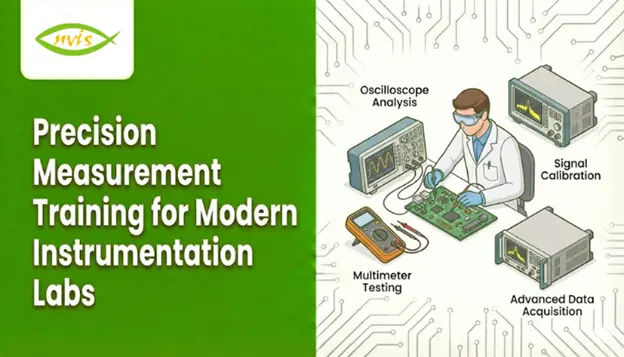
    Precision-Measurement-Training-for-Modern-Instrumentation-Labs

    TL;DR

    1. The blog will be used by students of engineering, technical institutions, lab managers, training providers, and industry professionals in the field of instrumentation, manufacturing, R&D and quality control to learn about the significance of precision measurement training in contemporary labs.
    2. In accurate measurement, repeatability, reliability, and traceability form the foundation of quality assurance, product verification, research accuracy and industrial compliance.
    3. As digital instruments, automation, AI, and Industry 4.0 evolve, professionals are required not only to operate instruments but also to be proficient in calibration, uncertainty analysis, and advanced measurement systems.
    4. Formal precision measurement training reduces costly production errors and prepares professionals for roles such as Calibration Engineer, Instrumentation Engineer, and Metrology Specialist.
    5. The new technological advances such as AI-based measurement systems, IoT-connected instruments, digital twins, and automated calibration demand the use of modern and industry-fit precision measurement programs in order to remain competitive.


    In today’s technological world, innovation is no longer limited by ideas but by accuracy. Whether designing microprocessors, manufacturing aerospace components, calibrating medical equipment, or validating renewable energy systems, precision measurement is the foundation of success.

    Modern instrumentation laboratories are no longer limited to analog meters and manual gauges. They are advanced environments that comprise digital systems, automation, data analytics and globally applicable calibration standards. As production systems evolve toward smart manufacturing, Industry 4.0, and AI-driven operations, the demand for professionals trained in precision measurement has never been higher.

    Precision measurement training involves more than simply learning how to operate instruments. It involves developing competence in measurement science (metrology), understanding uncertainty, calibration principles, traceability and data interpretation with conviction. Colleges investing in formalized precision measurement courses train students and practitioners to work in high-impact careers in instrumentation, quality assurance, research and development, automation and high-technology manufacturing.


    Related Blogs


    Understanding Precision Measurement in Modern Instrumentation Labs

    Precision measurement is the art and technique of having extremely repeatable, trustworthy, and traceable measurements with a minimal amount of uncertainty. In contemporary instrumentation laboratories, it is used to make sure that not only the results are consistent but also scientifically justified and corresponding to accepted standards. Accurate measurement forms the basis of quality assurance, product validation, research integrity, and industry compliance.

    It involves several critical components:

    • Accurate instrument selection – Choosing the appropriate instrument based on required tolerance, range, sensitivity, and application needs.
    • Calibration against standards – Verifying and adjusting instruments using traceable reference standards to maintain accuracy.
    • Statistical validation – Applying statistical methods to confirm repeatability, reproducibility, and overall measurement consistency.
    • Error analysis – Identifying and minimizing systematic and random errors that may affect results.
    • Environmental control – Managing temperature, humidity, vibration, and other external factors that influence measurement performance.
    • Data interpretation – Analyzing, documenting, and reporting measurement results in accordance with industry and regulatory standards.

    Accuracy is often confused with precision, but they are not the same. Accuracy is the term describing the closeness of a measurement to the accepted or true reference value. Precision is the extent or consistency of the repeated measurement in giving the same result. The smallest increment an instrument can detect is referred to as its resolution. These differences are fundamental in ensuring reliability and credibility in the contemporary instrumentation laboratories.

    The Role of Precision Measurement in Modern Instrumentation Labs

    State-of-the-art instrumentation labs support applications such as academic training, industrial calibration, research and development,  product verification, product quality control and prototype testing. Precision measurement has been critical in all these functions as it provides assurance that results obtained are accurate, repeatable, and traceable to known standards.

    Labs cannot ensure reliability or compliance without strong precision measurement capabilities. Failure to make accurate measurements may cause inaccurate research, defective products, and loss of operations. Hence, quality, credibility, and technical excellence of the current instrumentation laboratories is pegged on precision measurement.

    Why Precision Measurement Training Is Essential in Industry

    Traditional lab education primarily focuses on basic instrument handling, but modern industry requires more advanced technical skills. Due to the development of technology, preciseness in measurement training has been considered a necessity to achieve accuracy, reliability and compliance.

    1. Increasing Technological Complexity

    Modern labs use sophisticated equipment such as digital storage oscilloscopes, high-resolution data acquisition systems, PLCs, automated calibration benches, spectrum analyzers, and laser-based measurement systems. These tools require proper training in order to operate them efficiently and draw conclusions about the results.

    2. Growing Demand for Skilled Professionals

    Electronics and other industries, aerospace, renewable energy and defense demand professionals capable of carrying out high precision testing, performing the uncertainty analysis, handling the schedule of calibration, and troubleshooting the instrumentation problems. Precision measurement training enhances technical capability and workability.

    3. Minimizing Costly Errors

    The consequences of measurement errors include rejected batches, product recalls, warranty, and product delays. Formal training mitigates these dangers and provides dependable and steady output.

    Education in precision measurement has become an urgent need of the contemporary instrumentation laboratory and industry-prepared specialists.

    Key Benefits of Precision Measurement Training

    1. Enhanced Technical Competency

    Professionals understand not only how to measure but how to validate measurements scientifically.

    2. Improved Employability

    Roles include:

    • Calibration Engineer
    • Instrumentation Engineer
    • Quality Control Specialist
    • Metrology Technician
    • Test & Measurement Engineer

    3. Reduced Industrial Risk

    Proper training minimizes production defects and improves system reliability.

    4. Strong Foundation for R&D

    Research depends on accurate experimental data. Precision measurement is foundational to innovation.

    Emerging Trends in Precision Measurement

    The field of precision measurement is rapidly evolving as the modern instrumentation laboratories and the industrial processes are redesigned with the new technologies. Training programs should keep up with such developments in order to be relevant and efficient and can equip the professionals with the next generation measurement systems.

    1. AI-Based Measurement Systems

    Measurement platforms are being introduced with artificial intelligence to increase the detection of anomalies, predictive maintenance, and intelligent calibration schedules. AI-powered systems can analyze large datasets, identify patterns, and improve decision-making accuracy.

    2. IoT-Connected Instruments

    IoT-enabled instruments allow real-time remote measurement, centralized data collection, and enhanced system integration. This interconnectedness increases efficiency in operations, promotes preventive maintenance and is able to manage labs more intelligently.

    3. Digital Twins

    Digital twin technology develops virtual models of measurement environments and systems. These models reproduce the real world conditions to test advanced, optimize performance and predictively analyze and do not interfere with the physical operations.

    4. Automated Calibration Systems

    Calibration automation decreases human error, enhances repetitiveness, and improves reliability of the measurements in general. The automated systems also simplify documentation and make sure that the standards of the industry are met.

    Conclusion:

    Accurate measurement is no longer a luxury; it is a necessity in the contemporary engineering and manufacturing fields, automation, as well as research. As industries operate with tighter tolerances, smarter systems, and stricter quality standards, the need for accurate, reliable, and traceable measurements continues to grow. Modern instrumentation laboratories can no longer rely solely on basic tool-handling methods and need to embrace systematic and industry-oriented courses on precision measurements that not only focus on scientific validation and exposure to practical applications, but also calibration skills, uncertainty assessment, and the incorporation of automation. Companies that invest in extensive training on precision measurement develop professionals who are industry ready and in turn add to innovation, efficiency at work and competitiveness at the global scene. As technology advances and automation expands, the demand for professionals trained in precision measurement will continue to grow.

    NVIS Technologies  delivers advanced technical training systems and lab solutions for engineering education and industrial skill development.

    FAQs

     Precision measurement means taking measurements that are consistent, reliable, and very close to the correct value with minimal error.

    It helps students and professionals learn how to use instruments correctly, reduce errors, and ensure accurate results in labs and industries.

     It is used in industries like electronics, automotive, aerospace, renewable energy, manufacturing, and research labs

    Training includes calibration techniques, error analysis, uncertainty calculation, instrument handling, and data interpretation.

     You can work as a calibration engineer, instrumentation engineer, quality control specialist, or metrology technician in various industries.

    Tags: Advanced Measurement Techniques, Industrial Instrumentation Training, Industrial Sensors & Transmitters, Industry 4.0 Instrumentation, Instrumentation & Control Training, Instrumentation Lab Training, Instrumentation Practical Lab, Measurement & Calibration Training, Metrology Training Program, Modern Instrumentation Course, PID Loop Tuning Training, Precision Calibration Course, precision measurement, Precision Measurement Training, Process Control Measurement, Smart Instrumentation Systems