






TL;DR
- This blog is designed for engineering students, educators, researchers, and industry professionals who want to understand data acquisition systems, how they work, and their real-world applications.
- A Data Acquisition System (DAS) collects real-world electrical signals and converts them into usable digital data for monitoring and analysis.
- DAS consists of core components such as sensors, signal conditioning circuits, ADCs, and DAQ software working together as a complete measurement chain.
- These systems can measure a wide range of parameters including voltage, current, speed, power with supporting both single-phase and three-phase applications.
- With benefits like high accuracy, real-time monitoring, data logging, safety, and scalability, data acquisition systems are essential in laboratories, industries, automation, research, and education.
Introduction
The world of today has become data-driven and the quality of decisions depends on the quality of data. Industrial automation, energy control, healthcare diagnostics, and environmental monitoring are just a few areas where organizations rely on accurate, real-time information to operate efficiently and safely. Here, data acquisition is very crucial.
In its simplest form, data acquisition is concerned with measuring the real-world phenomena and converting such measurements into the digital format, which is usable A Data Acquisition System (DAS) is used to measure, collect, and analyze electrical parameters such as voltage, current, speed & torque. It transforms the analog signals in the real world into digital data which can be processed, displayed and stored in a computer. The application of data acquisition systems in the laboratories, industrial monitoring, research and educational uses is very common in order to guarantee that there are accurate measurements, real time monitoring and also effective analysis of the system performance.
2. What Is a Data Acquisition System?
The data acquisition system is an electronic system that design to gather, store, visualize and data, which allows users to record the information required to analyze and interpret the electrical phenomenon.
Related Blogs
- How Practical Labs Make Technical Education and Skilling Industry-Driven
- How a Modular Electrical Workbench Prepares Students for Industry
- Preparing Future Technicians and Engineers for Smart Energy Management
Electrical Data Acquisition System
An electrical data acquisition system can measure all three phases simultaneously without requiring separate individual meters. It is a small tabletop unit that can be used to efficiently perform a detailed analysis of electricity.
The instrument has various visual displays and audible buzzers to measure important parameters, such as AC/DC voltage, AC/DC current, frequency, and power-related parameters. A dedicated light indicator shows the active channel in operation, hence making the operations very visible.
Also, the system has a high level of signal processing implementation needed to precisely measure and analyze Voltage, Current, Frequency, Active Power, Reactive Power, Apparent Power, and Power Factor, that is why it can be used in educational and industrial purposes.
Single-Phase Measurements
- 3 AC voltage channels
- 3 AC current channels
- Active, Reactive & Apparent Power
- Frequency, Power Factor & Phase Angle
- 2 DC voltage channels
- 2 DC current channels
- Speed and Torque
Three-Phase Measurements
- Line-to-Neutral & Line-to-Line Voltage
- Line Current
- Active, Reactive & Apparent Power
- Frequency & Power Factor
- Speed and Torque
How Does a Data Acquisition System Work?
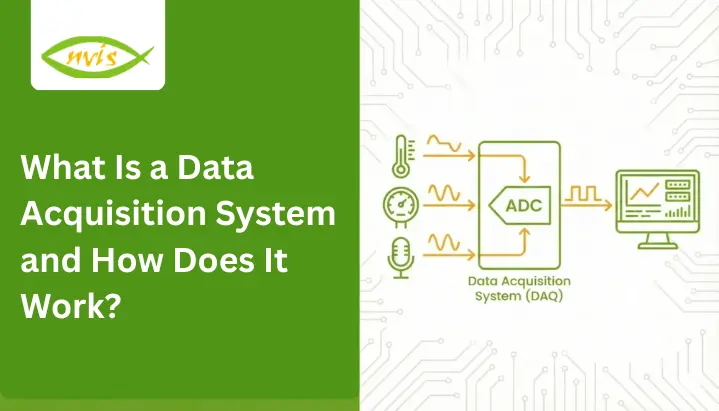
A Data Acquisition System (DAS) collects real-world physical or electrical measurements and converts them into digital data that can be analyzed using a computer. Parameters such as voltage, current, speed, or torque are first measured by sensors or transducers and converted into analog electrical signals.
These signals are transmitted to signal conditioning circuits, where they are amplified, filtered, scaled, and electrically isolated to ensure accuracy and safety. The conditioned analog signals are then converted into digital form using an Analog-to-Digital Converter (ADC).
A microcontroller or DAQ hardware processes the digital data to compute useful values such as RMS, frequency, power, and power factor. Finally, the processed data is sent to PC software via wireless communication, where it is displayed in real time, plotted as graphs, stored for analysis, and used for monitoring, learning, or control applications.
Importance of Data Acquisition Systems
The Data Acquisition Systems (DAS) are necessary to measure, monitor and analyze real-world physical and electrical quantities such as voltage, current, speed, and torque with precision. They allow real-time data collection and visualization, in order to facilitate the quick decision-making by engineers to locate faults, enhance performance in a system, and stay secure with its operation. DAS assists in analysis, documentation and reference in the future by enabling the storage and recording of data that will be used in future research. Such systems are also used to save time, reduce costs, and improve accuracy since they do not rely on various measuring tools. The data acquisition systems are very popular among laboratories, industries, automation systems, and the learning institutions due to their reliability and versatility.
Advantages of Using a Data Acquisition System
Data Acquisition System is very accurate and reliable in physical and electrical parameter measurement and capable of real time measurement of the performance of a system. It is time-saving, as it automatically gathers and processes data, and is also much safer, because it can be used in dangerous or high-voltage areas to take measurements remotely. A DAS also enables the simultaneous multi-parameter measurement with a single setup, reducing the number of instruments required and monetary expense. Having inbuilt data-logging and software analysis, it can easily be seen visually, analyzed by trends and data stored over long periods. Also, other characteristics like wireless connectivity and flexibility of the system can justify the use of data acquisition systems in laboratories, industrial use, research, and educational training.
- Accuracy: Precise measurements with minimal human error
- Speed: High-speed data collection and processing
- Scalability: Easily expand channels and sensors
- Automation: Reduced manual intervention
- Insights: Better decisions through data analytics
Conclusion
A Data Acquisition System is essential in the purpose of precise measurement, monitoring and analyzing of real-life physical and electrical quantities. It allows real time monitoring, dependable saving of data and easy analysis using computer software as analog data is converted into digital form. Being able to provide high accuracy, better safety, multi-parameter measurement, and adaptability to many applications, the data acquisition systems are important tools in the laboratories, industries, research and learning processes.
FAQs
A Data Acquisition System is a technology that measures real-world physical or electrical parameters and converts them into digital data for monitoring, analysis, and storage using a computer or embedded system.
A DAS can measure parameters such as voltage, current, speed, torque, power, frequency, and many other physical or electrical quantities depending on the sensors used.
The main components include sensors or transducers, signal conditioning circuits, an analog-to-digital converter (ADC), and a computer or DAQ hardware with data acquisition software.
Unlike manual measurement, a DAS provides automated, real-time data collection with higher accuracy, faster processing, data storage, and graphical visualization for better analysis.
Data acquisition systems are widely used in electrical and electronics laboratories, industrial automation, power systems, research and development, environmental monitoring, and educational training applications.