





• Nvis Technology
  • Nvis Technology
  • Nvis Technology
  • Nvis Technology
  • Nvis Technology
  • Nvis Technology
Nvis Technology

Head Office

141-A, Electronic complex, Pardesipura,Indore - 452010 India

Phone: +91 73899 00887 , +91 98932 70303

Email:info@nvistech.com

Request a Quote

Looking for a quality and affordable builder for your next project?


    Nvis Technology

    Toll Free

    +91 73899 00887

    We are happy to meet you during our working hours. Please make an appointment.

    • Monday-Saturday: 9:00 AM - 5:30 PM (IST)
    • Sunday: Closed

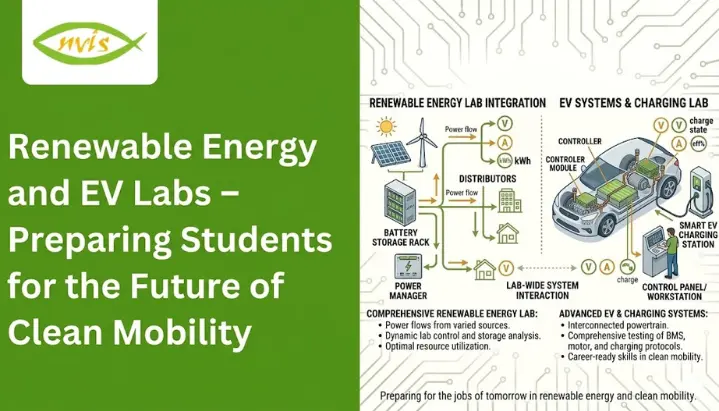
    Renewable Energy and EV Labs – Preparing Students for the Future of Clean Mobility

    TL;DR 

    • This blog is designed for engineering students, educators, technical institutes, and EV training centers who want to understand the role of renewable energy and EV labs in preparing students for the future of clean mobility.
    • Renewable energy is essential for sustainable transportation because it provides clean power sources such as solar, wind, and hydropower that reduce carbon emissions and support environmentally friendly electric vehicle ecosystems.
    • Renewable energy integration with electric vehicles through technologies like solar-powered charging stations, smart grids, energy storage systems, and vehicle-to-grid (V2G) helps build a sustainable and efficient clean mobility infrastructure.
    • EV laboratories in educational institutions provide hands-on learning environments where students can explore electric vehicle components, renewable energy systems, battery technology, and EV charging infrastructure.
    • By combining renewable energy education with EV training, institutions can equip students with the practical skills needed for careers in electric mobility, renewable energy systems, and the rapidly growing global clean mobility industry.


    The transportation sector is undergoing a major transformation worldwide. The shift toward electric vehicles (EVs) has been driven by growing environmental concerns, rising fuel costs, and the pressing need for the automobile industry to curb carbon emissions. Renewable energy is at the center of this transformation because it provides sustainable and environmentally friendly sources of power that can encourage the development of electric mobility.

    The use of electric vehicles is generally regarded as one of the most effective methods that can minimize the emissions of greenhouse gases and pollution in cities. Nevertheless, the environmental advantages of EVs can only be fully realized when the electricity used to charge vehicles comes from renewable sources rather than fossil fuels. This highlights the need to integrate renewable energy systems with electric vehicles.

    Education institutions are vital in the future generation of employment that will build, operate, and be creative in the clean transportation ecosystem. Colleges, technical institutes and engineering colleges are also starting to set up EV laboratories and renewable energy training facilities so that their students can be equipped with the hands-on information necessary to meet the changing mobility industry.

    Understanding how electric vehicles operate, and how renewable energy can be integrated into EV systems has become a crucial component of contemporary engineering studies. Students have the opportunity to learn about technologies like solar-powered charging stations, battery management systems, electric powertrains, and smart grid connectivity in hands-on EV labs.

    These labs do not stand alone as a mere educational aid, they are the grounds that train students to work in the clean mobility, renewable energy systems, electric transportation, and sustainable infrastructure development industry.

    Similar Posts

    1. How Analog and Digital Multimeters Work: Basic Working Principles?
    2. How practical labs make technical education and skilling industry-driven?
    3. Preparing Students for In-Demand Jobs in EV and Green Hydrogen Sectors

    What is Renewable Energy?

    To understand the relationship between renewable energy and EVs, it’s important to first understand why renewable energy is becoming central to global energy strategies before going any further to determine the relationship between renewable energy and electric vehicles.

    The term renewable energy is used to refer to energy derived from natural resources that are naturally replenished. In contrast to fossil fuels like coal, oil and natural gas, renewable sources of energycan be used repeatedly without causing long-term environmental degradation.

    Solar Energy

    In the renewable energy category solar energy is among the most common energy sources. Photovoltaic cells use the photons to generate electricity using solar panels. The use of solar energy systems to power homes, the industry and even charging stations of electric vehicles is on the rise.

    Wind Energy

    Wind turbines produce power by converting wind energy into mechanical power, which is then converted into electricity. Wind farms are emerging as one of the largest producers of electricity in the world.

    Hydropower

    Hydropower involves the use of flowing water to produce electricity. Renewable electricity can be generated by large hydroelectric dams, as well as small-scale hydro plants to supplement power grids in countries.

    Biomass Energy

    Biomass energy is produced with the help of organic substances like agricultural waste, wood and other biological substances. It may be transformed into biofuels, electricity or heat.

    The Importance of Renewable Energy in Clean Mobility

    Clean mobility is an idea used to develop transportation systems that will minimize pollution, and environmental impact and increase energy efficiency. Electric cars are at the center of this change as they do not have tailpipe emissions and are more efficient when compared to traditional cars.

    Sustainability of the electric vehicles however will be determined by the energy employed in charging them. Using electricity produced using fossil fuels to charge EVs makes the benefits to the environment minimal.

    This is the reason why renewable energy is vital in creating a really sustainable transportation.

    Reducing Carbon Emissions

    Electricity generated from renewable energy produces far fewer greenhouse gas emissions than electricity generated from fossil fuels. When EVs are powered with renewable energy like solar or wind power, the total carbon footprint of transportation will be significantly reduced.

    Sustainable Energy Supply

    The sources of renewable energy offer sustainable and unlimited flow of electricity.This ensures that growing EV charging demand does not deplete natural resources.

    Energy Independence

    When the renewable energy sources are invested in by countries, it means that the reliance on the imported fossil fuels is minimised. The infrastructure of renewable energy is conducive to national energy security and allows cleaner transportation systems.

    Lower Operational Costs

    In the long run, the price of electricity production can be lowered through renewable energy systems. Electric vehicle charging stations that run on solar, such as solar-powered ones, have the benefit of producing electricity at a comparatively low cost of operation upon installation.

    Renewable energy coupled with electric vehicles is hence imperative towards realizing long-range clean mobility.

    How Renewable Energy Integration Supports Electric Vehicles

    Transitioning from gasoline to electric vehicles alone is not enough, making the transition of mobility in a cleaner way. It also demands smart systems that link renewable energy sources, energy storage technology, and transport infrastructure.

    The process is referred to as renewable energy integration.

    Renewable energy integration can be defined as the integration of renewable energy sources in electrical systems which serve transportation, industry and domestic power use of the populace.

    Solar Powered EV Charging Stations

    EV charging stations can also have solar panels mounted to produce electricity directly out of the sunlight. Through these systems, the electric vehicles will be able to charge with renewable energy rather than grid electricity that is generated using fossil fuels.

    Universities, commercial buildings, and transit centers are starting to have more and more solar EV charging infrastructure.

    Energy Storage Systems

    Solar and wind power are some of the renewable energy sources that are intermittent i.e. they do not produce power all the time. Lithium-ion battery energy storage systems are used to store surplus renewable energy electricity until the time when production is low.

    EV charging networks and grid stability are also essential to be sustained through battery storage systems.

    Smart Grid Technology

    Smart grids are equipped with modern communication systems and sensors to control power distribution efficiently. They enable the coordination of the renewable energy sources, EV charging stations, and energy storage facilities to work together.

    Even when the production of renewable energy varies, smart grids will ensure a balanced and stable supply of electricity despite fluctuations in renewable energy generation

    Vehicle-to-Grid (V2G) Systems

    The vehicle to grid technology enables the electric cars to contribute the electric supply back to the power grid when required. EV batteries are considered to be distributed energy units in this system.

    This is a new creative strategy that can be used to stabilize the grid and more effectively combine renewable energy.

    By using these technologies, the integration of renewable energy produces a more sustainable and resilient transportation infrastructure.

    The Role of EV Labs in Renewable Energy Education

    As the integration between electric vehicles and renewable energy systems increases, the field of engineering has to adjust to accommodate this kind of interconnection with the aim of training students to work with it.

    The EV laboratories and renewable energy training systems come in here.

    The conventional classroom learning tends to concentrate on hypothetical information. Nevertheless, the multidimensional character of electric mobility and renewable energy integration need practical experience with the actual systems.

    The EV labs also give students the hands-on experience of the elements and technologies that are involved in electric cars and renewable energy systems in the present.

    Understanding Electric Vehicle Systems

    In EV labs, students can study and experiment with various components of electric vehicles, including:

    • Electric motors
    • Battery packs
    • Power electronics
    • Motor controllers
    • Regenerative braking systems

    By working directly with these components, students develop a deeper understanding of EV operation.

    Renewable Energy System Experiments

    EV labs often include renewable energy modules such as solar panels and wind energy simulators. These systems allow students to explore how renewable energy can power electric vehicles.

    Students can perform experiments related to:

    • Solar power generation
    • Renewable energy conversion
    • Energy storage systems
    • Renewable energy integration with EV charging

    EV Charging Infrastructure

    Modern EV labs include training modules that demonstrate how charging stations work. Students learn about:

    • Level 1, Level 2, and DC fast charging
    • Charging station design
    • Power management systems
    • Smart charging technologies

    Understanding EV charging infrastructure is essential for supporting the global shift toward clean mobility.

    Key Skills Students Gain from Renewable Energy and EV Labs

    EV labs provide students with a wide range of technical and interdisciplinary skills that are essential for careers in renewable energy and electric transportation.

    Electric Powertrain Knowledge

    Students learn how electric motors, motor controllers, and power electronics work together to drive electric vehicles.

    Battery Technology Expertise

    Battery technology is one of the most critical components of EVs. Students gain knowledge about:

    • Lithium-ion batteries
    • Battery management systems
    • Charging and discharging cycles
    • Thermal management

    Renewable Energy System Design

    Experiments with renewable energy allow students to learn how such systems as solar panels, wind turbines, and energy storage work and how they can be applied in the transport system.

    Energy Management Skills

    The transport systems of today demand smart energy systems. EV labs provide students with an understanding of how to measure, regulate, and streamline the energy flow of the renewable energy sources to the electric vehicles.

    Smart Grid and IoT Applications

    Students are also exposed to smart grid technologies and Internet of Things (IoT) apps that are used in monitoring energy and EV infrastructure.

    These are the essential skills in coming up with innovative solutions in the area of clean mobility.

    Conclusion

    One of the most significant technological changes of the 21 st century is the shift to sustainable transportation. The automotive industry is evolving with electric vehicles, which can reach their full potential when powered by renewable energy.

    Understanding how renewable energy systems are implemented and integrated into EV ecosystems is a necessity to the upcoming generation of engineers.

    EV laboratories and renewable energy education systems offer students a good practical experience that helps them to bridge the knowledge gap between the theory and practices.

    In these labs, the students learn skills in electric vehicle systems, renewable energy technologies, battery management and the energy infrastructure.

    With the ever rising need to use sustainable transportation methods, engineers with training in EV and renewable energy technologies will be important in determining the future of clean mobility.

    Schools which adopt EV laboratories and renewable energy instruction in the present day are investing in the engineers who will create the transportation infrastructure that is environmentally friendly.

    FAQs

    Renewable energy refers to energy obtained from naturally replenishing sources such as sunlight, wind, and water that can be used repeatedly without being depleted.

    Renewable energy ensures that the electricity used to charge EVs comes from clean sources like solar or wind power, reducing the overall carbon footprint of transportation

     Renewable energy integration means connecting renewable energy sources like solar or wind power with EV charging systems and energy storage technologies.

     EV laboratories provide learners with practical experience of electric vehicle design, electric vehicle charging technology and renewable energy technologies.

      EV labs assist students to develop applicable skills regarding electric automobiles and renewable energy, and equip them to work in the clean mobility sector.
    Tags: clean mobility, Renewable Energy, renewable energy integration, what is renewable energy

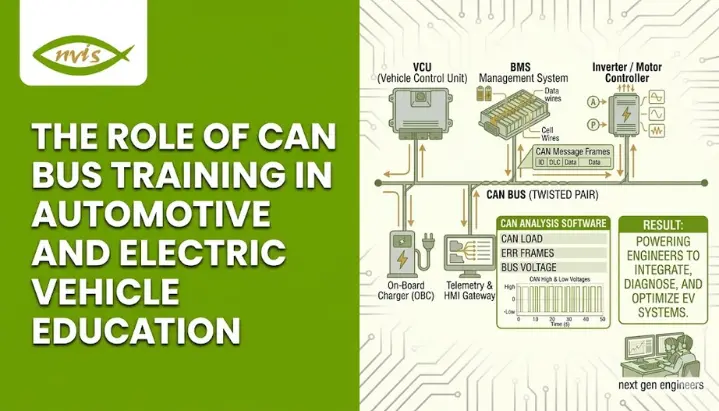
    The Role of CAN Bus Training in Automotive and Electric Vehicle Education

    TL;DR 

    • This blog is primarily for engineering students, automotive technicians, EV researchers, and educators involved in Electric Vehicle Education who want to understand the importance of CAN Bus training in modern vehicle systems.
    • CAN Bus is a critical communication protocol that allows multiple electronic control units (ECUs) in a vehicle to exchange data efficiently, enabling modern vehicles to operate safely and reliably.
    • In EVs, CAN Bus supports essential systems such as battery management, motor control, charging systems, and energy management, making it a fundamental component of Electric Vehicle Education programs.
    • Can bus training helps students and professionals develop practical skills in vehicle electronics, diagnostics, embedded systems, and automotive communication networks.
    • Growth of Online Learning: The availability of can bus training online allows learners to access flexible, cost-effective training programs with simulations and expert guidance, helping them stay competitive in the evolving automotive and EV industries.


    The automobile sector is experiencing one of the greatest technological changes in its history. Modern vehicles are no longer purely mechanical machines powered by engines and basic electronics. Modern vehicles are complex systems that integrate advanced software, sensors, electronic control units (ECUs), communication networks, and intelligent diagnostics. The demand for engineers and technicians with advanced knowledge of electronic and communication systems is increasing rapidly as the electric vehicles (EVs) continue to dominate the global market.

    The Controller Area Network (CAN) Bus is one of the most important technologies that enables communication among various vehicle components. It is a communication protocol which enables various electronic control units of a vehicle to communicate effectively and dependably. CAN Bus technology is at the heart of modern automotive systems, used in engine management systems, braking systems, battery monitoring systems, and motor control.

    Due to its growing significance, CAN Bus training has become a key element of modern automotive training programs. Colleges, high schools, educators, and engineering schools are progressively integrating the concepts of CAN Bus into their syllabus to educate young engineers on the challenges of the future of the automotive and electric mobility sector.

    Meanwhile, the growth of Electric Vehicle Education has further increased the need for CAN Bus knowledge. The automotive industry depends on electronic systems and digital communication networks to control battery operation, motor performance, power distribution, and charging processes in electric vehicles. A lack of proper CAN Bus knowledge makes it difficult for engineers to design, diagnose, and maintain these systems effectively.

    Related Blogs 

    1. How to Use a Programmable DC Power Supply Safely in Student Laboratories
    2. Preparing Future Technicians and Engineers for Smart Energy Management
    3. What Is a Data Acquisition System and How Does It Work?

    Understanding CAN Bus Technology

    However, in discussing the significance of can bus training, it is necessary to know what CAN Bus technology is and how it works in the current cars.

    The Controller Area Network (CAN) Bus is a powerful communication protocol that was initially devised by Bosch in the 1980s to allow microcontrollers and electronic devices in a vehicle to communicate with one another, and not with a central computer. CAN Bus allows multiple devices to communicate over a shared network instead of relying on complex point-to-point wiring.

    In contemporary automobiles, there are dozens of electronic control units that control different functions including engine performance, braking, steering, safety systems, infotainment, climate control, and battery management. These ECUs need to continuously communicate with each other in order to provide efficient and smooth running of the vehicles.

    CAN Bus is a dependable means of conveying such information throughout the car network.

    To illustrate, when a driver presses the brake pedal, a number of systems should react at the same time.The braking system is activated, the stability control system adjusts wheel pressure, and the engine control unit reduces power. All these necessitate quicker communication among various electronic units and this is enabled by CAN Bus networks.

    The key advantages of CAN Bus technology include:

    • Reduced wiring complexity
    • High-speed data communication
    • Reliable and error-resistant messaging
    • Real-time system coordination
    • Scalable integration of multiple electronic devices

    Due to this feature, CAN Bus has emerged as the universal vehicle communication system in the majority of contemporary vehicles.

    With the increasing technology that vehicles have, the engineers and technicians should be aware of the operation of CAN Bus networks.This is where CAN Bus training comes in with immense value to automotive training programs.

    The Importance of CAN Bus in Modern Automotive Systems

    Modern automobiles are highly dependent on electronic systems and digital communication networks. The number of electronic components within vehicles has been growing exponentially over the last 20 years. In present times, an average car can have over 70 electronic control units that interact via networks such as CAN Bus.

    These electronic systems control a wide range of vehicle functions, including:

    • Engine performance and fuel management
    • Anti-lock braking systems (ABS)
    • Electronic stability control
    • Airbag deployment systems
    • Advanced driver assistance systems (ADAS)
    • Infotainment and navigation systems
    • Climate control
    • Transmission management
    • Vehicle diagnostics


    The coordination of these systems would be a very hard task without an efficient communication network.

    CAN Bus also makes sure that every component has the ability to transmit and receive data effectively, and the vehicles can operate effectively and safely. It also enables automotive engineers to make the vehicle architecture simplified and lessen complex wiring harnesses.

    In the case of automotive technicians, the knowledge of the CAN Bus communication is necessary in diagnosing vehicle problems. Most of the contemporary vehicle defects do not have anything to do with mechanical faults but rather issues with the communication between electronic modules.

    The Role of CAN Bus in Electric Vehicles

    Although the CAN Bus technology has extensively been applied in traditional cars, it is more important in electric cars. EVs require the use of digital control systems and advanced electronics in order to regulate the flow of energy, battery safety, and powertrain functioning.

    Electric vehicles have some major systems which use CAN Bus communication and they include:

    • Battery Management Systems (BMS)
    • Motor controllers
    • Charging systems
    • Thermal management systems
    • Inverter systems
    • Power distribution modules

    All these components continuously share data to ensure efficient and safe vehicle operation. As an illustration, the battery management system should continually check the temperature of the battery, its voltage and whether it is charging.This information is communicated to other vehicle systems via CAN Bus.

    Likewise, motor controllers are based on the real-time information provided by other control units and sensors to control power and achieve the best car performance.

    Due to such an interdependent structure, CAN Bus expertise is a requirement when engineers operate in the electric vehicle industry.

    Consequently, CAN Bus training has become a part of the Electric Vehicle Education program.

    Why CAN Bus Training is Essential for Automotive Students

    The automotive industry is becoming increasingly software-driven. Mechanical skills that were being taught traditionally are no longer adequate to modern automotive engineers and technicians.

    Knowledge of vehicle communication networks has emerged as a major requirement to anyone intending to make a career in the field of automotive technology.

    Through structured training programs, students learn how electronic control systems communicate and how engineers design reliable automotive networks.

    Practical Understanding of Vehicle Electronics

    The CAN Bus training assists the students in leaving the theory behind and gaining the insights about the practical aspects of the automobile systems. Studying the communication protocols, students can get a clue of how the modern vehicles work.

    Improved Diagnostic Skills

    Most of the new car problems are associated with electronic failure in communication. Diagnostic tools and network analysis techniques can be used by students trained in CAN Bus technology to diagnose these problems much better.

    Preparation for Industry Requirements

    There are engineers and technicians who are supposed to know vehicle communication networks in automotive companies. CAN Bus knowledge has therefore gained significant importance in the automotive job market.

    Integration with Embedded Systems Learning

    CAN Bus training also supports learning in embedded systems, microcontrollers as well as automotive software development.

    Students who understand communication protocols, can easily design and integrate the electronic systems of vehicles.

    Advantages of CAN Bus Training Online

    The workings of technical education have been revolutionized in recent years through digital learning platforms. Nowadays, students and professionals are able to receive high-quality training programs wherever they are in the world.

    Online training in can bus has facilitated the acquisition of special skills in the automobile communication systems by individuals.

    The main advantages of the online CAN Bus training are:

    Flexible Learning

    The online courses enable students to study at their own speed. This is particularly useful to working professionals who do not want to move out of the job to upgrade their skills.

    Access to Global Expertise

    Training materials are available on online platforms created by industry professionals, engineers of automobiles, and scholars.

    Simulation-Based Learning

    Various training courses on line provide simulation tools that enable the students to practice with virtual CAN Bus networks. These simulations enable the learners to learn about the transmission of a message, the behavior of a network and the diagnostic methodology.

    Cost-Effective Education

    The online training programs can be cheap compared to the traditional classroom training and offer useful technical knowledge.

    Due to these benefits, CAN Bus training online is becoming a popular choice among engineers, technicians, and students around the globe.

    Conclusion

    The automotive field is witnessing a new age that is characterized by electrification, connectivity and smart car systems. In such a fast changing environment, the electronic communication networks are now a fundamental part of modern vehicle design.

    The Controller Area Network (CAN) Bus is one of the most significant communication protocols applied in car systems.

    CAN Bus is used in engine management, braking systems, battery monitoring, and motor control in electric vehicles to provide an efficient way to communicate in-car components.

    Due to its vitality, can bus training has become a necessary component in contemporary automotive training. It equips students and technicians with ideas on how to grasp vehicle electronics, troubleshoot communication problems and develop sophisticated automotive systems.

    Simultaneously, the growth of the Electric Vehicle Education programs has also augmented the need of the CAN Bus expertise. Electric cars are strongly dependent on the digital communication, thus the knowledge of CAN bus is inevitable among the EV engineers.


    FAQs

     CAN Bus ( Controller Area Network) is a communication protocol whereby various electronic control units (ECUs) found in a car can communicate effectively. It also allows systems like braking, engine control, battery control and safety to interact in a seamless way.

    CAN Bus training helps students understand the process of communication between the electronics of the vehicle. This is necessary in the diagnosis of system failures, automotive network design and involvement with state of the art vehicles and electric vehicle systems.

     CAN Bus is applied in the Electric Vehicle Education to control communication among the major EVs systems like battery management systems (BMS), motor controllers, charging systems, and thermal management units. The knowledge of this technology aids students in getting to know how EV systems are efficient.

     There are indeed numerous training facilities that can provide CAN Bus training online, hence students, engineers and technicians have access to learning more about the CAN Bus concepts via virtual laboratories or simulation as well as in practice locations, without needing to step outside their homes.

     Having gone through bus training, a person may choose the career of automotive electronics engineer, EV system engineer, embedded systems developer, automotive diagnostic specialist or vehicle network engineer in the automotive and electric vehicle sectors.

    Tags: can bus training, can bus training online

    Request a Callback

    Please enable JavaScript in your browser to complete this form.

    No spam. Just a quick call.