





• Nvis Technology
  • Nvis Technology
  • Nvis Technology
  • Nvis Technology
  • Nvis Technology
  • Nvis Technology
Nvis Technology

Head Office

141-A, Electronic complex, Pardesipura,Indore - 452010 India

Phone: +91 73899 00887 , +91 98932 70303

Email:info@nvistech.com

Request a Quote

Looking for a quality and affordable builder for your next project?


    Nvis Technology

    Toll Free

    +91 73899 00887

    We are happy to meet you during our working hours. Please make an appointment.

    • Monday-Saturday: 9:00 AM - 5:30 PM (IST)
    • Sunday: Closed

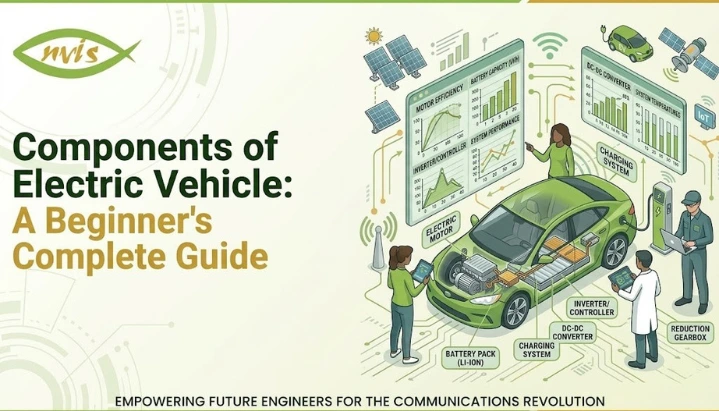
    Components of Electric Vehicle: A Beginner’s Complete Guide

    TL;DR

    • This blog is for university students, freshers, and technology learners. This guide explains what are the main components of electric vehicle systems without assuming any prior engineering knowledge.
    • Electric vehicles replace traditional combustion engines with a battery-powered electric motor system, a fundamental shift that changes almost every part of how a vehicle works.
    • The core components of an electric vehicle include the traction battery pack, electric motor, inverter, onboard charger, and controller, each playing a distinct and critical role. 
    • Understanding how EV components interact from energy storage to motion to normal regulation helps you grasp why EVs are more efficient, lower in maintenance, and better for the environment.
    • The EV industry is one of fastest-growing technology sectors globally, and knowing these components gives you a solid foundation for careers in automotive engineering, energy, or sustainable technology.

    The switch to EVs is one of the biggest engineering transformations in modern transport. Conventional ICE (internal combustion engine) vehicles rely on burning fossil fuels to generate mechanical power, while EVs use a completely different energy chain that is all based around the storage, conversion and management of electrical energy.

    This shift is not simply about replacing one energy source with another. This shift requires a completely new set of components designed to operate together within an integrated electrical system. The knowledge of the components of EV architecture is not just about being technically interested, but is essential for any aspiring engineer in the automotive industry, sustainable energy, power electronics, or EV policy.

    The EV market is growing rapidly around the world, as battery prices drop, emission mandates from governments increase and charging station investments are pouring in. With EVs gaining traction, engineers, students, and consumers alike would benefit from understanding the primary elements of an EV system as well as how they work together.

    This guide provides fundamental information on the key sections of an electric vehicle system in a non-technical and easy-to-understand manner. This article explains the role and purpose of each component, whether you are a student, a curious learner or a potential EV tech enthusiast.

    What Makes an Electric Vehicle Different

    It is important to understand the bigger picture before jumping into components.

    A standard car uses an internal combustion engine (ICE) to power the vehicle. It produces mechanical energy and helps in the movement of vehicles by burning petrol or diesel. It involves hundreds of moving parts such as pistons, crankshafts, gearboxes, and exhaust systems, while also producing carbon emissions as a byproduct.

    An electric vehicle gets rid of all that. Rather than use fuel to spin a motor, it uses electricity from a battery pack to spin an electric motor. The wheels are powered by the motor. It’s the basic concept.

    This creates a simpler energy chain with fewer parts, less friction, lower maintenance, and no direct emissions. Creating a car based on electric power, however, comes with its own set of engineering difficulties and hence the components of EV design become especially interesting.

    Major Components of Electric Vehicle Systems

    Let us now go through each of the main components of electric vehicle architecture, one by one.

    1. Traction Battery Pack

    The traction battery pack is the most important component of an electric vehicle. It stores the electrical energy required to power the motor and operate the vehicle 

    It’s like a fuel tank in a normal car but it stores a charge of electricity. A battery pack is made up of hundreds or thousands of individual lithium-ion cells grouped into modules, which are assembled into a full pack.

    Batteries are rated by their energy capacity, in kilowatt-hours (kWh). The higher the kWh rating the longer the driving range. For instance, a 75 kWh battery will enable a vehicle to cover more distance in one charge, than a 40 kWh battery.

    The battery pack also supplies direct current (DC) power to other vehicle components. Its biggest advantage is the ability to store energy produced during the process of regenerative braking, which we’ll discuss later in this guide.

    2. Electric Motor (Traction Motor)

    The electric motor is the muscle of the electric vehicle.

    An electric motor converts electrical energy into mechanical rotational force that turns the wheels. This is the component that propels the car forward and backward.

    This is a function of the combustion engine on a traditional car. However, an electric motor is much more efficient to do this. In a combustion engine, only 20 to 40 per cent of fuel energy is converted into useful motion. In contrast, electric motors can convert more than 90 per cent of electrical energy into mechanical movement. 

    There are two common types of electric motors used in EVs:

    • AC (Alternating Current) motors are widely used because they are efficient, reliable, and require less maintenance. Tesla Model 3, for instance, uses an AC induction motor.
    • DC (Direct Current) motors Less common in modern EVs but still used in some applications.

    Many high-end EVs use two or more electric motors, one for the front axle and one for the rear axle which gives the vehicle all-wheel drive and much better performance.

    3. Power Inverter

    This is where it gets a little technical, but don’t worry, it’s not too bad.

    A traction battery stores energy in the form of DC electricity. However, most high power electric motors used in EVs operate on alternating current (AC) electricity. How then does a car do this? The power inverter will do that.

    The inverter is a power module that converts the direct current from the battery, into alternating current for the motor. It also works during regenerative braking, where the motor acts as a generator and the inverter helps transfer recovered electrical energy back to the battery.

    The inverter is not only a type-switching device. It also regulates the frequency and voltage of electricity sent to the motor, resulting in a varying speed and torque of the motor. This means that the inverter is involved in the acceleration of the vehicle and its running efficiency.

    4. Onboard Charger (OBC)

    Electricity from the grid (when plugged into the wall socket or public charging station) is alternating current or AC. However, the battery keeps the DC. In order to charge the battery, it must be converted from AC to DC power. That is the role of the onboard charger.

    This conversion is performed by an onboard charger that is located inside the vehicle and is used during Level 1 and Level 2 charging. It controls charging speed, keeps track of battery health, and ensures the electric current the battery receives is of proper voltage and current.

    It should be noted that DC fast chargers (such as those at highway charging stations) don’t use the onboard chargers at all. Fast charging times are much faster, because you are providing high power DC electricity directly to the battery.

    5. Charge Port

    EV connects to an outside power source via a charge port. It’s kind of like a fuel cap on a regular car, but with a cable.

    Each manufacturer has a different location of the charge port. On some EVs, it is located at the front, while on others it may be placed at the rear or on the side. Charge ports need to be compatible with the charging standards used in your region. For instance, Type 2 connectors are widely used in Europe, and CCS (Combined Charging System) connectors enable both AC and fast DC charging.

    Wireless charging is another feature that is still new on most consumer EVs, but is supported by some.

    6. DC-DC Converter

    This is a component that many people new to EV technology may overlook , but it is very practical.

    A traction battery is a high voltage battery, typically 200 to 800 volts depending on the vehicle. However, the low voltage inside of the car lights, dashboard screens, the power window, the audio system and the horn are all powered by a 12 volt battery.

    The DC-DC converter reduces high-voltage DC from the traction battery to 12-volt DC for low-voltage accessories. It also charges the auxiliary battery.

    If not for a DC-DC converter, you’d have to have a separate power source for the car’s electronics, something that would be unnecessarily bulky and complicated.

    7. Auxiliary Battery

    Each EV is equipped with a secondary battery as well as the primary battery for propulsion. This type of battery is known as an auxiliary battery and usually consists of a standard 12-volt battery that would be found in a standard car.

    The auxiliary battery powers essential low-voltage systems before the main traction battery becomes active. This covers such items as onboard computers, door locks, lights and low voltage components that must function whether or not the vehicle is moving.

    The auxiliary battery is kept charged by a DC-DC converter during normal operation. It can be thought of as a backup power system for the vehicle’s electronics.

    8. Controller (Electronic Control Unit / VCU)

    The controller is the brain, while the battery is the heart and the motor is the muscle.

    The Vehicle Control Unit (VCU), also called the Electronic Control Unit (ECU), acts as the central decision-making system of an EV. It continuously monitors driver inputs such as accelerator position, brake pressure, battery condition, motor speed, and many other variables to make real-time decisions about power distribution throughout the vehicle. 

    When you press the accelerator pedal, the controller tells the battery to send power through the inverter to the motor, resulting in vehicle movement. When you ease off, it controls the regenerative braking process. It also enforces safety limits to prevent overcharging, overheating, and over-discharging of the battery.

    In addition to VCU, modern EVs will also employ a dedicated Battery Management System (BMS), which is there to specifically manage all of the traction battery cells. It will ensure that the cells have even charging and discharging, keeping the battery healthy and increasing its life.

    9. Thermal Management System 

    Don’t subject batteries or electronics to extreme temperature variations. Overheating can create hazardous conditions, and excessively high temperatures can significantly reduce performance. In extremely cold conditions, the battery becomes less efficient and delivers reduced driving range.

    A thermal management system maintains the temperature of all components within an optimal range. It consists of liquid cooling circuits, heat exchangers, radiators and in some cases heating elements, that help regulate temperatures in battery packs, motors, inverters, and power electronics.

    The system also manages the heat generated during regenerative braking and other high-power operations. It is essential that the right temperature is achieved during this process to ensure efficiency and safety.

    Some high-tech EVs also feature heat pumps, which are systems used in home heating that can efficiently warm the cabin even in cold weather conditions without spending too much battery.

    10. Regenerative Braking System

    It is one of the most ingenious aspects of today’s electric cars, and when you grasp how it works, you’ll be amazed at the efficiency that’s built into these cars.

    A conventional car converts the kinetic energy of a moving vehicle into heat when the brakes are applied, due to friction between the brake pads. This heat is lost energy.

    Regenerative braking harnesses energy that would otherwise be lost in an EV. When the driver lifts off the accelerator or applies the brakes, the electric motor temporarily acts as a generator. It takes the vehicle’s kinetic energy and changes it back to electrical energy, which passes through the inverter and is stored in the vehicle’s battery pack.

    This is done simultaneously: it slows down the vehicle (as normal braking does), and it partially charges the battery. Regenerative braking can make a significant improvement to the driving range of an EV on city roads where frequent stops are common.

    11. Transmission

    Older vehicles rely on a multi-speed automatic transmission to maintain the optimum power range of the engine at various speeds. Electric motors don’t require this since they provide a steady torque over a broad range of speeds. That is why most EVs utilize a solitary speed transmission, a far simpler setup.

    A single-speed transmission transfers power from the motor to the wheels using a fixed gear ratio. This reduces the need for complex gears and clutch systems 

    It is this simplicity that helps EVs to be so smooth and responsive to drive. No power loss due to gear changes.

    How All Components of Electric Vehicle Work Together

    Now that you know each component individually, it helps to understand complete energy flow.

    Here is a simplified version of what happens when you drive an EV:

    1. The charge port and onboard charger bring electricity in from the grid and store it in a traction battery pack.
    2. When you press the accelerator, the controller signals the battery to release energy.
    3. Electricity flows from battery to inverter, which converts DC to AC.
    4. An electric motor receives AC electricity and converts it into mechanical energy.
    5. The transmission delivers mechanical energy to the wheels, causing the vehicle to move. 
    6. DC-DC converter continuously powers accessories and keeps the auxiliary battery charged.
    7. A thermal management system monitors temperatures  and keeps everything within safe limits.
    8. When you slow down, the regenerative braking system recovers kinetic energy and sends it back to the battery.
    9. The Battery Management System watches over every cell to ensure health and safety at all times.

    Every one of the components of electric vehicle systems plays a role in that chain. Remove any one of them, and the vehicle cannot function safely or efficiently.

    Why Understanding Electric Vehicle Components Matters?

    EVs are more than just a trend , they represent a paradigm shift in how we power our transportation, and the trend is accelerating.

    The International Energy Agency (IEA) Global EV Outlook report indicates that the EV market will see significant growth year on year, as battery costs continue to drop and governments push for cleaner transportation. India is investing heavily in EV infrastructure and promoting EV adoption through the Faster Adoption and Manufacturing of Electric Vehicles (FAME) scheme 

    This is an actual opportunity for students and young professionals. Knowing the major parts of EV systems is essential for the automotive industry, battery engineering, power electronics, embedded electronics, and sustainable energy professions.

    As a consumer, this information can be helpful when you’re weighing the range of an EV, the charging options, or which EV is the right one for you.

    Conclusion

    Electric vehicles are sophisticated systems that combine electrical, mechanical, and thermal engineering. Every component, from the traction battery pack that stores energy to the inverter that converts it and the Battery Management System that protects it, serves a specific purpose in the EV energy chain. All of these components are interconnected, and their effectiveness depends on how efficiently they work together.

     This change from combustion to electric propulsion is not merely an engineering replacement. It represents a paradigm shift in energy storage, propulsion, cooling, and regenerative systems within vehicle operation. This knowledge of key elements of electric vehicle systems offers a conceptual base for fruitful discussion of this technology in an academic, professional or practical setting.

    Understanding these basic components is becoming increasingly important, especially for engineers, but also for anyone wishing to understand the technology that defines the future of transportation, as the use of electric vehicles is growing rapidly everywhere and an EV sector is building up in India.

    Frequently Asked Questions

    The key components of an EV system are the traction battery pack, electric motor, power inverter, onboard charger, charge port, DC-DC converter, auxiliary battery, controller, Battery Management System, thermal management system , and single-speed transmission. Each component serves a particular function for energy storage, conversion or management.

    The traction battery pack is typically the most important element in an EV design. It carries all the energy required to propel a vehicle, and directly affects vehicle range, vehicle performance and the total cost of ownership. The EV industry is moving forward largely due to battery technology.

    The electric motor converts to a generator when the driver slows down or applies the brakes. The motor uses kinetic energy to provide electrical energy, which is not wasted as heat (as happens with friction brakes). This electricity is then fed back through the inverter to the traction battery for later use. Regenerative braking allows for longer driving range – especially in urban environments.

    Electric motors can provide continuous torque at all speeds and unlike combustion motors are required to run in a limited range of RPMs. This eliminates the need for EVs to have a multi-speed gearbox to ensure that the motor operates within its optimal range. There is no need for a complex multi-speed gearbox because a single-speed transmission is sufficient for most EVs, and there’s a reduction in mechanical complexity and maintenance.

    BMS is an electronic control system, which controls and manages each individual cell in a traction battery pack. It also ensures even charging and discharging of the cells, avoids over charging and over-discharging, keeps track of temperature, and reports battery health information to the vehicle’s primary controller. A properly designed BMS will be crucial for battery life and vehicle safety.

    Most modern EV traction batteries are designed to last around 8–15 years or approximately 200,000 miles under normal usage conditions.  Battery performance gradually degrades over time rather than failing suddenly,  but it will deteriorate over time. Warranties on EV battery packs are available  and are offered by many manufacturers for 8 years or 100,000 miles, whichever is reached first.
    Lead Acid vs Lithium Ion Battery: A Complete Comparison for Beginners

    TL;DR 

    • This blog is written for university students, engineering freshers, and curious learners exploring battery technology for the first time, helping them understand one of the most debated topics in energy storage today.
    • Lead acid and lithium ion batteries differ fundamentally in chemistry, energy density, weight, and long term cost and choosing the wrong one for an application can be an expensive mistake.
    • While lead acid batteries cost less upfront, lithium ion batteries deliver 3 5 times higher energy density, last 5 10 times longer, and prove more cost effective over a full lifecycle.
    • Lithium ion allows up to 80-90% depth of discharge vs just 50% for lead acid meaning you get significantly more usable power from the same battery capacity.
    • Neither battery is universally better, the right choice depends on your application, budget, and usage pattern, and this guide will help you figure that out clearly.

    Lead acid and lithium ion are two words that you have heard many times before if you have ever opened the hood of a car, set up a home inverter or read about electric vehicles.

    These are the two most widely-used rechargeable battery technologies in the world today. One has been powering cars, backup systems, and industrial equipment for more than 150 years. The other is rapidly transforming how smartphones, laptops, and electric vehicles store and use energy.

    What exactly is the difference between lead acid and lithium ion batteries? Which one is better for your needs, and why?

    This article explains the differences between lead acid and lithium ion batteries from the ground up and provides a practical comparison guide you can use

    What is a battery?

    Let’s first discuss what a battery is before going into comparison.

    In essence, a battery is a device which stores chemical energy and can transform it into electrical energy when required. What we call electricity is a flow of electrons, and inside every battery, there is a chemical reaction which causes a flow of electrons.

    The electrodes, also known as anode/cathode and electrolyte, are two essential components of a battery. The materials used in these components can result in vastly different battery characteristics, such as voltage, weight, efficiency and life.

    That’s where lead acid and lithium ion batteries differ.

    What is a Lead Acid Battery?

    Lead acid batteries are the oldest existing type of rechargeable battery still in use. They were developed in 1859, yes more than 160 years ago, and they continue to be used to power car engines, home inverters and UPS systems around the world.

    How a Lead Acid Battery Works

    The name gives it away. In a lead acid battery, lead acts as the anode, lead dioxide acts as the cathode, and sulfuric acid acts as the electrolyte. The cells inside the battery generate about 2.0 volts each. If you join cells together in series, you can get common voltages, such as 6V, 12V or 24V.

    During battery discharge, the lead and lead dioxide combine with the sulfuric acid to generate electricity. The reaction is reversible and when the battery is recharged it will be ready for use once again.

    Where Lead Acid Batteries Are Used

    You encounter lead acid batteries more often than you think:

    • The battery in a petrol or diesel car that starts the engine
    • Home inverters and UPS backup systems
    • Solar energy storage in budget setups
    • Industrial equipment, forklifts, and emergency lighting
    • Telecom towers and data center backup systems

    In India particularly, lead acid inverter batteries are commonly used in homes and the brands such as Exide, Amaron and Luminous are supplying power to the homes during frequent power cuts in the cities and towns of India.

    Advantages of Lead Acid Batteries

    • Very low upfront cost
    • Proven, well understood technology
    • Widely available and easy to replace
    • Safe and stable under normal operating conditions
    • Highly recyclable

    Disadvantages of Lead Acid Batteries

    • Heavy and bulky, often weighing 2–3 times more than a lithium ion battery of the same usable capacity
    • Requires regular maintenance in flooded variants
    • Only about 50% of rated capacity is usable without damaging battery
    • Relatively short cycle life typically 300 to 1,000 charge discharge cycles
    • Releases hydrogen gas during charging, which requires proper ventilation
    • Performs poorly in extreme temperatures

    What is a Lithium Ion Battery?

    Lithium ion batteries are a newer type of energy storage. They charge your smartphone, your laptop, electric cars like Ola S1 and Tata Nexon EV and power large scale solar storage systems.

    Lithium ion battery technology became commercially viable in the early 1990s and has evolved rapidly ever since. Today, lithium ion also known as Li ion batteries, represents the gold standard for portable and high performance energy storage.

    How a Lithium Ion Battery Works

    A lithium ion battery has a lithium based metal oxide cathode (such as lithium cobalt oxide or lithium iron phosphate), a carbon anode and a lithium salt solution electrolyte.

    During the discharging of a battery, lithium ions flow from the anode to the cathode via the electrolyte, releasing electrical energy. Ions move backwards when the battery is being charged. This exchange of ions is responsible for the name of the battery.

    The Battery Management System (BMS) is a smart electronic control system that plays an important role in each lithium ion pack, monitoring the battery temperature, voltage, and current to ensure safe and efficient operation.

    Where Lithium Ion Batteries Are Used

    • Smartphones, laptops, and tablets
    • Electric vehicles like two wheelers, cars, buses
    • Solar rooftop energy storage systems
    • Portable power tools and medical devices
    • Grid scale energy storage projects

    The lithium ion battery market in India is growing rapidly, driven by surge in EV adoption and rooftop solar installations.

    Advantages of Lithium Ion Batteries

    • 3 to 5 times higher energy density than lead acid batteries, allowing more energy storage in less space
    • Much lighter, typically around one-third the weight of an equivalent lead acid battery
    • Deep depth of discharge up to 80 90% without causing damage
    • Long cycle life typically 3,000 to 6,000 cycles
    • Zero maintenance required
    • Faster charging times
    • Better performance in a wider range of temperatures

    Disadvantages of Lithium Ion Batteries

    • Higher upfront cost roughly 2 to 3 times more expensive than lead acid for same capacity
    • Risk of thermal runaway if damaged, overcharged, or exposed to extreme heat.
    • Requires more complex management electronics
    • Recycling infrastructure is still developing in many regions

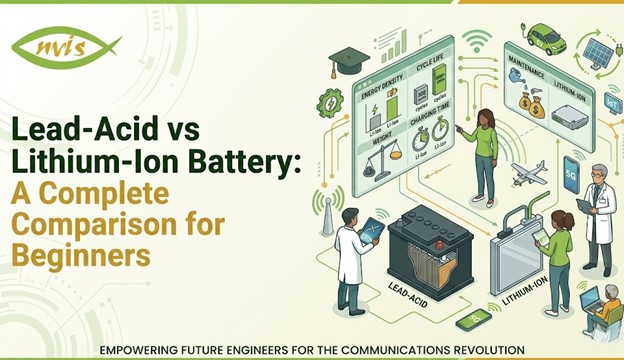
    Lead Acid vs Lithium Ion Battery: Detailed Comparison

    Now that you understand both technologies individually, let us put them side by side across every dimension that matters.

    1. Energy Density: Storing More in Less Space

    Energy density is a measure of energy stored per unit mass and volume of a battery.

    Lithium ion batteries typically offer an energy density of 125–600+ Wh/L (watt-hours per litre), while lead acid batteries generally provide only 50–90 Wh/L. On the other hand, in practical applications, a lithium ion battery can store 3-5 times more energy in the same volume.

    Imagine it like this. A lead acid battery is like carrying a heavy backpack full of books, while a lithium ion battery delivers the same energy in a much smaller and lighter package.

    When it comes to applications such as electric vehicles or portable solar power systems, where weight and space are critical, the difference is a crucial one to consider in the lead acid vs lithium ion battery comparison.

    2. Usable Capacity: What You Actually Get

    It is a very important point that novices tend to overlook.

    Ideally, a 100Ah lead acid battery should not be discharged more than 50%. Regularly discharging a lead acid battery beyond 50% can significantly reduce its lifespan!. In practice, however you will only be able to use around 50Ah from a 100Ah lead acid battery.

    A 100Ah lithium ion battery, on other hand, can be safely discharged to 80-90% of its capacity. This means 80–90% of the battery’s rated capacity can be safely used without significantly affecting battery life.

    This has a great practical impact. If space is limited, lithium ion batteries can deliver significantly more usable energy than lead acid batteries of similar size.

    3. Cycle Life and Lifespan: How Long Will It Last?

    One charge and discharge of a battery = one cycle.

    The number of cycles that lead acid batteries can provide, before they noticeably degrade, is usually 300 to 1,000 cycles. That means 2-6 years of service based on use.

    Lithium ion batteries last 3,000 to 6,000 cycles or more in the case of lithium iron phosphate batteries. That translates to roughly 10–15+ years of service.

    Although lithium ion batteries cost more upfront, a lead acid battery may need replacement 3–5 times before a lithium ion battery reaches the end of its lifespan. The total cost of lithium ion is typically less over a full life cycle.

    4. Cost: Upfront vs Lifetime Value

    That’s where the choice of lead acid vs lithium ion battery becomes complicated.

    The initial cost of a lead acid battery is much less. A lithium ion battery of similar capacity will usually be 2-3 times the cost when first bought.

    But the whole cost of ownership is quite different. When you factor in:

    More frequent replacement of lead acid batteries.

    Regular maintenance requirements for flooded lead acid batteries.

    A larger lead acid battery bank may be required to achieve the same usable output as lithium ion.

    Lower charging and discharging losses.

    Lithium ion batteries can be 3x as cost effective as lead acid on a per cycle cost basis when the batteries are compared over their entire life.

    Key takeaway: When evaluating battery systems, do not focus only on the upfront purchase price. Total lifetime cost is equally important.

    5. Charging Time and Efficiency

    The charging rate of lithium ion batteries is much faster than lead acid batteries.They also offer higher charging efficiency around 95% for lithium ion batteries compared to roughly 80% for lead acid batteries.This reduces the energy that is lost as heat during the charging process.

    Lithium ion provides a clear advantage if you are using a solar panel system and wish you could make the most of the solar energy stored and utilised.

    6. Weight and Size

    Lead acid batteries are significantly heavier than lithium ion batteries for the same usable capacity, often weighing 2–3 times more..

    The difference is huge for mobile applications such as electric scooters, bicycles, portable solar kits and drones. Heavier batteries have shorter range, put more strain on vehicles and make handling more difficult.

    This is one of the main reasons why all EV manufacturers today are using lithium ion technology and not lead acid.

    7. Maintenance Requirements

    Flooded lead acid batteries, particularly, should be maintained by regular checks for electrolyte levels, distilled water addition, equalization charge and adequate ventilation.

    Lithium ion batteries have a negligible maintenance requirement. BMS automatically balances and protects the cells. It’s a set and forget experience for the end user.

    8. Safety Considerations

    There are safety issues with both types of batteries, but they are different.

    Hydrogen gas released during charging can accumulate in confined spaces and become a fire hazard. They also contain corrosive sulfuric acid, which can create handling and safety hazards.

    Lithium ion batteries are typically safe when handled and cared for properly, but they are susceptible to overcharging, physical damage, and high temperatures. Such conditions can lead to “thermal runaway” which can lead to fire or explosion. In commercial products, a well-designed BMS will greatly reduce this risk.

    9. Environmental Impact

    Lead acid batteries contain toxic lead and sulfuric acid. They also have a very high recycling rate (95-99%) in developed markets. Recycling of lead acid is well developed and established.

    Lithium ion batteries do not contain toxic lead, but lithium mining has its environmental impact. Recycling facilities for lithium ion are developing but not on par with lead acid in other parts of the world.

    Comparison Table

    Parameter

    Lead Acid Battery

    Lithium Ion Battery

    Energy Density

    50 90 Wh/L

    125 600+ Wh/L

    Usable Capacity

    ~50%

    80 90%

    Cycle Life

    300 1,000 cycles

    3,000 6,000 cycles

    Lifespan

    2 6 years

    10 15+ years

    Weight

    High

    ~1/3rd of lead acid

    Upfront Cost

    Low

    2 3x higher

    Lifetime Cost

    Higher overall

    Lower overall

    Charging Efficiency

    ~80%

    ~95%

    Maintenance

    Regular

    Minimal/None

    Self Discharge Rate

    Higher

    Lower

    Temperature Range

    Limited

    Wider range

    Safety Risk

    Corrosive acid, H2 gas

    Thermal runaway if mishandled


    Which One Should You Choose?

    The honest answer is: it depends on your use case. Here is a practical guide for common scenarios.

    Choose Lead Acid If:

    • Budget is primary constraint and upfront cost matters most
    • application involves infrequent, light usage
    • You are working on a short term project or prototype where longevity is not critical
    • system is stationary and weight is not a concern
    • You need a proven, widely available option with easy local servicing

    In India, lead acid still makes sense for basic home inverters in areas where power cuts are short and infrequent, and where the budget does not support a lithium upgrade.

    Choose Lithium Ion If:

    • Application requires high energy in a compact, lightweight package
    • You need long cycle life and low maintenance over many years
    • system operates frequently daily cycling for solar storage, EVs, or critical backup
    • Space and weight constraints are real factors
    • You are designing a modern product and total cost of ownership matters

    For solar rooftop systems, electric two wheelers, and any high frequency use case, lithium ion is a smarter long term investment.

    Lead Acid vs Lithium Ion in Indian Context

    This is particularly relevant for students and young engineers in India, given the distinct energy environment in the country.

    Exide and Amaron inverter batteries are common in millions of Indian households. These have been a reliable source for decades and have been affordable for a substantial part of the population.

    Meanwhile, the EV revolution, driven by government incentives and brands such as Ola Electric, Ather, and Tata Motors, is making lithium ion batteries increasingly common. India’s battery market is at a turning point, seeing lithium ion technology steadily take the lead in the solar storage, electric vehicles and smart energy systems markets.

    Understanding the difference between lead acid and lithium ion battery technologies is becoming essential for students pursuing careers in EVs, Renewable energy, Product design, and Electronics in India.

    Key Takeaways for Students and Learners

    Understanding lead acid vs lithium ion battery comparison is about more than memorizing numbers. It is about developing the engineering judgment needed to match a technology to the right application.

    Here is what to remember:

    • Lead acid is older, cheaper upfront, heavier, and lower in performance but proven, recyclable, and still widely useful for budget applications.
    • Lithium ion is lighter, denser, longer lasting, more efficient, and increasingly cost effective over time making it the technology of the future.
    • Usable capacity, cycle life, and total cost of ownership are three metrics that should guide any serious battery selection decision.
    • Neither technology is universally superior. Context always determines the right choice.

    As the world moves toward renewable energy and electric mobility, batteries sit at the center of everything. An engineer or technologist who understands energy storage deeply will be one who builds solutions that matter.

    Conclusion

    It is more than just chemistry that distinguishes a lead acid battery from a lithium ion battery, it’s a difference in philosophy, performance, and purpose.

    Lead acid batteries, reliable traditional workhorses, still have an important role in applications where low cost is the main priority. From the smartphone to the next generation of electric vehicles and grid scale solar storage, Lithium ion batteries are high-performance energy storage systems that power many modern technologies.

    Lithium ion beats lead acid in modern, high frequency or mobile applications. Lead acid can be used for low budget, stationary, or low frequency applications.

    The most important take-away message from this comparison as a student or learner is not that one battery is “more effective” than the other, but rather the ability to assess technologies in the context of actual requirements, efficiency, life cycle cost, and technology fit. That is what separates great engineers from average ones.

    Begin to use this model with products and technologies in your environment. It will come as a surprise to you how regularly battery selection is the key to a good design.

    The main difference is their chemistry, energy density and performance. Lead acid batteries are heavier and have lower usable capacity than other batteries and have lead and sulfuric acid. Lithium ion batteries are based on lithium materials, and have 3-5 times the storage capacity by weight, without maintenance and with a much longer life. When it comes to the comparison of a lead acid battery with lithium ion battery, lithium ion offers a clear advantage in almost every aspect of performance.

    Lithium ion batteries last much longer than lead acid batteries. A typical lead acid battery will experience 300 to 1,000 charge cycles, approximately 2-6 years; a lithium ion battery will take 3,000 to 6,000 charge cycles, approximately 10-15+ years. This results in lithium ion being more cost-effective in the long run, despite its higher initial price.

    Yes, in many cases, but compatibility checks are necessary before replacing a lead acid battery with lithium ion. The required charging algorithm for the inverter must be compatible with lithium ion chemistry, and voltage requirements must be the same. There are some modern inverters that are able to handle both. In recent years lithium inverter batteries are also gaining popularity in India and are beneficial in terms of weight, longevity and maintenance.

    Each has unique safety characteristics. When charged, lead acid batteries generate hydrogen gas and contain sulfuric acid which is a corrosive agent. Lithium ion batteries are prone to damage from overcharging and physical damage, leading to thermal runaway. Lithium ion batteries are extremely safe to use with the right Battery Management System. Both types are safe to use if installed and used properly.

    In order to become viable, EVs must be powered by batteries that are lightweight, high-energy density, fast charging, and with thousands of cycles. Lithium ion batteries meet all these criteria. Lead acid batteries are simply too heavy, have too little usable capacity per kg, and lose capacity too rapidly to be used in EVs. Where the differences between lead acid and lithium ion batteries are most apparent is in high cycle applications such as EVs.

    The upfront cost of lithium ion is usually 2–3 times higher than a comparable lead acid battery. But when used over the entire life, which includes replacement costs, maintenance costs, efficiency and usable capacity, lithium ion can be cheaper per cycle and per year of service. The appropriate metric for making this comparison is TCO, total cost of ownership.

    Tags: Lead Acid vs Lithium Ion Battery

    Request a Callback

    Please enable JavaScript in your browser to complete this form.

    No spam. Just a quick call.