





TL;DR
- This blog is for ECE, EEE, and CSE engineering students, freshers, and GATE, SSC JE, and RRB JE aspirants who are confused about whether to start their embedded systems journey with a PIC microcontroller or 8051.
- PIC refers to a family of Microchip microcontrollers, and many PIC families use RISC style instruction sets. The original 8051 architecture is generally classified as CISC. Both are still taught and used in Indian industry and exams today.
- 8051 is usually a better starting point academically because it exposes students to how memory, ports, and interrupts work at a very basic level, and it is a microcontroller most exam syllabi are built around.
- PIC microcontrollers can be useful for hands-on hardware projects because many PIC devices integrate peripherals such as ADC, timers, PWM, and serial interfaces. However, industry uses many different MCU families, so students should also develop transferable skills in C, debugging, communication protocols, RTOS concepts, and modern MCU platforms.
- The smartest strategy is not to pick one and ignore the other. Learn 8051 fundamentals for your exams and conceptual base, then move to PIC (or ARM based boards) for hands-on projects and placements.
All electronics students come to this crossroad at some point. You open your embedded systems lab book and it says, “8051 microcontroller.” You go to a hobbyist forum or placement group, and someone asks what a PIC microcontroller is used for, and swears by it for their final year project. Confusion really does come quickly.
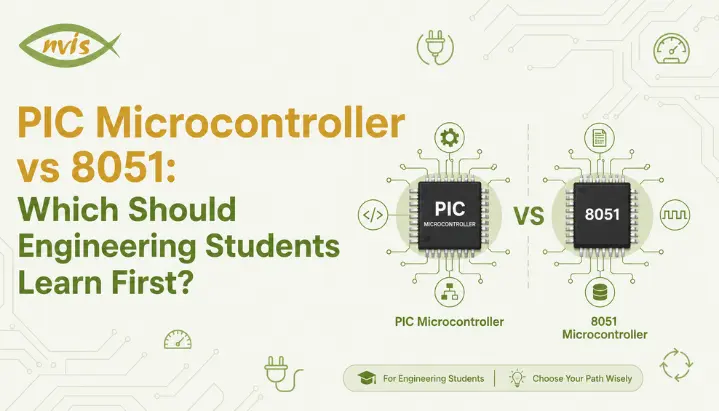
One of the most frequent queries of engineering freshers entering into Embedded Systems is this one. PIC microcontroller and 8051 microcontroller are both popular, well documented and featured in Indian University syllabus as well as in competitive exams and job description. However, they have been constructed at different times, for different reasons, and to impart different knowledge.
This blog explains what PIC is in microcontroller terms, compares the two, and finally, which would be the first to pay attention to as a student. At the end of the day, you’ll have a firm, easy to understand solution rather than further puzzlement.
Also read
- Swinburne Test of DC Machine: Procedure & Working
- Ward Leonard Method of Speed Control: Working Principle, Advantages and Disadvantages
- Three Phase AC Voltage Controller Waveforms: Modes & Working
What Is a Microcontroller, in Plain English
Before comparing PIC and 8051, let’s get one basic idea straight, because a lot of students jump into comparisons without this foundation.
Think of a microcontroller like a tiny, dedicated employee inside a machine. It does not do everything a computer does. It does one job, and it does that job repeatedly and reliably. A microcontroller inside a washing machine only worries about spin cycles, water levels, and timers. It does not need to browse the internet or run a spreadsheet.
Technically, a microcontroller is a single chip that packs together a processor, memory, and input output circuitry, all in one place. Compare that to a microprocessor like one in your laptop, which needs separate memory chips and support circuitry to function. A microcontroller is self contained, like a mini computer built for one specific task.
Both PIC and 8051 fall under this “single chip mini computer” category. The difference lies in who designed them, how they process instructions, and how easy they are to work with.
What Is PIC Microcontroller, and Where Did It Come From
PIC is a family of microcontrollers developed by Microchip Technology. Many classic 8 bit PIC families use RISC style instruction sets, but PIC is a broad product family with different architectures and capabilities. In simple terms, RISC architectures generally use a relatively small set of streamlined instructions designed for efficient execution. The exact instruction cycle timing depends on the specific PIC family and device. Because many RISC architectures use a smaller set of relatively simple instructions, instruction execution can be efficient and predictable, although actual performance depends on the specific architecture and device.
Let’s get an analogy here to help make this sink in. Imagine two chefs. One chef (RISC, as PIC) knows a few basic cooking methods very well, and can mix them up quickly to come up with any dish. Another chef (CISC, 8051) has hundreds of special recipes – some of which require a few more steps to implement – because he does a lot in one. Both cooks are ‘correct’ but the first cook is more efficient at repetitive cooking jobs.
Many PIC microcontrollers use a Harvard style architecture in which program memory and data memory are accessed separately. Combined with instruction pipelining, this allows many instructions to be fetched and executed efficiently. This is why the PIC micros are capable of decent speed at lower clock frequencies.
Then what is a PIC Microcontroller used for in the real world? Its ease of development tools makes it suitable for a wide variety of consumer electronics such as remote controls and home electronics, industrial automation systems, automotive modules, and countless student and hobbyist projects. PIC devices are available across a wide range of performance and memory configurations, so the exact capabilities vary significantly between PIC families and individual models, making for a PIC variant that suits almost any project size, from a simple LED blinker to a reasonably sophisticated industrial controller.
What Is 8051, and Why Is It Still Taught Today
Intel developed 8051, an 8 bit microcontroller, back in 1981 and so it is more than 40 years old. So if you’re thinking, Why does a college still teach something this old in 2026? The honest answer is: it’s not about being modern; it’s about learning the fundamentals.
The 8051 is an 8 bit microcontroller with a CISC style instruction set. Continuing with the chef metaphor, this is a chef who can remember hundreds of recipes, some of which involve a number of steps to implement internally. Classic 8051 devices use a well defined machine cycle model, with individual instructions taking a specified number of machine cycles. PIC devices use a different instruction cycle model, so their timing should be compared on a device and instruction specific basis.
The real value of 8051 for the new programmer is the exposure of everything. The classic 8051 architecture includes internal program memory and RAM, while also supporting external program and data memory. This makes it useful for learning how a processor communicates with memory and peripherals at a relatively fundamental level. This is because when learning, it is possible to view how the processor communicates with the memory, rather than it all being hidden in the processor itself as it is in most modern microcontrollers. No compiler magic, no hidden pipeline behavior, and no mystery. You experience fundamentals.
That’s why 8051 still appears in many embedded-systems lab courses and exam-preparation materials in India. It teaches concepts and NOT conveniences.
Historically, 8051 based microcontrollers have been used in cost sensitive embedded applications and continue to appear in some legacy and simple control systems. Modern automotive and medical products, however, often use newer MCU architectures with more advanced safety, connectivity, and processing capabilities.
PIC vs 8051: Head to Head Comparison
Once you understand “why” behind each chip, actual technical differences become much easier to digest. Here is a side by side comparison covering what matters most for students.
| Parameter | PIC Microcontroller | 8051 Microcontroller |
| Developed by | Microchip Technology | Intel (1981) |
| Architecture type | RISC (Reduced Instruction Set) | CISC (Complex Instruction Set) |
| Memory architecture | Modified Harvard | Harvard (classic variants often use external memory) |
| Instruction set size | Around 35 instructions (PIC16 family) | Around 111 to 255 instructions depending on variant |
| Ease of programming | Easier for beginners, strong IDE support (MPLAB X) | Slightly steeper learning curve, relies on tools like Keil |
| Peripheral integration | Extensive: ADC, PWM, USB, CAN in higher end models | Basic peripherals: timers, UART, I/O ports |
| Power consumption | Generally lower, strong sleep modes | Moderate, varies heavily by manufacturer variant |
| Typical use in India | Hobby projects, industrial automation, consumer electronics | Academic labs, legacy industrial systems, exam syllabi |
| Best suited for | Real hardware projects, placements, prototyping | Building fundamental concepts, government exam prep |
Notice that neither column says “better” outright. That’s intentional. The right choice depends entirely on what you are trying to achieve at this stage of your engineering journey.
A Worked Example: Comparing Instruction Execution
Numbers make this comparison much more concrete, and this is exactly the kind of question that shows up in exam vivas and GATE adjacent microcontroller papers.
Suppose you want to toggle an output pin, and both microcontrollers are running at a 12 MHz clock frequency.
On 8051: classic 8051 uses a machine cycle made up of 12 clock periods. So at 12 MHz, one machine cycle takes:
Machine cycle time = 12 divided by clock frequency = 12 divided by 12,000,000 Hz = 1 microsecond
Suppose we compare the instruction cycle timing of a classic 8051 and a PIC16 device, both using a 12 MHz oscillator. A classic 8051 machine cycle takes 12 oscillator periods, or 1 microsecond. A typical PIC16 instruction cycle takes 4 oscillator periods, or about 0.33 microseconds. However, the actual time required for a pin toggle operation depends on the specific instruction sequence and device.
On a PIC16 microcontroller: Most PIC16 instructions execute in a single instruction cycle, and one instruction cycle equals 4 clock periods (this is because PIC uses an internal clock divider). At same 12 MHz clock:
Instruction cycle time = 4 divided by 12,000,000 Hz = 0.33 microseconds approximately
At 12 MHz, a classic 8051 machine cycle is 1 µs because one machine cycle consists of 12 oscillator periods. A classic PIC16 instruction cycle is four oscillator periods, or approximately 0.33 µs. However, these are different timing units, so this comparison alone does not establish that one MCU is three times faster. The number of cycles required by the actual instruction sequence and the device’s peripheral architecture must also be considered.
This calculation shows why, for this particular instruction and clock frequency, a PIC16 can complete the operation in fewer instruction cycle periods than a classic 8051. It illustrates the difference in instruction cycle design, rather than proving that RISC always outperforms CISC.
Programming Experience: PIC vs 8051 for a Beginner
8051 uses a CISC architecture, or Complex Instruction Set Computing. Going back to our chef analogy, this is a chef with hundreds of recipes memorized, some of which take multiple steps internally to complete. That does not necessarily make it slower for every task, but its instruction timing differs from that of RISC-based devices such as many PIC microcontrollers.
What makes 8051 really useful to a beginner is that it’s very accessible. Classic 8051 devices include internal program memory and RAM while also providing mechanisms for accessing external program and data memory. This makes the memory interface particularly useful for learning how processors communicate with memory. PIC devices can be a good fit for products that benefit from integrated peripherals and an established development ecosystem, although the MCU family chosen ultimately depends on the product’s technical and commercial requirements. No magic compilers; no pipeline secrets; nothing mysterious here. You watch fundamentals happen.
This is precisely because 8051 continues to be used in embedded systems lab manuals, GATE related coursework, and government exam syllabus throughout India. It teaches principles, not conveniences.
In reality, 8051 based devices are more commonly associated with simple or legacy embedded applications, while newer automotive and medical systems generally use more modern microcontroller architectures.
India Context: Where These Microcontrollers Actually Matter
This is the part that most tutorials skip entirely, and it matters a lot if you are studying in India with placements or government exams in mind.
In many Indian engineering courses and some exam preparation materials, 8051 remains a commonly taught microcontroller because of its historical importance and simple architecture. For RRB JE Electronics & Allied Engineering, the current syllabus includes a broader “Microprocessor and Microcontroller” section covering microprocessors, assembly language programming, peripherals, other microprocessors, and microcontrollers. Candidates should therefore follow the latest official syllabus rather than assuming that every 8051 specific topic is explicitly prescribed. 8051 fundamentals can be useful if you are preparing for these exams, but candidates should prioritize the topics explicitly covered in the latest official syllabus.
The picture is wider on an industry and PSU level. ISRO, DRDO, and BEL employ electronics engineers for embedded systems roles involving areas such as satellite payloads, radar systems, and control systems. These roles usually require knowledge of microprocessors and microcontrollers, C programming, real time systems, and hardware interfacing rather than expertise in one specific MCU family. In the private sector, automotive Tier 1 companies, industrial automation firms, and IoT product companies use whichever microcontroller family fits their product needs, and PIC devices can be attractive in products where their integrated peripherals, memory options, package choices, and development ecosystem fit the design requirements.
Entry level embedded systems roles for freshers generally fall in 3 to 8 LPA range depending on company type and city, with service companies at lower end and product or automotive Tier 1 companies at higher end. Specializing more deeply within automotive embedded systems or IoT could take mid career packages further than this range as experience builds up. Bengaluru, Chennai, and Hyderabad are metropolitan cities with high demand for automobiles and semiconductors that provide better pay rates compared to other cities.
Practical implications for you as a student: 8051 can help you prepare for courses and exams that emphasize its architecture, while PIC or modern ARM based platforms such as STM32 can give you hands-on project experience. For placements, focus on transferable embedded systems skills rather than one specific microcontroller.
Exam Relevance: GATE, SSC JE, and RRB JE Strategy
If you are balancing coursework with competitive exam prep, here is how to prioritize your microcontroller study time.
For GATE ECE, note that microcontroller specific questions are not a dominant, separately weighted topic in official syllabus structure. GATE ECE leans heavily on Engineering Mathematics, Communications, Networks, and Signals and Systems, so microcontroller concepts usually surface indirectly through digital electronics and embedded logic questions rather than as a dedicated 8051 versus PIC comparison. Do not over invest your GATE prep time here at expense of higher weightage sections.
For SSC JE and RRB JE Electronics, the story flips completely. For exams where microcontroller architecture is explicitly included in the syllabus, candidates may encounter questions on areas such as 8051 architecture, addressing modes, timers, interrupts, and interfacing. Always use the latest official syllabus and previous year papers to determine the appropriate depth. If you are targeting these exams, treat 8051 syllabus as core preparation material, not optional reading.
For university semester exams and lab vivas, expect a mix. Many Indian engineering colleges still run their embedded systems lab entirely on 8051 kits, so practical viva questions will test your understanding of registers, timers, and interrupt handling on this chip specifically. If your final year project happens to use PIC or another RISC based microcontroller, be ready to explain architectural differences confidently since examiners often ask “why did you choose this over 8051.”
Career and Salary Outlook for Embedded Systems Engineers
Choosing between PIC and 8051 is really a small decision inside a much bigger career path: embedded systems engineering, and the outlook for this field in India remains genuinely strong.
Entry level embedded systems roles for freshers generally fall in 3 to 8 LPA range, with variation based on whether you join a service based company or a product focused firm. Automotive embedded roles involving areas such as AUTOSAR, CAN, and ADAS can offer strong career progression, particularly as engineers gain specialized experience. Once you gain a few years of specialized experience, mid-level engineers with 3 to 5 years of experience can move into the 8 to 14 LPA bracket, and senior embedded architects at larger semiconductor and automotive companies can cross well beyond that.
What actually drives these numbers upward is not which specific microcontroller you know, but how deep your fundamentals go combined with adjacent skills like RTOS concepts, embedded Linux, communication protocols such as I2C and SPI, and increasingly, IoT integration. A student who understands both 8051 fundamentals and modern PIC or ARM based development has a noticeably stronger foundation walking into interviews than someone who only memorized one chip’s datasheet.
India’s growing semiconductor push and EV manufacturing boom are also expanding demand for embedded talent significantly, which is good news if you are entering this field over the next few years.
So, Which Should You Learn First?
If you are a first or second year student building your foundation, or if you are preparing for SSC JE, RRB JE, or a university exam with 8051 in the syllabus, start with 8051. Its exposed architecture forces you to understand memory, registers, and interrupts at a level that pays off for years, even after you move to more modern chips.
If you are a third or final year student focused on projects and placements, consider moving beyond 8051 toward a modern MCU platform such as STM32, while also learning PIC if it aligns with your course, existing hardware, or project requirements, which are widely used across embedded, industrial, automotive, and IoT applications. PIC devices can also provide a useful bridge between academic microcontroller concepts and hands-on hardware development, particularly through the MPLAB X development environment and integrated peripherals.
The strongest students do not pick a side. They use 8051 to build conceptual depth, then use PIC (or ARM) to build practical, portfolio worthy projects. That combination is what actually gets noticed in interviews and technical rounds.
Conclusion
The PIC microcontroller vs 8051 debate is not really about which chip wins. It’s about matching the right tool to the right stage of your learning journey. 8051 hands you transparency and conceptual clarity, which is exactly what a beginner needs and exactly what Indian competitive exams still test. PIC microcontrollers can give you useful hands-on experience with peripherals, firmware development, and hardware interfacing. For broader placement preparation, however, combine that experience with C, communication protocols, debugging, RTOS concepts, and a modern MCU platform such as STM32.
Start with whichever your syllabus or exam demands right now, but make sure you eventually get comfortable with both. If you are just getting started, pick up an 8051 development kit or a PIC16F877A board, work through a few basic LED and interfacing projects, and build from there. That hands-on practice will teach you more in a weekend than any comparison article, including this one.
FAQs
PIC microcontrollers are used in consumer electronics like remote controls and home appliances, industrial automation systems, automotive control modules, and a large share of student and hobbyist electronics projects because of their beginner friendly MPLAB X toolchain and strong peripheral support.
PIC is the name used for a family of microcontrollers from Microchip Technology. The acronym is historically associated with ‘Peripheral Interface Controller,’ although the PIC family includes different architectures and capabilities. The name reflects its original design purpose of efficiently interfacing with external peripherals.
Install MPLAB X IDE along with XC8 compiler, pick a common beginner friendly chip like PIC16F877A, connect a programmer such as a PICkit, and start with a simple LED blink project before moving on to interfacing sensors, displays, and motors.
8051 remains relevant for Indian academic syllabi, SSC JE and RRB JE exam preparation, and for building a strong conceptual foundation. Studying 8051 can provide a useful way to understand registers, memory access, interrupts, and low-level interfacing, particularly when those topics are part of your course or exam syllabus.
Neither carries heavy dedicated weightage in core GATE ECE syllabus, which focuses more on Communications, Networks, Signals and Systems, and Engineering Mathematics. Basic 8051 concepts occasionally support digital electronics and embedded logic questions, but this should not be a major focus area for GATE aspirants.
Yes, it is technically possible, especially if your course or exam does not require 8051. However, many students find that skipping 8051 means missing out on foundational concepts around registers, addressing modes, and low level memory access, which are easier to grasp on 8051’s simpler, more transparent architecture.