







TL;DR –
- The blog will target RF engineers, electronics engineers, test and measurement engineers, R&D teams and manufacturing/QA engineers involved in working with microwave and RF systems.
- Microwave power measurement is critical for system performance, regulatory compliance, and reliability in wireless, aerospace, defense, and industrial applications.
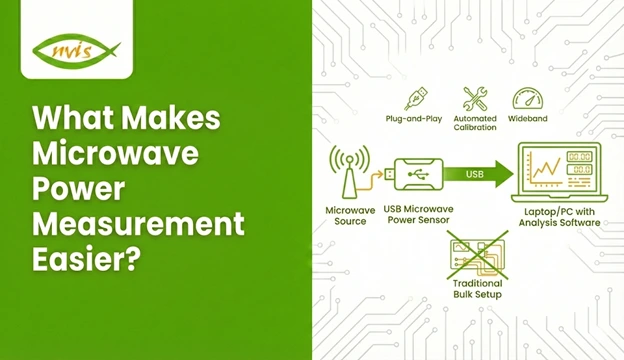
- The development of sensors, digital meters, and real-time measurement methods has increased the speed of the Power Measurement, making it more accurate and accessible, as compared to the traditional approach.
- Being automated, remotely controlled, and data logging software eases the workload, minimizes human error, and provides efficiency in the laboratory and production process.
- Recent Microwave Power measurement products simplify the setup process, minimize errors, and provide repeatable and consistent results in the laboratory, production lines and field testing.
Precision microwave power measurement is one of the foundations of RF and microwave engineering. In the validation of wireless communication systems and the performance of radar and satellite systems, accurate and efficient Microwave Power Measurement directly impacts product quality, compliance, and system reliability.
In the past, Power Measurement at microwave frequencies has been deemed complex, time consuming and sensitive to setup errors.. Advancements in sensor technology, instrumentation, software, and automation have transformed this process. As a result, microwave power testing today is faster, more user-friendly, and highly repeatable.
Also Read:
- What Is a Data Acquisition System and How Does It Work?
- How Analog and Digital Multimeters Work?
- Choosing the Right Power Supply for Your Lab
Understanding Microwave Power Measurement
Microwave power is the amount of electromagnetic energy transmitted per unit time at microwave frequencies, which are normally in the range of 300 MHz to 300 GHz. As opposed to low-frequency or DC power, microwave signals are waves propagating through transmission lines, waveguides, and space and thus more difficult to measure accurately.
Why Is Microwave Power Measurement Critical?
Precise Power Measurement ensures:
- RF components meet design specifications
- Wireless systems comply with regulatory standards
- Transmitters operate efficiently without distortion
- Devices perform reliably under real-world conditions
Errors in Microwave Power Measurement can lead to signal degradation, interference, reduced system efficiency, or even hardware failure.
Faster and More Accurate Measurement Techniques
Real-Time Measurement Capability
High-speed sampling allows engineers to:
- Capture fast signal changes
- Measure modulated and pulsed microwave signals
- Analyze transient power behavior
This is especially important for modern digital communication systems.
Temperature Compensation
Advanced sensors automatically compensate for temperature variations, which makes the Microwave Power reading consistent and repeatable in various conditions.
Role of Software in Simplifying Power Measurement
- Automation and Control
Power Measurement is made easier with software since one can control instruments remotely, run automated tests, and view data in real-time. This reduces manual intervention, minimizes human error, and significantly improves measurement speed and consistency, particularly in production and high-throughput testing environments particularly in a production and high throughput testing setting. - Data Management and Reporting
The results of the measurements are automatically recorded with the help of modern microwave power measurement software, and therefore, it is not difficult to create compliance reports, monitor long-term changes in performance, and keep quality documentation. This provides traceability, supports regulatory compliance, and simplifies overall test workflows.
Minimizing Measurement Errors
High-quality connectors and accessories play a key role in improving Microwave Power measurement accuracy, Precision connectors, low-loss cables, and high-quality adapters reduce impedance mismatches and signal losses and lead to more stable measurements and better repeatability of test configurations.
Moreover, current Microwave Power Measurement devices also include built-in automatic error correction that compensates for sensor non-linearity. frequency response variations as well as other environmental effects like temperature changes. Such corrections are greatly built in to improve the accuracy and reliability of measurements in comparison with the past manual methods of measurements.
Applications Benefiting from Easier Microwave Power Measurement
Wireless Communications
Accurate Microwave Power Measurement ensures optimal performance in:
- Cellular base stations
- Wi-Fi and 5G equipment
- IoT and short-range wireless devices
Aerospace and Defense
Microwave power data is used in radar systems, satellite communications, and electronic warfare applications to ensure mission-critical reliability in satellite communications and electronic warfare applications.
Research and Development Laboratories
Simplified Power Measurement allows engineers and researchers to focus more on innovation and less on test complexity.
Manufacturing and Quality Control
Fast, automated measurement systems improve throughput and consistency on production lines, reducing defects and rework.
Choosing the Right Microwave Power Measurement Solution
To obtain accurate, repeatable, and efficient test results, it is necessary to select the appropriate Microwave Power Measurement solution. The instruments used must be well matched with the testing requirements at present as well as in the future.
In the measurement equipment, the following are the important factors that should be taken into account:
Frequency range and power levels
Ensure the power sensors and meters support the full frequency spectrum and power levels required by your applications, from low-level signal analysis to high-power transmission testing.
Measurement speed and accuracy requirements
Fast measurements are important in modulated or pulsed signal applications and high precision is important in compliance testing, calibration and R & D applications.
Compatibility with existing test systems
Choose instruments that integrate easily with your current RF setups, automated test equipment, and communication interfaces to minimize reconfiguration and downtime.
Software and automation capabilities
Advanced software enables automated measurements, data logging, remote control and simplification of the reporting processes- which would dramatically enhance productivity and minimize operator error.
Through appropriate choice of microwave power sensor combinations, meters and software tools, laboratories and production staff are able to ease up the testing processes, cut down on the measurement effort, and attain a high degree of reliability in the results.
Future Trends in Microwave Power Measurement
Higher Frequency Support
As technologies move toward millimeter-wave and terahertz applications, Microwave Power Measurement tools continue to evolve with wider frequency coverage.
Smarter Automation
AI-driven test systems will further simplify Power Measurement by automatically optimizing setups and identifying anomalies.
Compact and Portable Solutions
Smaller, USB-powered sensors and handheld meters are making accurate Microwave Power testing accessible outside traditional lab environments.
Conclusion
The ease with which Microwave Power Measurement can be performed today is not due to one technology- but rather a collection of smarter sensors, sophisticated digital meters, automation software, better calibration techniques as well as user-friendly design.
These developments have transformed Power Measurement from a complex, expert-driven task into an efficient, automated process, which can be used in the laboratory, on the production floor, and field testing. With the current rise in the development of microwave technologies, measurement will only get much more precise, faster and convenient, so that engineers can not only be sure that the RF and microwave systems demand at the moment can be met, but also that these systems will operate with ease.
FAQs
Modern sensors, digital meters, and automation software simplify microwave power measurement by reducing manual setup, correcting errors automatically, and delivering faster, more accurate, and repeatable results.
Accurate microwave power measurement ensures RF systems meet specifications, comply with standards, and operate efficiently without signal distortion or performance loss.
Software enables automated measurements, remote control, real-time monitoring, and data logging, reducing human error and improving testing speed and consistency.
Common errors include cable losses, impedance mismatch, sensor non-linearity, frequency response variation, and temperature changes, which modern instruments automatically correct.
Microwave power measurement is widely used in wireless communications, aerospace and defense, R&D labs, and manufacturing for testing, validation, and quality control.