







TL; DR
- This blog is ideal for engineering students, diploma learners, and aspiring EV professionals who want to understand regenerative brakingthrough practical learning.
- Regenerative brakingimproves EV efficiency by converting kinetic energy into electrical energy and storing it via regenerative charging.
- A regenerative braking systemenhances driving range, reduces energy loss, and minimizes wear on traditional braking components.
- Factors like tyre quality, rolling resistance, and pressure directly impact effectiveness of regenerative braking.
- Hands on EV training labs help students gain real world experience, understand system integration, and build industry ready technical skills.
The future of transportation is changing with rapid development of electric vehicles in India and other parts of the world. Increase in fuel prices, environmental issues, and the need to achieve sustainable mobility has increased the pace of EV adoption, which has resulted in a high demand for professionals in this field. Efficiency is a key factor in EV performance and driving range, as these vehicles rely entirely on electricity. This is where regenerative braking comes in as one of innovations, which assists vehicles to recover energy that would have been wasted.
The regenerative braking system transforms kinetic energy into electrical energy during deceleration and recharges it into battery via regenerative charging. This process not only enhances energy efficiency but also increases vehicle range and reduces wear on conventional braking components. These concepts are best understood through practical experience. EV training laboratories allow students to view and study regenerative braking in real time, closing the gap between theory and practice and preparing them for the dynamic electric mobility industry.
Related Blogs:
- Relay Coordination Techniques for Over Current and Earth Fault Protection
- Load Flow and Voltage Regulation in Radial and Ring Distribution Systems
Hydrogen Education Labs: Preparing Next Generation of Clean Energy Engineers
What is Regenerative Braking?
Regenerative braking is an established technology that is applied in electric cars where energy produced during braking is not wasted but is converted into useful electrical energy. A regenerative braking system, unlike traditional braking systems, does not dissipate energy as heat, but instead, it recaptures energy and feeds it back to battery via regenerative charging, enhancing overall efficiency of the vehicle. In a traditional braking system, the vehicle is slowed down by friction between brake pads and wheels, which results in loss of energy. In regenerative braking, however, the electric motor is an important component, as it reverses its role. It does not use energy but instead, it is a generator during deceleration, transforming the kinetic energy of a vehicle into electrical energy. Energy thus recovered is stored in the battery and hence the process is efficient and sustainable.
How a Regenerative Braking System Works?
A regenerative braking system is developed to not only decelerate vehicles but also to recover energy in process. The system uses regenerative braking to transform wasted kinetic energy into useful electrical energy and recharges the battery through regenerative charging, which makes EVs more efficient and sustainable.
1. Brake Input or Accelerator Release
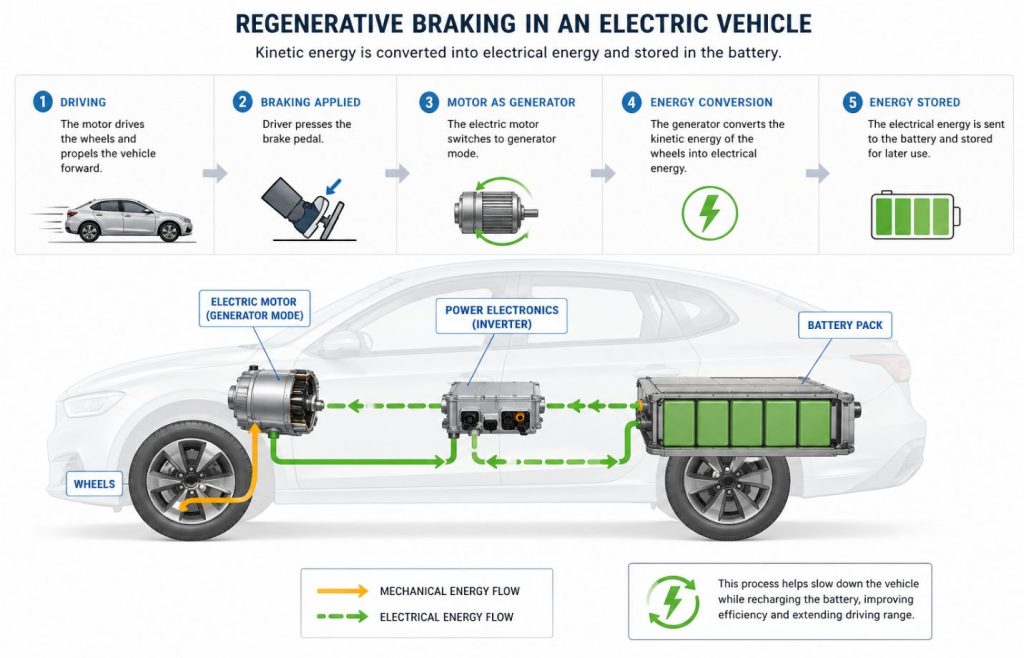
Regenerative braking starts when the driver presses the brake pedal or releases the accelerator. system does not rely solely on friction brakes, but it switches to energy recovery mode.
2. Motor Acts as a Generator
In a regenerative braking system, an electric motor reverses its function during deceleration. It begins to operate as a generator, which is necessary to transform motion into useful energy.
3. Energy Conversion Process
The kinetic energy of a vehicle is transformed into electrical energy as the vehicle decelerates. This is the main concept of regenerative braking, and the system is more efficient than traditional braking.
4. Regenerative Charging of Battery
Generated electricity is sent back to the battery through regenerative charging. This helps in recovering energy and extending the overall driving range of vehicles.
5. Role of Battery Management System (BMS)
Battery Management System oversees the whole process, which is safe charging, regulating voltage levels, and optimizing performance of regenerative braking systems in repeated braking cycles.
Why Regenerative Braking Matters in EVs
Electric vehicles would not be as efficient as they are today without regenerative braking. The regenerative braking system assists in reclaiming energy when decelerating, enhancing overall efficiency and increasing driving range. It also minimizes waste of energy, which enables vehicles to control power better. This is particularly helpful when driving in a city where there is a lot of stopping and starting. Rather than wasting energy, EVs employ regenerative charging to feed energy back to the battery each time it slows down. Meanwhile, decreased use of traditional brakes results in fewer wear and tears, decreased maintenance requirements, and a more affordable and sustainable driving experience.
Benefits of Regenerative Braking
- Regenerative braking significantly improves energy efficiency by capturing energy that would otherwise be lost as heat and converting it into usable electrical energy through regenerative charging.
- A regenerative braking system helps extend driving range of electric vehicles by continuously recovering and reusing energy during deceleration.
- It reduces dependence on traditional friction brakes, leading to less wear and tear, lower maintenance costs, and improved durability of braking components.
- By optimizing energy usage and reducing wastage, regenerative braking contributes to sustainable transportation and supports shift toward cleaner mobility solutions.
Importance of Tyre Quality in Regenerative Braking
Although regenerative braking is very efficient, its operation is greatly affected by the quality of tires and contact with the road. Depending on following factors, effectiveness of a regenerative braking system and regenerative charging may differ:
· Tyre Tread and Grip
tread pattern and quality of rubber used determine grip of tyre on road. A good grip can support more stable and efficient energy recovery, whereas old or poor-quality tyre will decrease efficiency of regenerative braking.
· Rolling Resistance
High rolling resistance tyre consumes more energy to move and this limits efficiency of the system. Tyer with low rolling resistance improves overall efficiency and supports better energy recovery during regenerative braking.
· Tyre Pressure
Proper tyre pressure will provide maximum contact with the road. Under inflated tyre reduce grip and have an adverse impact on regenerative braking systems.
· Tyre Type
Various types of tyre, including summer, winter, or all season, have different degrees of grip and resistance, efficiency of regenerative braking can be maximized by selecting appropriate tyre to suit driving conditions.
· Overall Impact
Simply put, the state and quality of tyre directly affect the effectiveness of a regenerative braking system to recover energy. Good quality tyre enhances efficiency and energy recovery, leading to improved EV performance and range.
Role of EV Training Labs in Understanding Regenerative Braking
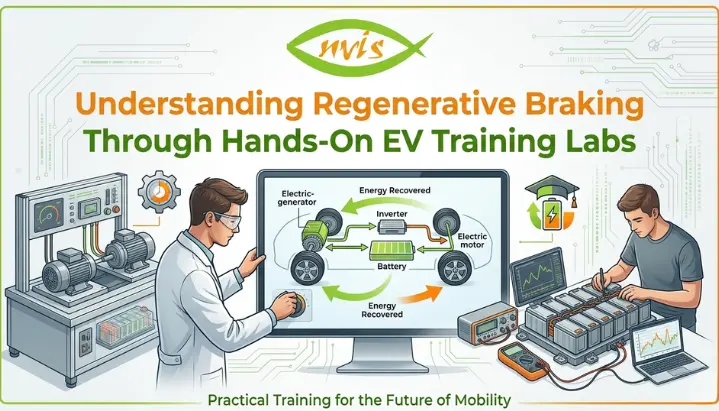
EV training laboratories are crucial in enabling engineering students to learn about regenerative braking beyond theoretical knowledge. Practical learning provides students with practical experience with real EV systems, such as motors, controllers, and batteries, which makes them have a clear understanding of how a regenerative braking system works in the real world. This practical method not only enhances technical knowledge but also prepares students for industry demands. Moreover, these laboratories enable students to conduct simulations and experiments to test regenerative braking in various conditions. Students will be able to see regenerative charging in real time, study flow of energy back to battery, and learn how systems such as BMS control and optimize performance. This is a practical understanding that is necessary in establishing a solid base in electric vehicle technology.
Practical Experiments in EV Labs
EV training laboratories give students a chance to conduct practical experiments that make concepts such as regenerative braking come to life. Among the most important experiments is one that shows energy recovery during braking where students can easily see how a regenerative braking system can capture kinetic energy and transform it into electrical energy rather than dissipate it as heat. Other parameters that students measure include voltage and current produced during regenerative braking, which assists them to comprehend real time system performance. They can understand system behavior better by examining efficiency at various speeds and load conditions. Moreover, work with controllers and BMS integration will enable learners to learn about management control, and optimization of regenerative charging in an EV system.
Students Gain Through Hands on Training
Practical EV training laboratories enable students to acquire practical skills that are not limited to theoretical knowledge. Through direct interaction with systems such as regenerative braking and knowledge of how a regenerative braking system interacts with other EV systems, learners can have a holistic perspective of electric vehicle technology and its practical use.
- Students develop a system level understanding of EV powertrain, including how regenerative braking interacts with motors, batteries, and controllers.
- They learn diagnostics and troubleshooting techniques, enabling them to identify faults and optimize performance of systems like regenerative charging and battery management.
- Practical experiments enhance their ability to collect, analyze, and interpret data, especially related to voltage, current, and energy flow during regenerative braking.
- Training also equips students with industry relevant technical skills, preparing them for careers in EV design, testing, maintenance, and advanced mobility solutions.
Conclusion
Regenerative braking is crucial to enhance efficiency of EVs, increase their range, and promote sustainable mobility by means of efficient regenerative charging. A regenerative braking system is not only integrated to enhance performance but also reduces maintenance needs. This knowledge is further supported by EV training labs that give students real world exposure to systems. This helps them build industry-relevant skills and prepares them to contribute to the growing electric mobility industry.
FAQS
Regenerative braking is a mechanism that transforms kinetic energy during braking into electrical energy and charges the battery by regenerative charging.
A regenerative braking system minimizes loss of energy by reclaiming energy during deceleration, which contributes to increasing driving range and overall efficiency.
Regenerative charging is the process of sending recovered energy back to the battery when a vehicle slows down or brakes.
No, regenerative braking cannot completely substitute traditional brakes. It operates in conjunction with them, particularly when braking at low speeds or in case of an emergency.
Practical training in EV laboratories enables students to see real time regenerative braking and regenerative charging, which will enable them to better understand how the system works and how it can be used in practice.