






TL;DR
- This blog is for ECE, EEE, and CSE students, embedded systems beginners, and GATE, SSC JE, and RRB JE aspirants who want a clear, practical understanding of AVR microcontrollers.
- AVR is a family of 8-bit microcontrollers, with many classic AVR devices based on RISC and Harvard-style architectures and it is one of easiest and most widely taught microcontrollers in Indian engineering colleges.
- This post breaks down what AVR microcontroller is, architecture of AVR microcontroller block by block, and where it is actually used in Indian industry.
- You will also find a worked numerical example, a comparison with 8051, PIC, and ARM, and exam focused tips for GATE and SSC JE preparation.
- By the end, you will know exactly why AVR is often the first microcontroller recommended for beginners, and how learning it can lead to real embedded systems career paths in India.
AVR is one of the best-known 8-bit microcontroller families, particularly in electronics education and hobbyist embedded development. It was developed by Alf-Egil Bogen and Vegard Wollan, and Atmel launched its first AVR devices in the late 1990s. The ATmega328P later became especially well known through the Arduino Uno platform. In this guide, we will cover what an AVR microcontroller is, how its architecture works, how its concepts relate to competitive-exam preparation, and how these fundamentals connect to a career in embedded systems.
Also read
- Swinburne Test of DC Machine: Procedure & Working
- Ward Leonard Method of Speed Control: Working Principle, Advantages and Disadvantages
- Three Phase AC Voltage Controller Waveforms: Modes & Working
What is AVR in a Microcontroller?
A microcontroller is a little, self contained computer that fits on one chip. It doesn’t require a separate keyboard, monitor or hard drive as all the components it requires – processor, memory, and input output – are built in.
Suppose you would like to use this little computer to blink an LED, read the temperature of a sensor, or control a motor in a washing machine. That’s what a microcontroller’s job is all about! Does not attempt to open a Web browser or play videos. Designed to perform one specific task efficiently, consistently, repeatedly, and often for years without a problem.
What is an AVR microcontroller, then? AVR is a series of 8 bit microcontrollers that are based upon the Reduced Instruction Set Computing (RISC) architecture. RISC stands for the fact that the chip will know a few simple instructions, and will execute most of them in just one clock cycle rather than multiple, as was the case with the older designs. This is one reason AVR is classified as an 8-bit microcontroller family: its core architecture is designed around 8-bit data operations.
AVR microcontroller was developed by two students at Norwegian Institute of Technology, Alf Egil Bogen and Vegard Wollan. In 1997, Atmel bought the design and produced the first commercial AVR chip, AT90S1200. The name AVR is commonly associated with the initials of its original designers, Alf-Egil Bogen and Vegard Wollan. ‘Advanced Virtual RISC’ is sometimes given as an expansion, but it is not generally treated as the official meaning of AVR.
Arduinos use an AVR microcontroller, so if you have ever used an Arduino Uno, you have already used an AVR microcontroller. That chip, ATmega328P, is a good old microcontroller, which is one reason AVR has become a familiar entry point for many students learning embedded systems through Arduino-based projects.
Architecture of AVR Microcontroller Explained Simply
Think of a little factory, before you get into the technical blocks. The raw material enters via one gate, the finished goods exit via another, and the instruction is fed from the factory’s rule book via a third. No confusion in the streets as each type of traffic runs on its own road.
For a deeper look at AVR’s CPU core, registers, pipelining, and Harvard architecture, see Microchip’s AVR CPU Core documentation, in which program memory and data memory have separate buses. This is in contrast to most desktop computers that have von Neumann architecture, which involves both instructions and data sharing the same bus. AVR uses separate program and data memories and buses. Its CPU also uses a simple instruction pipeline, allowing the next instruction to be fetched while the current instruction is being executed and it’s one of the main reasons AVR chips can perform almost 1 instruction per clock cycle.
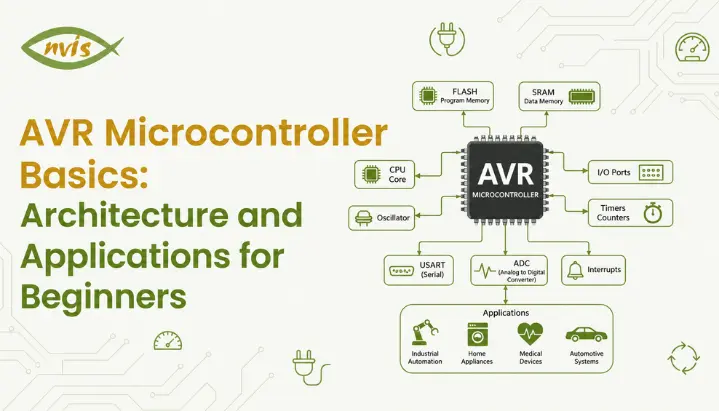
Let’s go through the essential components of AVR microcontrollers, one by one.
CPU Core and General Purpose Registers
The CPU core is at the core of any AVR chip, which is then tied to 32 general purpose 8-bit-wide registers. That’s quite a whopping amount for an 8 bit microcontroller. Microchip provides a detailed explanation of the AVR’s 32 general-purpose registers compared with many earlier 8-bit microcontrollers, reducing the need to fetch data from slower memory as often.
These 32 registers are closely integrated with the AVR CPU core, allowing instructions to access registers efficiently. Many AVR instructions can read operands from the register file and write the result back within a single instruction cycle. This register organization can reduce the need for frequent memory accesses and contributes to efficient instruction execution.
Memory Organization
The AVR microcontrollers control three different types of memory and each has a distinct purpose.
The actual program code is stored in flash memory. Flash memory is non-volatile, so it retains the program when power is removed. It can be erased and reprogrammed many times, including through In-System Programming (ISP) on supported AVR devices. This allows supported AVR devices, including the ATmega328P used in classic Arduino Uno boards, to be reprogrammed repeatedly within the device’s specified write-cycle limits.
SRAM or Static Random Access Memory: Memory used for temporary data during the execution of your program, e.g., variable values and stack. SRAM is volatile, meaning that it loses its contents when the power is removed, unlike flash.
EEPROM is a smaller portion of non volatile memory that is used to hold data that remains even after a power down, such as calibration values or a saved setting for a configuration. As an example, if you’re designing an electronic door lock, access code could be stored in EEPROM and therefore it will not be lost if the device is disconnected.
ALU and Single Cycle Execution
Actual number crunching takes place in the Arithmetic Logic Unit, where addition, subtraction, logical comparisons, bit manipulation occur. The ALU is located next to 32 general purpose registers, so most AVR instructions run in one clock cycle.
That is precisely why AVR feels ‘snappy’ when compared to older 8 bit designs requiring more than 1 clock cycle an instruction. For instructions that execute in a single clock cycle, a 1 MHz AVR can theoretically execute up to about 1 million instructions per second. The higher the clock the higher the throughput, at the expense of increased power consumption.
I/O Ports, Timers, and Peripherals
The surrounding CPU core is a set of peripherals that let the microcontroller talk to the outside world. AVR chips typically expose their pins as 8 bit I/O ports, commonly labelled Port A, Port B, Port C, and Port D depending on specific chip. Each port can be configured pin by pin as either input or output.
On top of basic I/O, AVR microcontrollers include built in timers and counters, an Analog to Digital Converter or ADC for reading analog sensor signals, communication interfaces like USART, SPI, and I2C for talking to other chips, and a watchdog timer that automatically resets microcontroller if program ever gets stuck in an infinite loop. There is also an interrupt controller, which allows the chip to instantly pause its current task and respond to an urgent event, like a button press, without constantly checking for it in a slow polling loop.
Worked Numerical Example: Calculating Execution Time
Understanding the relationship between clock frequency, instruction cycles, and execution time is useful for microprocessor and microcontroller exam preparation. Here is a simple worked example using AVR’s single cycle execution model.
Problem: An AVR microcontroller operates at a clock frequency of 8 MHz. Assuming most instructions execute in a single clock cycle, calculate time taken to execute one instruction and number of instructions executed in one second.
Step 1: Find clock period. Clock period T equals 1 divided by frequency. T = 1 / (8 x 10^6 Hz) = 0.125 microseconds per cycle.
Step 2: Since most AVR instructions take one clock cycle, execution time per instruction is approximately 0.125 microseconds.
Step 3: Calculate instructions per second. For the simplified assumption that each instruction takes one clock cycle, the theoretical instruction throughput is approximately equal to the clock frequency: 8 million instructions per second, or 8 MIPS.
Interpretation: This is why AVR datasheets often state performance directly in MIPS at a given clock frequency. Compare this with classic 8051 implementations, which commonly use 12 oscillator periods per machine cycle, although newer 8051-compatible devices can use fewer cycles. A classic 12-clock 8051 requires 12 oscillator periods for a machine cycle, so an 8 MHz clock corresponds to about 666,667 machine cycles per second. However, actual instructions can require different numbers of machine cycles, so this should not be treated as a direct instruction-per-second comparison with AVR. This single comparison is a favorite in exam numericals because it tests both your formula knowledge and your conceptual understanding of RISC versus CISC design.
AVR vs 8051 vs PIC vs ARM: How Do They Compare?
Students preparing for interviews or exams are frequently asked to compare AVR with other microcontroller families. Here is how they stack up on fundamentals that matter most.
| Feature | AVR | 8051 | PIC | ARM Cortex M |
| Architecture | RISC, Harvard | CISC, Von Neumann | RISC, Harvard | RISC, Harvard |
| Data width | 8 bit | 8 bit | 8/16 bit | 32 bit |
| Cycles per instruction | Mostly 1 | 12 (classic), 1 (enhanced) | Mostly 1 to 4 | Mostly 1 |
| General purpose registers | 32 | Limited (accumulator based) | Fewer, banked registers | 13 general registers |
| Typical use case | Hobby projects, mid range embedded control | Legacy industrial systems, teaching | Motor control, automotive | IoT, smartphones, complex embedded systems |
| Beginner friendliness | High, Arduino ecosystem | Moderate, widely taught in colleges | Moderate | Lower, steeper learning curve |
AVR sits in a comfortable middle ground. Its register organization and instruction model can make AVR easier for many beginners to work with than classic 8051 implementations, while ARM Cortex-M devices offer substantially greater processing capability for more demanding applications. This balance makes AVR a useful starting point before moving to more advanced ARM-based development, particularly Cortex-M platforms used widely in IoT, automotive, industrial automation, and other embedded applications.
Real World Applications of AVR Microcontroller
AVR microcontrollers are not confined to college labs. AVR microcontrollers have been used across consumer electronics, industrial control, instrumentation, automotive subsystems, and hobbyist projects, although the specific devices selected in modern products vary widely by application.
AVR devices have been used in consumer electronics, home automation, instrumentation, and other control applications, although the specific MCU used in a commercial product depends on its technical requirements. AVR based modules handle tasks like dashboard indicators and basic sensor monitoring, though more complex modern vehicle systems increasingly rely on 32 bit processors.
Robotics and drone hobby projects frequently use AVR based boards for tasks like motor control, sensor fusion at a basic level, and communication between subsystems. AVR microcontrollers can also be useful for low-complexity monitoring, control, and instrumentation prototypes. AVR also plays a strong role in industrial signal sensing, data acquisition systems, and prototyping new hardware designs before a company commits to a more expensive custom chip.
Perhaps the biggest reason for AVR’s popularity, though, is education. Because classic Arduino boards such as the Uno R3 use AVR microcontrollers, the Arduino ecosystem has helped introduce many students and hobbyists to AVR-based embedded development, including a huge number of Indian engineering students, to get their first hands on experience with embedded systems.
AVR Microcontroller in Indian Engineering and Job Market Context
For Indian engineering students, AVR is more than an academic topic. It connects directly to real employment opportunities and government backed industry growth.
Organizations such as ISRO, DRDO, BEL, and BHEL recruit engineers for electronics, embedded systems, control, instrumentation, and related roles. The specific microcontroller or processor technologies used vary by project, so students should view AVR as a foundation for embedded-systems concepts rather than as a guaranteed technology used by these organizations. Private sector opportunities are expanding quickly too, driven by India’s growing semiconductor and electronics manufacturing push. India’s semiconductor and electronics ecosystem is also receiving policy support, with initiatives focused on domestic manufacturing, semiconductor development, research, and workforce development. India has a significant share of the global semiconductor design workforce, according to Indian government and industry estimates, which means AVR can provide a foundation in registers, memory, peripherals, interrupts, and firmware development. These fundamentals can then support further specialization in embedded software, firmware, verification, semiconductor design, or other electronics roles.
Government initiatives such as the Production Linked Incentive (PLI) schemes and broader electronics-manufacturing policies are supporting investment and capacity growth in India’s electronics ecosystem. This growth can create additional opportunities for engineers with embedded-hardware and firmware skills. This growth can create opportunities for engineers with embedded hardware and firmware skills. Learning AVR can provide a foundation in registers, memory, peripherals, interrupts, and firmware development that can be transferred to other MCU platforms.
For students targeting the EV sector, embedded controllers in Battery Management Systems and motor drive units often build on the same fundamental microcontroller concepts covered here, even when the specific chip used is a more advanced ARM based part.
GATE, SSC JE, and RRB JE Exam Relevance
Microprocessor and microcontroller concepts appear in relevant engineering and technical-exam syllabi, although the exact topics and weightage vary by exam and year, so it is worth preparing strategically rather than memorizing randomly.
For GATE EC preparation, concepts such as machine instructions and addressing modes, ALU, data paths and control, and instruction pipelining are covered under Computer Organization. AVR-specific details are not required by the GATE EC syllabus. For GATE IN and other papers, the relevant topics depend on the current official syllabus for that specific paper. AVR-specific details should therefore be treated as a way to strengthen fundamentals rather than as a guaranteed GATE topic. For technical recruitment exams that include electronics or microprocessor/microcontroller topics, focus on fundamentals such as microprocessor operation, memory, digital electronics, and interfacing. Always check the latest official syllabus for the specific exam and post.
A smart strategy is to master fundamental concepts, RISC versus CISC, Harvard versus Von Neumann architecture, register organization, and memory types, since these concepts repeat across multiple microcontroller families in syllabus, not just AVR. Once you are comfortable with AVR’s architecture, understanding 8051 or PIC becomes significantly easier because underlying principles overlap heavily.
Solving previous-year papers that cover microprocessor, microcontroller, and digital-electronics concepts is a useful way to prepare, particularly because the question style and emphasis can vary between exams and recruitment cycles, since these questions test the same clock cycle and MIPS calculation pattern shown earlier in this post, just with different numbers.
Career and Salary Outlook for Embedded Systems Engineers in India
Embedded systems is an important career path within electronics and electrical engineering in India, and microcontroller knowledge is one of the foundational skills for entering the field.
Freshers entering embedded systems roles in 2026 can typically expect salaries in the range of roughly 3 to 8 LPA, depending on their skill set, internship experience, and project portfolio. Freshers specifically at automotive Tier 1 companies and semiconductor firms often start around 4 to 8 LPA, while service based companies tend to offer figures at lower end of typical fresher ranges. As experience grows, compensation rises meaningfully. Professionals with three to five years of experience can expect roughly 8 to 14 LPA on average, and senior embedded architects at major companies can reach 20 to 38 LPA.
Skills that meaningfully boost these numbers include familiarity with multiple microcontroller families such as ARM Cortex, PIC, and AVR, exposure to Real Time Operating Systems like FreeRTOS, and domain specialization in automotive or IoT embedded systems. Building two or three solid personal projects using an AVR based board like Arduino, then progressing to STM32 or another ARM based platform, is a practical and low cost way for students to build a portfolio that stands out during placements.
Conclusion
AVR microcontroller remains one of best entry points into embedded systems for engineering students in India, and for good reason. Its RISC-based instruction model, register-rich architecture, and generally efficient instruction execution make it a useful platform for learning embedded-systems fundamentals. From understanding what an AVR microcontroller is and breaking down its architecture, to solving exam style numericals and mapping out real career paths, this post has covered the complete picture a student needs.
If you are preparing for GATE, SSC JE, or RRB JE, treat AVR as your foundation rather than an isolated topic. The concepts you learn here RISC versus CISC, memory organization, register-based execution, and instruction timing carry over to 8051, PIC, ARM, and other microcontroller platforms. And if you are exploring embedded systems as a career, pick up an AVR based board like Arduino, build a few small projects, and use that hands-on experience as your first real step toward a career in India’s rapidly growing electronics and semiconductor industry.
Frequently Asked Questions
AVR is a family of 8-bit microcontrollers associated with RISC-based and Harvard-style architectures, with many classic AVR devices supporting efficient single-cycle instruction execution and widespread use in devices like Arduino boards.
A common beginner platform is the ATmega328P, which is used in the classic Arduino Uno. Other AVR devices are also used in development boards and standalone projects to learn programming fundamentals, build simple LED and sensor projects, and understand core embedded systems concepts before moving to more advanced platforms.
AVR can be easier for many students to grasp because of its relatively straightforward instruction model and register organization, although the difficulty depends on the student’s background and the specific AVR device being studied even though 8051 is often taught first in many Indian college syllabi.
Yes, AVR can help students understand general microcontroller concepts such as registers, memory, instruction execution, and peripherals. However, students should prepare according to the current syllabus of each examination rather than assuming AVR-specific knowledge is required.
AVR is an 8 bit microcontroller family suited for simpler, cost sensitive applications, while ARM Cortex M microcontrollers are 32 bit and handle more complex, memory intensive, and connectivity heavy applications like IoT devices and modern automotive systems.
Yes, AVR is widely used as a foundational learning platform, and skills it builds directly support entry into embedded systems roles in India, where entry-level salaries vary considerably depending on the employer, location, skills, and project experience.