






Head Office
141-A, Electronic complex, Pardesipura,Indore - 452010 India
Phone: +91 73899 00887 , +91 98932 70303
Email:info@nvistech.com
Toll Free
+91 73899 00887
Working Hours
We are happy to meet you during our working hours. Please make an appointment.
- Monday-Saturday: 9:00 AM - 5:30 PM (IST)
- Sunday: Closed
Head Office
141-A, Electronic complex, Pardesipura,Indore - 452010 India
Phone: +91 73899 00887 , +91 98932 70303
Email:info@nvistech.com
Toll Free
+91 73899 00887
We are happy to meet you during our working hours. Please make an appointment.
- Monday-Saturday: 9:00 AM - 5:30 PM (IST)
- Sunday: Closed
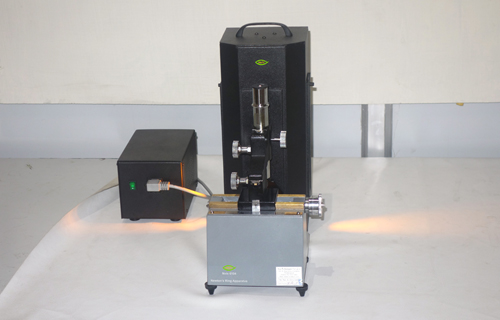
Newton`s Ring apparatus
Nvis 6104
Product Description
Nvis 6104 Newton`s Ring Apparatus is one of the basic experiments at graduation level. With the help of this apparatus, the wave nature of light is confirmed. It is based on the phenomenon of interference of light waves obtained from single coherent (of same frequency and constant or zero phase difference).
The Newton Ring Experiment demonstrates the wave nature of light through optical interference. The Newton’s Ring Experiment Setup is designed to observe and study the characteristic ring pattern produced by interference.
The phenomenon of Newton`s ring, is the result of interference between the partially reflected and partially transmitted rays from both the lower curved surface of planoconvex lens as well as upper surfaces of the glass plate. When viewed with a monochromatic light, it appears as a series of concentric, alternating bright and dark rings centered at the point of contact between the two surfaces. The thickness of the film is radially symmetrical and increases outwards from the point of contact. By studying the ring pattern, we can determine the wavelength of the monochromatic light and also the refractive index of a given transparent liquid medium present in the wedge-shaped film.
The Newton’s Ring Setup allows students to practically observe the formation of concentric interference rings and understand the principles behind the Newton’s Ring Experiment.
Nvis 6104, Newton`s Ring apparatus is an ideal platform to enhance education, training, skills & development amongst our young minds.
Product Features
- A microscope with x-y-z axes movement
- Horizontal measurement scale with fine and coarse movement screw
- Cross wire in the field of view for ring`s diameter measurement
- Newton`s ring assembly consisting of plano-convex lens mounted on an optically plane glass plate
- Adjustable plane glass plate is provided to be inclined at 45� with respect to the vertical plane
- Sodium vapour lamp as the monochromatic (5893�) and broad light source
- Online product tutorial
- Designed for conducting the Newton Ring Experiment
- Complete Newton’s Ring Apparatus for practical laboratory learning
Scope of Learning
- Determination of the Wavelength of sodium light by measuring the diameters of Newton’s rings
- Determination of the Refractive Index of a liquid transparent medium such as water using Newton’s Ring apparatus
- Study of interference patterns using the Newton’s Ring Experiment Setup
- Understanding the formation and measurement of concentric Newton’s rings
- Practical understanding of the wave nature of light through the Newton’s Ring Setup
Why Choose Nvis 6104 Newton’s Ring Apparatus?
Nvis 6104 provides a complete and practical solution for studying light interference and conducting the Newton Ring Experiment in physics laboratories.
- Complete Experimental Setup – Includes essential components required for conducting the Newton’s Ring Experiment.
- Accurate Ring Measurement – Microscope with x-y-z movement and cross wire supports precise measurement of ring diameters.
- Monochromatic Light Source – Sodium vapour lamp provides a suitable monochromatic source for the experiment.
- Easy Practical Learning – Helps students understand interference, wave nature of light, and formation of Newton’s rings.
- Refractive Index Measurement – Enables determination of the refractive index of transparent liquids such as water.
- Wavelength Determination – Allows students to determine the wavelength of sodium light by measuring Newton’s ring diameters.
- Adjustable Optical Components – Adjustable glass plate and fine/coarse movement mechanisms provide convenient experimental alignment.
- Online Tutorial Support – Online product tutorial helps students and instructors understand the experimental procedure.
FAQs
What is the Nvis 6104 Newton’s Ring Apparatus?
The Nvis 6104 Newton’s Ring Apparatus is a physics laboratory setup used to study light interference, determine the wavelength of sodium light, and measure the refractive index of a transparent liquid.
What is the Newton Ring Experiment used for?
The Newton Ring Experiment is used to demonstrate the wave nature of light through interference. It can also help determine the wavelength of monochromatic light and refractive index of a transparent liquid.
What does the Newton’s Ring Apparatus include?
The apparatus includes a microscope with x-y-z movement, measurement scale, cross wire, plano-convex lens, optically plane glass plate, adjustable glass plate, and sodium vapour lamp.
What can students learn from the Newton’s Ring Experiment Setup?
Students can learn about optical interference, formation of concentric bright and dark rings, wavelength measurement, and determination of the refractive index of a transparent liquid.
How does the Newton’s Ring Setup work?
The setup produces interference between reflected light rays from the plano-convex lens and glass plate. This creates concentric bright and dark rings that can be measured using the microscope.
- Request Quote
- Technical Specification