





Head Office
141-A, Electronic complex, Pardesipura,Indore - 452010 India
Phone: +91 73899 00887 , +91 98932 70303
Email:info@nvistech.com
Toll Free
+91 73899 00887
Working Hours
We are happy to meet you during our working hours. Please make an appointment.
- Monday-Saturday: 9:00 AM - 5:30 PM (IST)
- Sunday: Closed
Head Office
141-A, Electronic complex, Pardesipura,Indore - 452010 India
Phone: +91 73899 00887 , +91 98932 70303
Email:info@nvistech.com
Toll Free
+91 73899 00887
We are happy to meet you during our working hours. Please make an appointment.
- Monday-Saturday: 9:00 AM - 5:30 PM (IST)
- Sunday: Closed
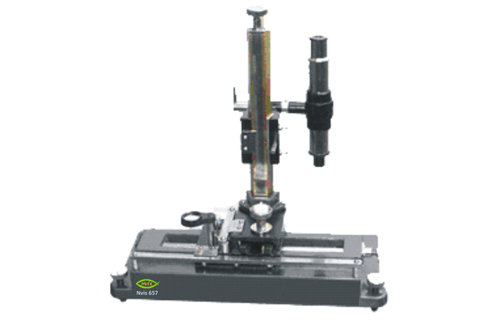
Travelling Microscope
Nvis 657
Product Description
Nvis 657 Travelling Microscope is an extensively used product in Research, Colleges, Schools and Industrial laboratories for accurate measurement of the diameters of different objects. Two slow motion knobs are provided for taking accurate readings and precise travelling microscope reading observations. For placing objects on a horizontal stage, a milky cenolite sheet is provided on the base. The position of the microscope can be varied coarsely by sliding along the rails, or finely by turning the screw. The microscope is focused by rack and pinion, and has achromatic objective of 50mm focal length and eye piece with cross line graticule. The purpose of the travelling microscope is to aim at reference marks with much higher accuracy compared to bare eyes. It is used in labs to measure refractive index of liquids using the geometrical concepts of Ray Optics. It is also used for accurate determination of small variations in liquid levels, the refractive index of liquids as well as in surface tension & diameter of capillary tubes with precision.
Nvis 657, Travelling Microscope is an ideal platform to enhance education, training, skills & development amongst our young minds. The instrument is designed to deliver reliable travelling microscope reading results for educational and laboratory applications.
Product Features
- Wide Aperture Optics
- Accurate and precise arrangement
- Magnifying lens for reading
- Rack and pinion arrangement focusing
- Online product tutorial
- Suitable for accurate travelling microscope reading and measurement applications
Why Choose Nvis 657 Travelling Microscope?
The Nvis 657 Travelling Microscope is designed for students, educators, researchers, and laboratory professionals who require precise optical measurements. Its robust construction, smooth movement mechanism, and high-quality optics ensure reliable performance in academic and industrial environments. The instrument enables accurate travelling microscope reading observations, making it ideal for experiments involving refractive index, surface tension, capillary tube diameter, and liquid level measurements. With easy focusing, precise adjustment controls, and durable design, this travelling microscope offers a dependable solution for achieving consistent and accurate results in laboratory applications.
FAQs
Q. How to Calculate Least Count of Travelling Microscope?
The least count of a travelling microscope is calculated by dividing the value of one main scale division by the total number of vernier scale divisions. This calculation determines the smallest measurement that the instrument can accurately read during experiments.
Q. What is the Least Count of Travelling Microscope?
The least count of a travelling microscope depends on the instrument’s main scale and vernier scale design. Many laboratory models have a least count of 0.01 mm, although this may vary by manufacturer and model, allowing highly precise measurements of small distances, liquid levels, and optical observations.
Q. What is Travelling Microscope?
A travelling microscope is a precision optical instrument used to measure small distances, diameters, liquid levels, and refractive indices with high accuracy. It consists of a microscope mounted on a movable carriage that travels along a graduated scale for precise measurements.
Q. What are the Uses of a Travelling Microscope?
A travelling microscope is commonly used in physics and engineering laboratories for measuring refractive indices, capillary tube diameters, surface tension effects, and small variations in liquid levels. It is also widely used in educational and research experiments requiring accurate optical measurements.
Q. How Do You Take a Travelling Microscope Reading?
To take a travelling microscope reading, align the crosshair with the reference point, note the main scale reading, and then record the corresponding vernier scale reading. Combining these values provides an accurate measurement of the observed object or distance.
- Request Quote
- Technical Specification