







Head Office
141-A, Electronic complex, Pardesipura,Indore - 452010 India
Phone: +91 73899 00887 , +91 98932 70303
Email:info@nvistech.com
Toll Free
+91 73899 00887
Working Hours
We are happy to meet you during our working hours. Please make an appointment.
- Monday-Saturday: 9:00 AM - 5:30 PM (IST)
- Sunday: Closed
Head Office
141-A, Electronic complex, Pardesipura,Indore - 452010 India
Phone: +91 73899 00887 , +91 98932 70303
Email:info@nvistech.com
Toll Free
+91 73899 00887
We are happy to meet you during our working hours. Please make an appointment.
- Monday-Saturday: 9:00 AM - 5:30 PM (IST)
- Sunday: Closed
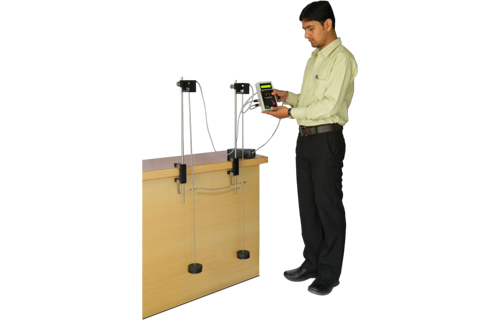
Coupled Oscillator
Nvis 6112
Product Description
Nvis 6112 Coupled Oscillator is a useful apparatus for understanding the basic modes of coupling. This coupled oscillator model uses two pendulums that are coupled through a compression spring, and energy transfer takes place from one pendulum to the other. To make both the pendulums oscillate with the same frequency, they are made identical.
Magnetic Field Sensors are used for accurate measurement of time period and frequency of oscillation. Oscillations are being recorded with the help of interfacing software which facilitates visualization of all the three modes of coupling. This makes the apparatus useful for conducting a coupled oscillator experiment and observing the behavior of coupled oscillations. Time period of oscillations can also be measured manually by counting the number of oscillations and recording time on the provided Data Acquisition Unit.
Nvis 6112, Coupled Oscillator is an ideal platform to enhance education, training, skills & development amongst our young minds. The coupled oscillator model helps students understand the fundamental concepts of coupling, oscillation, energy transfer, and resonance.
Product Features
- Needle pivoting for very less friction
- Two identical pendulums
- Spring coupling
- Oscillations of pendula is recorded on PC
- Online product tutorial
- Suitable for coupled oscillator experiment demonstrations
- Useful for studying cross coupled oscillator concepts
Scope of Learning
- Study two normal modes of Coupled Oscillator and record the oscillations to determine the time period for both the modes (T and T )
- Record the oscillations for Resonance Mode. To determine the Coupled Time Period and Beat Time Period of the oscillation (T and T ), also compare the experimental values of time period with calculated values? This coupled oscillator experiment helps in understanding resonance and beat phenomena.
- To determine Degree of Coupling, Coupling Constant for different coupling lengths and study the variance of both T0 and T with Coupling Constant ? The coupled oscillator model can be used to observe the effect of coupling length.
- To study the transfer of energy between the two pendulums using the coupled oscillator model.
- To observe and analyze the oscillatory behavior of a cross coupled oscillator during different modes of coupling.
- To compare the experimental observations obtained from the coupled oscillator experiment with the theoretical values of time period and coupling constant.
Why Choose a Coupled Oscillator?
Nvis 6112 Coupled Oscillator is designed to provide a practical approach to understanding coupled oscillations, resonance, energy transfer, and different modes of coupling. This coupled oscillator model is suitable for students and learners who want to understand theoretical concepts through hands-on experimentation.
- Practical Learning: Helps students understand the principles of a coupled oscillator through hands-on experiments.
- Accurate Measurements: Magnetic Field Sensors enable accurate measurement of the time period and frequency of oscillations.
- Easy Visualization: Interfacing software allows students to record and visualize oscillations during a coupled oscillator experiment.
- Study Multiple Modes: Supports the study of normal modes, resonance mode, beat time period, and coupled time period.
- Understand Energy Transfer: The coupled oscillator model demonstrates how energy transfers between two coupled pendulums.
- Study Coupling Effects: Allows students to investigate coupling length, degree of coupling, and coupling constant.
- Cross Coupled Oscillator Concepts: Useful for understanding the operating behavior and characteristics associated with a cross coupled oscillator.
- Manual and Software-Based Learning: Oscillation measurements can be performed manually as well as through the interfacing software.
- Suitable for Laboratories: An effective platform for physics and engineering laboratories, education, and practical training.
Frequently Asked Questions
1. What is a Coupled Oscillator?
A coupled oscillator is a system in which two or more oscillating bodies are connected so that energy can transfer between them. The Nvis 6112 coupled oscillator model uses two identical pendulums connected through a compression spring.
2. What is a Coupled Oscillator Experiment?
A coupled oscillator experiment is a practical experiment used to study normal modes, resonance, beat frequency, energy transfer, time periods, and coupling between oscillators. The Nvis 6112 supports several coupled oscillator experiments for laboratory learning.
3. What is a Coupled Oscillator Model?
A coupled oscillator model represents two or more oscillators that interact with each other through a coupling mechanism. In the Nvis 6112 coupled oscillator, two identical pendulums are coupled using a compression spring to demonstrate energy transfer and different modes of oscillation.
4. What is a Cross Coupled Oscillator?
A cross coupled oscillator is an oscillator configuration in which coupling between oscillator elements influences their frequency, phase, or energy transfer. Studying a cross coupled oscillator helps learners understand coupling behavior and oscillator interaction.
5. What Can Be Studied Using a Coupled Oscillator?
A coupled oscillator can be used to study normal modes, resonance mode, coupled time period, beat time period, degree of coupling, coupling constant, and spring constant. A coupled oscillator experiment also allows students to compare experimental and calculated values using the coupled oscillator model.
- Request Quote
- Technical Specification