







Head Office
141-A, Electronic complex, Pardesipura,Indore - 452010 India
Phone: +91 73899 00887 , +91 98932 70303
Email:info@nvistech.com
Toll Free
+91 73899 00887
Working Hours
We are happy to meet you during our working hours. Please make an appointment.
- Monday-Saturday: 9:00 AM - 5:30 PM (IST)
- Sunday: Closed
Head Office
141-A, Electronic complex, Pardesipura,Indore - 452010 India
Phone: +91 73899 00887 , +91 98932 70303
Email:info@nvistech.com
Toll Free
+91 73899 00887
We are happy to meet you during our working hours. Please make an appointment.
- Monday-Saturday: 9:00 AM - 5:30 PM (IST)
- Sunday: Closed
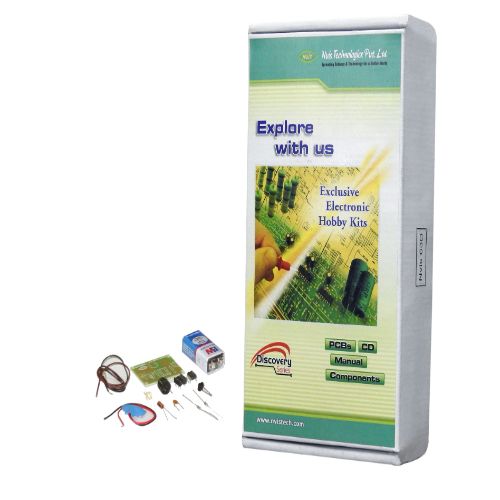
Simple Electronics Bell
Nvis 23D
Product Description
The Simple Electronic bell uses an IC 555 timer that operates in monostable mode. The circuit is powered by a 9V battery source. The use of the timer IC is to set the time for the doorbell to ring. The buzzer is used at output. It rings when we press the switch.
This electronic bell is a simple and practical example of bell electronics for understanding how an electronics bell circuit works. The Nvis 23D can be used to study the basic working principle of electronic bell systems using an IC 555 timer, battery supply, switch, and buzzer.
The Simple Electronic Bell is suitable for learning the basic concepts of electronic bell systems and timer-based circuits. It demonstrates how an electronic bell can produce a ringing sound when the switch is pressed.
Features
- Arrangement for continuous ringing of bell for sometime.
- Simple and easy to perform.
- Descriptive operating manual with procedure.
- Circuit diagram with PCB Layout for better understanding.
- Useful for understanding the working of an electronic bell.
- Helps students learn the basic principles of bell electronics.
- Demonstrates the operation of a simple electronics bell circuit using IC 555 timer.
- Suitable for studying basic electronic bell systems and their components.
Scope of Learning
The Simple Electronic Bell (Nvis 23D) helps learners understand the basic principles of electronic bell circuits, bell electronics, and simple electronic bell systems. Through this setup, learners can gain practical knowledge of:
- Understanding the working principle of an electronic bell.
- Learning how the IC 555 timer works in monostable mode.
- Understanding how a buzzer produces sound in an electronics bell circuit.
- Studying the role of a 9V battery and switch in electronic bell systems.
- Understanding how timing controls the duration of the bell sound.
- Learning the basic circuit arrangement of bell electronics.
- Understanding PCB layout and circuit diagrams used in an electronic bell.
- Developing practical skills in assembling and studying simple electronic bell systems.
Why Choose Nvis 23D Simple Electronic Bell?
The Nvis 23D Simple Electronic Bell provides a practical way to understand electronic bell circuits, bell electronics, and basic electronic bell systems. It is designed for simple operation and hands-on learning.
- Simple Circuit Design: Easy-to-understand circuit for learning basic electronics bell concepts.
- IC 555 Timer Based: Demonstrates the use of an IC 555 timer in monostable mode.
- Practical Learning: Helps learners understand how an electronic bell operates through hands-on experimentation.
- Easy Operation: The bell rings when the switch is pressed, making the working principle easy to observe.
- Clear Circuit Diagram: Includes a circuit diagram with PCB layout for better understanding.
- Continuous Ringing: Provides an arrangement for continuous ringing for a specific duration.
- Learning Support: Comes with a descriptive operating manual and procedure for studying electronic bell systems.
What is an Electronic Bell?
An electronic bell is a circuit that uses electronic components such as an IC 555 timer, switch, and buzzer to produce a ringing sound when the circuit is activated.
How does the Nvis 23D Electronic Bell work?
The Nvis 23D uses an IC 555 timer in monostable mode. When the switch is pressed, the timer activates the buzzer for a set duration, demonstrating a basic electronics bell circuit.
What is the role of the IC 555 timer in this electronics bell?
The IC 555 timer controls the ringing duration of the buzzer. It helps demonstrate how timing circuits are used in electronic bell systems and basic bell electronics applications.
What power source is used in the Nvis 23D?
The Nvis 23D electronic bell operates using a 9V battery source. The battery provides the required power for the IC 555 timer and buzzer in the electronics bell circuit.
What can students learn from this electronic bell system?
Students can learn about electronic bell operation, IC 555 timer circuits, monostable mode, buzzer operation, circuit diagrams, PCB layouts, and the basic working principles of electronic bell systems.
- Request Quote
- Technical Specification