






TL;DR –
- This blog is written for electronics engineers, embedded systems developers, communication engineers, educators, researchers, and industrial professionals who work with high-speed, mixed-signal, and complex electronic systems.
- A digital storage oscilloscope (DSO) enables accurate capture, storage, and analysis of both repetitive and non-repetitive signals, making it essential for modern electronics and engineering.
- The application of digital storage oscilloscopes spans core electronics, embedded systems, power electronics, communication systems, industrial automation, automotive, aerospace, education, and research.
- Key advantages of DSOs include transient event capture, high measurement accuracy, advanced triggering and analysis, multi-channel correlation, and easy data sharing.
- Selecting the right digital storage oscilloscope depends on bandwidth, sampling rate, channels, memory depth, analysis features, and the specific application requirements.
In present-day electronics and engineering, signals are seldom simple, repetitive, or slow. Modern systems,whether embedded controllers, power converters, communication networks, or industrial automation platforms,run fast and produce complex waveforms rich with transients. Understanding these signals is essential for design validation, troubleshooting, optimization, and research. It is at this point that the digital storage oscilloscope (DSO) comes in handy.
A digital storage oscilloscope uses a digital representation of electrical signals, whereas a traditional analog oscilloscope relies on continuous electron beam deflection and does not digitally store waveforms. This digital storage allows engineers to examine signals in detail long after the event has occurred. This capability revolutionized measurement techniques by enabling the capture of non-repetitive events, long-term monitoring, advanced mathematical analysis, and seamless integration with software tools.
Similar Posts
- How Analog and Digital Multimeters Work: Basic Working Principles?
- How practical labs make technical education and skilling industry-driven?
- Preparing Students for In-Demand Jobs in EV and Green Hydrogen Sectors
Understanding the Digital Storage Oscilloscope
A digital storage oscilloscope converts analog signals into digital data using an analog-to-digital converter (ADC), stores the waveform in internal memory, and displays it as a voltage-versus-time graph. The digital waveform data is stored in internal memory, and it is processed by electronics, and shown on a screen as a voltage versus time graph.
Key Characteristics of a Digital Storage Oscilloscope
- Signal Digitization: Incoming analog signals are sampled at high speed and converted into digital form.
- Waveform Storage: Signals can be stored indefinitely, recalled later, or exported for offline analysis.
- Advanced Triggering: Complex trigger conditions allow capture of rare or abnormal events.
- Automated Measurements: Voltage, frequency, rise time, duty cycle, and many other parameters can be calculated automatically.
- Mathematical Processing: FFTs, filters, waveform averaging, and custom math operations are possible.
These capabilities make the digital storage oscilloscope far more than a visualization tool; it is a powerful signal analysis platform.
Why Digital Storage Oscilloscopes Are Essential in Modern Engineering
The challenges in measuring electronic systems have increased alongside advancements in electronic technologies. Mixed-signal designs, high-speed digital logic, and switching power supplies require advanced high-speed measurement instruments. Digital storage oscilloscope applications address several critical measurement needs, including capturing non-repetitive and transient events, analyzing high-frequency and high-speed signals
Application of Digital Storage Oscilloscope in Electronics and Engineering
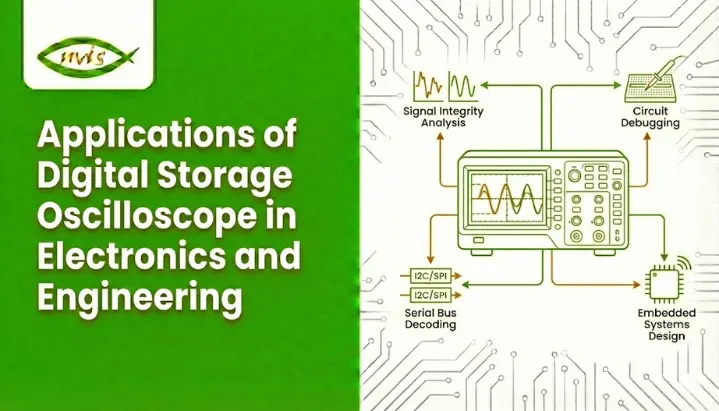
The digital storage oscilloscope is a crucial tool in modern electronics and engineering as it allows proper observation, measurement, and analysis of electrical signals. Its dynamic range of capturing, storing and analyzing repetitive and non-repetitive waveforms makes it essential for tasks ranging from basic circuit testing to advanced system-level debugging. Digital storage oscilloscopes are used across core electronics, embedded systems, power electronics, communication networks, industrial automation, and research, to assist engineers in design validation, fault diagnosis, and performance optimization.
Application of Digital Storage Oscilloscope in Core Electronics
Signal Visualization and Waveform Analysis
An important use of a digital storage oscilloscope is the analysis and display of electrical signals. DSOs assist engineers in monitoring the shape, amplitude, timing and distortion of the waveforms that validate that the circuit is functioning correctly.
Common applications include analyzing sine, square, and pulse waveforms; identifying overshoot, undershoot, and ringing; measuring rise time, fall time, and propagation delay and comparing predicted and real signal behavior. Waveforms are digitally stored and as such engineers can pause, zoom and analyze transient events which are difficult or impossible to observe using analog oscilloscopes.
Debugging Analog Circuits
DSOs are important in troubleshooting analog circuits like amplifiers, filters, oscillators and sensor interfaces. Gain and frequency response are measured, noise and interference are viewed, distortion and clipping are analyzed and filter performance is verified using a digital storage oscilloscope. Time-frequency analysis (TF) can be used in conjunction with time-domain analysis to give an understanding of real-life circuit behavior.
Application of Digital Storage Oscilloscope in Embedded Systems
Embedded systems incorporate microcontrollers, sensors, actuators and communication interfaces into a small design. These systems need a view into both the digital and the analog realms and the digital storage oscilloscope is a necessity in debugging them.
Microcontroller Signal Analysis
Digital storage oscilloscopes are used by engineers to check the existence of clock signals and the stability of oscillators, timing analysis of reset and power-up, the value of GPIO logic and transitions, and glitches or timing errors. The fact that several embedded faults can only be detected during the startup or under unusual circumstances makes the signal-storage option of DSOs very useful.
Digital Communication Protocol Debugging
Contemporary embedded systems are based on serial communications like UART, SPI, I²C, and CAN. Digital storage oscilloscopes used in protocol debugging include signal voltage levels and timing margins verification, bus contention or noise detection, setting up and hold times, and intermittent communication errors capture. Sophisticated DSOs are also able to decode protocol data allowing engineers to correlate electrical waveforms with actual transmitted data.
Application of Digital Storage Oscilloscope in Communication Systems
The communication systems require high signal integrity so that data is sent accurately and reliably. A digital storage oscilloscope is very important in testing, analyzing and optimizing such systems.
Modulation and Signal Integrity Analysis
Engineers apply DSOs when observing modulated waveforms, amplitude, phase, and frequency stability, noise and distortion, jitter, and timing errors. Digital storage oscilloscopes can demonstrate the frequency domain properties that cannot be identified through time domain measurements.
High-Speed Digital Communication
Signal margins are extremely narrow in high-speed serial interfaces, including USB, Ethernet and PCIe. Eye diagrams are generated on digital storage oscilloscopes and jitter and skew are computed, compliance with communication standards is checked, and and signal integrity problems are identified. DSOs have become essential in contemporary communication engineering due to their capability to handle and assess quick signals correctly.
Advantages of Using a Digital Storage Oscilloscope
Digital storage oscilloscopes offer significant advantages compared to conventional measurement tools in many different applications. They enable engineers to analyze signals that would be missed by their capacity to capture and store non-repetitive and transient events. The combination of high measurement accuracy and repeatability provides reliable results, whereas sophisticated triggering and analysis capabilities allow isolating faults with high accuracy.
Moreover, multi-channel correlation will assist in analyzing the complex systems that have interacting signals, and simplified data storage, sharing, and documentation make reporting and collaboration easier.
- Ability to capture and store transient events
- High measurement accuracy and repeatability
- Advanced triggering and analysis capabilities
- Multi-channel correlation
- Easy data sharing and documentation
Selecting the Right Digital Storage Oscilloscope for Your Application
There are a variety of digital storage oscilloscopes available; it is important to note that the choice of this type of oscilloscope depends on what the application is measuring. The main ones are bandwidth and sampling rate required, the number of input channels and adequate memory depth to record long or complex signals. The functionality of triggering options and analysis features must also match the kinds of signals being measured but environmental conditions and budget constraints also have a significant influence.
The knowledge of the purpose of using a digital storage oscilloscope can assist in achieving the best performance of the measurement, reliability and the value of the measurement in general.
Conclusion
A digital storage oscilloscope is considered to be one of the most efficient and universal instruments in electronics and engineering. Its uses are numerous and constantly growing, whether it is a simple observation of the waveforms or a complex protocol decoding and power analysis. Digital storage oscilloscopes are used in education, research, industrial automation, communication systems, power electronics, automotive engineering and aerospace technology.
With increasing speed, size and complexity of systems, the significance of precise signal measurements is increasing. Through the art of using digital storage oscilloscopes, engineers and scientists have the knowledge to design, debug, and optimize the current electronic systems with confidence and accuracy.
FAQs
A digital storage oscilloscope is a test instrument that converts analog signals into digital data, stores them in memory, and displays voltage versus time for detailed analysis that transforms analog signals into digital data, which is then stored in memory and shows voltage versus time to enable the detailed analysis of the signal.
The primary use of a digital storage oscilloscope is the capture, storage and analysis of electrical signals, such as fast, transient, and non-repetitive waveforms found in modern electronic systems.
DSOs are applied in embedded systems to analyze microcontroller signals, check the timing of clocks and reset, debugging the behavior of GPIOs and troubleshooting serial communication protocols such as UART, SPI, and I²C
The digital storage oscilloscopes assist in ensuring the integrity of the signal by analyzing quality of modulation, noise, jitter, eye diagrams, and timing errors of communication interfaces of high speed.
The selection of the optimal DSO varies with the bandwidth requirement, sampling rate, how many channels are needed, how much memory is needed, analysis capabilities, and the application of the electronics or engineering to which it will be used.