




TL;DR
- This blog is primarily for engineering students, automotive technicians, EV researchers, and educators involved in Electric Vehicle Education who want to understand the importance of CAN Bus training in modern vehicle systems.
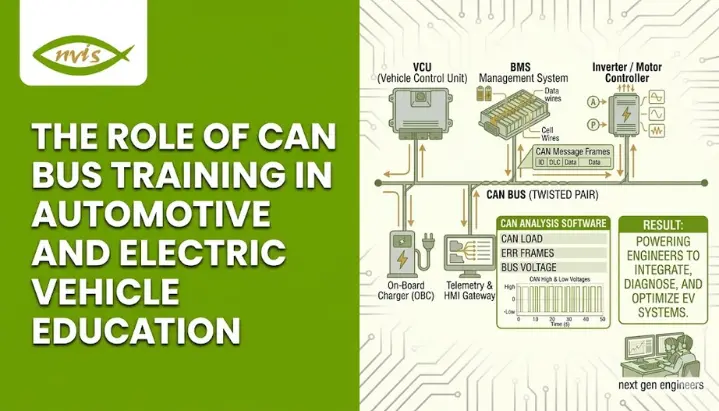
- CAN Bus is a critical communication protocol that allows multiple electronic control units (ECUs) in a vehicle to exchange data efficiently, enabling modern vehicles to operate safely and reliably.
- In EVs, CAN Bus supports essential systems such as battery management, motor control, charging systems, and energy management, making it a fundamental component of Electric Vehicle Education programs.
- Can bus training helps students and professionals develop practical skills in vehicle electronics, diagnostics, embedded systems, and automotive communication networks.
- Growth of Online Learning: The availability of can bus training online allows learners to access flexible, cost-effective training programs with simulations and expert guidance, helping them stay competitive in the evolving automotive and EV industries.
The automobile sector is experiencing one of the greatest technological changes in its history. Modern vehicles are no longer purely mechanical machines powered by engines and basic electronics. Modern vehicles are complex systems that integrate advanced software, sensors, electronic control units (ECUs), communication networks, and intelligent diagnostics. The demand for engineers and technicians with advanced knowledge of electronic and communication systems is increasing rapidly as the electric vehicles (EVs) continue to dominate the global market.
The Controller Area Network (CAN) Bus is one of the most important technologies that enables communication among various vehicle components. It is a communication protocol which enables various electronic control units of a vehicle to communicate effectively and dependably. CAN Bus technology is at the heart of modern automotive systems, used in engine management systems, braking systems, battery monitoring systems, and motor control.
Due to its growing significance, CAN Bus training has become a key element of modern automotive training programs. Colleges, high schools, educators, and engineering schools are progressively integrating the concepts of CAN Bus into their syllabus to educate young engineers on the challenges of the future of the automotive and electric mobility sector.
Meanwhile, the growth of Electric Vehicle Education has further increased the need for CAN Bus knowledge. The automotive industry depends on electronic systems and digital communication networks to control battery operation, motor performance, power distribution, and charging processes in electric vehicles. A lack of proper CAN Bus knowledge makes it difficult for engineers to design, diagnose, and maintain these systems effectively.
Related Blogs
- How to Use a Programmable DC Power Supply Safely in Student Laboratories
- Preparing Future Technicians and Engineers for Smart Energy Management
- What Is a Data Acquisition System and How Does It Work?
Understanding CAN Bus Technology
However, in discussing the significance of can bus training, it is necessary to know what CAN Bus technology is and how it works in the current cars.
The Controller Area Network (CAN) Bus is a powerful communication protocol that was initially devised by Bosch in the 1980s to allow microcontrollers and electronic devices in a vehicle to communicate with one another, and not with a central computer. CAN Bus allows multiple devices to communicate over a shared network instead of relying on complex point-to-point wiring.
In contemporary automobiles, there are dozens of electronic control units that control different functions including engine performance, braking, steering, safety systems, infotainment, climate control, and battery management. These ECUs need to continuously communicate with each other in order to provide efficient and smooth running of the vehicles.
CAN Bus is a dependable means of conveying such information throughout the car network.
To illustrate, when a driver presses the brake pedal, a number of systems should react at the same time.The braking system is activated, the stability control system adjusts wheel pressure, and the engine control unit reduces power. All these necessitate quicker communication among various electronic units and this is enabled by CAN Bus networks.
The key advantages of CAN Bus technology include:
- Reduced wiring complexity
- High-speed data communication
- Reliable and error-resistant messaging
- Real-time system coordination
- Scalable integration of multiple electronic devices
Due to this feature, CAN Bus has emerged as the universal vehicle communication system in the majority of contemporary vehicles.
With the increasing technology that vehicles have, the engineers and technicians should be aware of the operation of CAN Bus networks.This is where CAN Bus training comes in with immense value to automotive training programs.
The Importance of CAN Bus in Modern Automotive Systems
Modern automobiles are highly dependent on electronic systems and digital communication networks. The number of electronic components within vehicles has been growing exponentially over the last 20 years. In present times, an average car can have over 70 electronic control units that interact via networks such as CAN Bus.
These electronic systems control a wide range of vehicle functions, including:
- Engine performance and fuel management
- Anti-lock braking systems (ABS)
- Electronic stability control
- Airbag deployment systems
- Advanced driver assistance systems (ADAS)
- Infotainment and navigation systems
- Climate control
- Transmission management
- Vehicle diagnostics
The coordination of these systems would be a very hard task without an efficient communication network.
CAN Bus also makes sure that every component has the ability to transmit and receive data effectively, and the vehicles can operate effectively and safely. It also enables automotive engineers to make the vehicle architecture simplified and lessen complex wiring harnesses.
In the case of automotive technicians, the knowledge of the CAN Bus communication is necessary in diagnosing vehicle problems. Most of the contemporary vehicle defects do not have anything to do with mechanical faults but rather issues with the communication between electronic modules.
The Role of CAN Bus in Electric Vehicles
Although the CAN Bus technology has extensively been applied in traditional cars, it is more important in electric cars. EVs require the use of digital control systems and advanced electronics in order to regulate the flow of energy, battery safety, and powertrain functioning.
Electric vehicles have some major systems which use CAN Bus communication and they include:
- Battery Management Systems (BMS)
- Motor controllers
- Charging systems
- Thermal management systems
- Inverter systems
- Power distribution modules
All these components continuously share data to ensure efficient and safe vehicle operation. As an illustration, the battery management system should continually check the temperature of the battery, its voltage and whether it is charging.This information is communicated to other vehicle systems via CAN Bus.
Likewise, motor controllers are based on the real-time information provided by other control units and sensors to control power and achieve the best car performance.
Due to such an interdependent structure, CAN Bus expertise is a requirement when engineers operate in the electric vehicle industry.
Consequently, CAN Bus training has become a part of the Electric Vehicle Education program.
Why CAN Bus Training is Essential for Automotive Students
The automotive industry is becoming increasingly software-driven. Mechanical skills that were being taught traditionally are no longer adequate to modern automotive engineers and technicians.
Knowledge of vehicle communication networks has emerged as a major requirement to anyone intending to make a career in the field of automotive technology.
Through structured training programs, students learn how electronic control systems communicate and how engineers design reliable automotive networks.
Practical Understanding of Vehicle Electronics
The CAN Bus training assists the students in leaving the theory behind and gaining the insights about the practical aspects of the automobile systems. Studying the communication protocols, students can get a clue of how the modern vehicles work.
Improved Diagnostic Skills
Most of the new car problems are associated with electronic failure in communication. Diagnostic tools and network analysis techniques can be used by students trained in CAN Bus technology to diagnose these problems much better.
Preparation for Industry Requirements
There are engineers and technicians who are supposed to know vehicle communication networks in automotive companies. CAN Bus knowledge has therefore gained significant importance in the automotive job market.
Integration with Embedded Systems Learning
CAN Bus training also supports learning in embedded systems, microcontrollers as well as automotive software development.
Students who understand communication protocols, can easily design and integrate the electronic systems of vehicles.
Advantages of CAN Bus Training Online
The workings of technical education have been revolutionized in recent years through digital learning platforms. Nowadays, students and professionals are able to receive high-quality training programs wherever they are in the world.
Online training in can bus has facilitated the acquisition of special skills in the automobile communication systems by individuals.
The main advantages of the online CAN Bus training are:
Flexible Learning
The online courses enable students to study at their own speed. This is particularly useful to working professionals who do not want to move out of the job to upgrade their skills.
Access to Global Expertise
Training materials are available on online platforms created by industry professionals, engineers of automobiles, and scholars.
Simulation-Based Learning
Various training courses on line provide simulation tools that enable the students to practice with virtual CAN Bus networks. These simulations enable the learners to learn about the transmission of a message, the behavior of a network and the diagnostic methodology.
Cost-Effective Education
The online training programs can be cheap compared to the traditional classroom training and offer useful technical knowledge.
Due to these benefits, CAN Bus training online is becoming a popular choice among engineers, technicians, and students around the globe.
Conclusion
The automotive field is witnessing a new age that is characterized by electrification, connectivity and smart car systems. In such a fast changing environment, the electronic communication networks are now a fundamental part of modern vehicle design.
The Controller Area Network (CAN) Bus is one of the most significant communication protocols applied in car systems.
CAN Bus is used in engine management, braking systems, battery monitoring, and motor control in electric vehicles to provide an efficient way to communicate in-car components.
Due to its vitality, can bus training has become a necessary component in contemporary automotive training. It equips students and technicians with ideas on how to grasp vehicle electronics, troubleshoot communication problems and develop sophisticated automotive systems.
Simultaneously, the growth of the Electric Vehicle Education programs has also augmented the need of the CAN Bus expertise. Electric cars are strongly dependent on the digital communication, thus the knowledge of CAN bus is inevitable among the EV engineers.
FAQs
CAN Bus ( Controller Area Network) is a communication protocol whereby various electronic control units (ECUs) found in a car can communicate effectively. It also allows systems like braking, engine control, battery control and safety to interact in a seamless way.
CAN Bus training helps students understand the process of communication between the electronics of the vehicle. This is necessary in the diagnosis of system failures, automotive network design and involvement with state of the art vehicles and electric vehicle systems.
CAN Bus is applied in the Electric Vehicle Education to control communication among the major EVs systems like battery management systems (BMS), motor controllers, charging systems, and thermal management units. The knowledge of this technology aids students in getting to know how EV systems are efficient.
There are indeed numerous training facilities that can provide CAN Bus training online, hence students, engineers and technicians have access to learning more about the CAN Bus concepts via virtual laboratories or simulation as well as in practice locations, without needing to step outside their homes.
Having gone through bus training, a person may choose the career of automotive electronics engineer, EV system engineer, embedded systems developer, automotive diagnostic specialist or vehicle network engineer in the automotive and electric vehicle sectors.