







TL;DR –
- This blog is designed for electrical engineering students, power system engineers, trainers, technical institutions, and industry professionals who want to understand load flow and voltage regulation in a ring and radial distribution system.
- Load flow (power flow analysis) determines voltage magnitude, phase angle, active and reactive power flow, and line losses in radial and ring main distribution systems, forming the foundation for efficient network planning and operation.
- A well-designed ring distribution system or radial system must maintain voltage variation within ±5% to ensure stable and reliable power supply to consumers.
- Radial systems are simple and economical but experience higher voltage drops and lower reliability, while ring systems provide bi-directional power flow, reduced losses, better voltage regulation, and improved reliability.
- The Nvis training system enables hands-on analysis and voltage regulation are transforming both radial and ring distribution systems.
The distribution of electric power is the final and most important stage in delivering electricity from generating stations to consumers. While transmission networks carry bulk power over long distances, distribution systems deliver safe, reliable, and quality power to homes, industries, and commercial facilities. The most popular configurations include the ring and radial distribution system, which have several distinct operational features, reliability, and voltage performance.
Electrical engineers, planners, and energy managers should understand load flow and voltage regulation in radial and ring main distribution systems. Effective load flow analysis is essential for proper network operation, and voltage regulation ensures a stable power supply within acceptable limits.
This guide explains the structure, analysis methods, voltage behavior, mathematical modeling, comparison, and modern developments in radial and ring distribution systems.
Related Blogs
- How to Use a Programmable DC Power Supply Safely in Student Laboratories
- Preparing Future Technicians and Engineers for Smart Energy Management
- What Is a Data Acquisition System and How Does It Work?
Load Flow and Voltage Regulation
Two basic performance parameters in any electrical distribution network include load flow and voltage regulation. These parameters are analyzed in ring and radial distribution systems to ensure efficient power delivery, stable voltage levels, and minimal losses. A radial and a ring main distribution system require proper analysis of load flow and voltage regulation in order to ensure quality and reliable provision of power.
What is Load Flow?
Load flow (or power flow) analysis is the systematic study of how electrical power moves through a distribution network. It determines:
- Voltage magnitude at each bus
- Phase angle at each node
- Active power (kW) flow
- Reactive power (kVAR) flow
- Line losses
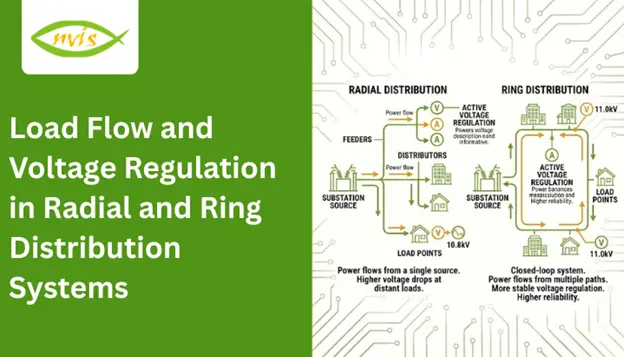
In a ring distribution system, power may flow in multiple directions due to the closed-loop configuration. In contrast, in a radial system, power flows in only one direction from the source to the load.
What is Voltage Regulation?
Voltage regulation measures the change in voltage at the consumer terminal between no-load and full-load conditions.
Voltage Regulation = (V_no-load − V_full-load) / V_full-load × 100%
A well-designed ring and radial distribution system should maintain voltage variation within ±5% of the rated value.
Radial and Ring Main Distribution System
The Radial and Ring Main Distribution System training setup is designed to demonstrate the operating principles of both radial and ring main electrical distribution networks. A distribution system is an essential component of the electric power system, which connects high-voltage transmission networks to low-voltage service points of consumers. These systems should be designed so that voltage variation at consumer terminals does not exceed ±5% of the rated value.
The Nvis training system provides in-depth practical learning support for manually developing and analytically assessing both ring and radial distribution system designs. Structured experiments and comparative studies help learners clearly understand the performance differences between the two systems.
The system consists of a built-in DC variable power supply, including sufficient safety controls and digital metrology. The radial and ring main structures are covered in separate sections where students can study each system step-by-step and understand their operational significance.
Product Features
- Three digital DC voltmeters and three digital DC ammeters for precise measurement
- Dedicated connection panels for both radial and ring main systems
- Built-in DC variable power supply
- Isolation transformer for enhanced operational safety
- Exclusive and ergonomically designed control panel
- Integrated lamp load holders
- Clear diagrammatic representation for easy circuit connections
Comparative View: Load Flow and Voltage Regulation
Parameter | Radial System | Ring Distribution System |
Power Flow | Single direction | Bi-directional |
Voltage Drop | Higher | Lower |
Losses | Higher | Reduced |
Reliability | Lower | Higher |
Complexity | Simple | Moderate |
Load Flow in Distribution Systems
Load flow, or power flow analysis, evaluates the operating condition of a distribution network. In a ring and radial distribution system, it determines:
- Voltage magnitude at each bus
- Phase angle at each bus
- Active power (P) and reactive power (Q) flow
- Line losses
In a radial and ring main distribution system, load flow analysis ensures proper voltage levels, efficient power delivery, and reliable operation. It forms the foundation of effective planning, design, and performance optimization in any ring distribution system.
Load Flow in Ring Distribution System
Power Flow Characteristics
A ring distribution system involves a closed-loop feeder configuration where power flows in both directions toward the load. Unlike the single power path in a radial setup, load current in a ring network is shared between two paths. With current shared between two paths, the current in each section is reduced, resulting in a more uniform voltage drop and lower overall line losses. The multi-path design of a ring distribution system enhances voltage stability and provides a more uniform voltage profile across all load points.
Mathematical Considerations
In a ring distribution system, electrical loops are closed. This means that Kirchhoff Voltage Law (KVL) needs to be met around every loop and loop current analysis is necessary. Ring systems require more complex iterative techniques for analysis, whereas radial systems can often be solved using simpler methods to determine voltage magnitude, phase angle, and power flow. The typical methods are the Newton-Raphson method, Gauss-Seidel method, and modified Forward-Backward Sweep method. These methods help in accurate analysis of load flow within a ring distribution system.
Voltage Regulation in Ring System
Since the current in a ring-type of distribution flows in two directions, the line current in each piece of the feeder is less. This results in reduced I²R losses and lower voltage drop across the network. Consequently, voltage regulation is better than in radial systems. The improved voltage profile and reliability of ring systems make them well suited for urban and industrial distribution networks where voltage stability is critical.
Conclusion
Performance parameters in any distribution network are load flow and voltage regulation which are paramount. Ring and radial distribution systems represent two different design philosophies with distinct operational characteristics.
Radial systems are cheap, easy, and may be applied in sparsely populated regions but have greater voltage drops and reduced reliability.
In contrast, the ring distribution system offers:
- Improved voltage regulation
- Reduced losses
- Better reliability
- Enhanced operational flexibility
The choice between radial and ring main distribution systems depends on cost, load density, reliability requirements, and operational complexity.
With the advent of smart grids and renewable integration, distribution systems are becoming intelligent, adaptive networks capable of maintaining excellent voltage profiles and efficient load flow performance.
FAQs
A ring and radial distribution system refers to two types of power distribution networks. A radial system has a single path from source to load, while a ring system forms a loop that allows power to flow in two directions.
Load flow analysis helps calculate voltage levels, power flow, and line losses in a radial and ring main distribution system, ensuring safe and efficient operation.
Voltage regulation is the change in voltage between no-load and full-load conditions. A good ring distribution system maintains voltage within ±5% of the rated value.
A ring distribution system is more reliable because power can reach the load from two directions, reducing the chance of complete supply failure.
Radial systems are commonly used in rural or low-load areas because they are simple, economical, and easy to maintain.