



• Nvis Technology
  • Nvis Technology
  • Nvis Technology
  • Nvis Technology
  • Nvis Technology
  • Nvis Technology
Nvis Technology

Head Office

141-A, Electronic complex, Pardesipura,Indore - 452010 India

Phone: +91 73899 00887 , +91 98932 70303

Email:info@nvistech.com

Request a Quote

Looking for a quality and affordable builder for your next project?


    Nvis Technology

    Toll Free

    +91 73899 00887

    We are happy to meet you during our working hours. Please make an appointment.

    • Monday-Saturday: 9:00 AM - 5:30 PM (IST)
    • Sunday: Closed

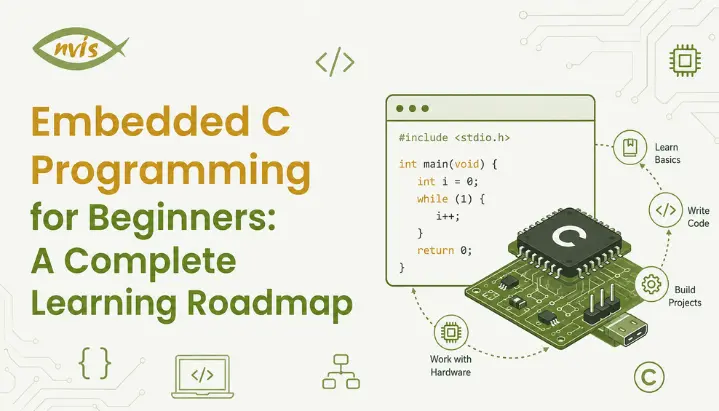
    Embedded C Programming for Beginners: A Complete Learning Roadmap

    TL;DR

    1. This blog is written for all engineering students, freshers who want to understand embedded c programming without getting confused in the scattered tutorials and even for self taught students in India who want a clear path to learn embedded c programming.
    2. Embedded C is not a separate programming language from C. It is C used in an embedded environment, where the program interacts closely with hardware and may run either without an operating system or with an RTOS or embedded operating system.
    3. The best way to learn is to have a step by step progression; learn the basics of the C language, the basics of a microcontroller, do some hands on board work, and learn the basics of real time and communications protocols.
    4. A single worked example to read and write only bits of the hardware illustrates the difference between embedded C and C learned in a classroom.
    5. Embedded C and microcontroller knowledge can be useful for engineering roles in organizations such as ISRO, BEL, BHEL, DRDO, and HAL. However, eligibility and recruitment routes vary by organization, and learning Embedded C alone does not qualify someone for these positions.

    Also read,

    Many electronic devices contain embedded systems, and C remains one of the most widely used languages for embedded firmware. However, embedded devices can also use C++, Rust, assembly, MicroPython, or other languages depending on the hardware and application. Many washing machines, automotive systems, fitness devices, and traffic controllers contain embedded software, and C is widely used for developing firmware for these systems. However, the exact languages and software architectures vary by product and manufacturer. It is one of the most practical and job oriented skills that one should learn during college, especially the ECE,EEE and CSE students.

    This guide offers a complete course roadmap for getting started with embedded systems programming, from the basics of embedded C programming to fundamental embedded systems concepts and a realistic course you can use, month by month. You will learn the difference between C programming on an embedded system and the desktop, complete a real numerical example using hardware registers, and the scope of this skill in the GATE and PSU exams and the job market in India.

    What Is Embedded C Programming?

    Consider this: If you had to write an application for your laptop, how would you do it? If you had to write software in a microwave oven, how would you do that? The laptop has an operating system, gigabytes of RAM and a screen to display error messages. A microwave doesn’t have that. It contains a very small processor, a few kilobytes of memory and one thing – to read your button presses, run the timer and control the heating element.

    Embedded C generally refers to using the C language to develop software for embedded systems. The language syntax is largely the same, but embedded development involves hardware-specific constraints, peripherals, memory limitations, timing requirements, and toolchains. Many beginner microcontroller projects run without a full operating system, while more complex embedded systems may use an RTOS or embedded Linux. In many bare-metal microcontroller applications, the firmware starts during system initialization and then continues running through a main loop or scheduled tasks until the system is reset or powered down.

    That is the reason that the question “what is embedded C programming” is recurring among the students. This seems like a whole new language, but it’s nothing more than C syntax in a very different context. You continue to write conditions, loops and functions. What changes is what those instructions interact with: memory-mapped registers, timers, GPIO pins, communication peripherals, and other hardware instead of desktop files and windows.

    Why C Remains Widely Used in Embedded Systems

    Now new languages such as Rust and MicroPython have moved into the embedded arena, but C programming for embedded systems has remained the most prevalent for one reason: It provides relatively low-level control over memory and hardware while offering better readability and portability than assembly in many embedded development environments.

    C can be compiled into relatively efficient machine code with predictable resource usage when the compiler, target architecture, and implementation are well understood. No garbage collector stops your program at any time on a random day, which is important when the airbag controller for the car has to respond in milliseconds. C allows you to control individual bits and memory addresses directly, which is not possible in most higher level languages or is awkward.

    E.g., most microcontroller vendors, such as STMicroelectronics, Microchip, Texas Instruments or Espressif, provide their hardware libraries in C. If you have some experience programming in embedded C, you can download documentation and sample programs from virtually all of the chip manufacturers and get to work. This portability is one major reason why Embedded C programming remains an important skill for many embedded-systems jobs in Indian companies ranging from automotive suppliers at Pune to defence electronics companies at Bengaluru.

    Embedded C vs Regular C: What Actually Changes

    One of the questions that comes to mind is whether a new syntax for embedded work is necessary. They do not change: keywords, loops, and functions remain unchanged. What shifts are there in the environment your code executes in and some habits to be developed.

    If you allocate memory with malloc() and do not call free(), that allocation remains unavailable to your process until it is released or the process terminates. On systems with an operating system, the OS normally reclaims the process’s memory when the process exits. On a small microcontroller, however, repeated allocations and leaks can exhaust limited RAM and cause failures. On a microcontroller with limited RAM, repeated allocations and memory leaks can eventually exhaust available memory and cause unpredictable behavior or failure. When you are given the opportunity to write C programs in an embedded system, you are going to be encouraged to use static memory allocation, which occurs when you know what memory each variable will require when you write the program.

    The other change is the volatile keywords. Typically, compilers in normal C optimize your code, and may even put a variable into a CPU register rather than re-reading it from memory each time. That optimization is great for regular software, but if it’s in an embedded program that reads hardware registers, those registers might change without your program knowing it, perhaps because of a timer or trigger, and then the program will fail. When you declare an object as volatile, you tell the compiler that its value may change for reasons outside the normal flow of the program, so accesses to it must not be optimized away or freely cached.

    Data types are often chosen more deliberately in embedded development. Fixed-width types such as uint8_t, uint16_t, and uint32_t make the intended integer width explicit, which is useful when working with hardware registers and communication protocols, since the size of a variable is important when it is being directly mapped to a hardware register.

    AspectRegular C (Desktop)Embedded C (Microcontroller)
    Operating systemFull OS manages memory and filesOften no OS, or a lightweight RTOS
    Memory allocationDynamic (malloc/free) commonly usedMostly static, memory is tightly budgeted
    Data typesint, float used looselyuint8_t, uint16_t, uint32_t for precision
    Hardware accessThrough OS drivers and APIsDirect access via memory mapped registers
    Program lifecycleStarts, runs, and exitsStarts once, runs forever in a loop
    DebuggingPrint statements, IDE debuggersJTAG/SWD debuggers, serial UART output

    Core C Concepts You Must Master Before Touching Hardware

    Before opening a microcontroller datasheet, get comfortable with these fundamentals in plain C on your laptop. Skipping this step is the single biggest reason beginners get stuck later.

    Data Types and Bitwise Operators

    Start with fixed width integer types and get fluent in bitwise operators: AND (&), OR (|), XOR (^), NOT (~), and shift operators (<< and >>). Almost every hardware interaction in embedded systems comes down to setting, clearing, or checking individual bits inside a register, so this is not optional groundwork. It is an actual skill you will use daily.

    Pointers and Memory Addresses

    A pointer is simply a variable that stores a memory address instead of a value. On a desktop, pointers feel abstract. In embedded C programming, they become very concrete, because a microcontroller’s peripherals are often controlled through memory-mapped registers located at specific addresses, which software can access through pointers or vendor-provided register definitions.

    Control Flow and State Machines

    If, else, for, while, and switch statements form the backbone of embedded logic. Most embedded programs are structured as state machines, a device that is always in one specific state (idle, reading a sensor, transmitting data, error) and moves between states based on conditions. Getting comfortable designing simple state machines on paper before you code them will save hours of confused debugging later.

    Structures and Function Pointers

    Structures let you group related data together, which becomes essential once you start managing multiple sensors, timers, and communication buffers in a single project. Function pointers, while intimidating at first, are how many embedded frameworks implement interrupt handlers and callback based designs.

    A Worked Example: Reading and Setting Hardware Registers

    Here is where embedded C programming stops being theoretical. For illustration, imagine a microcontroller whose GPIO port has an 8-bit register called PORTB, where each bit controls one physical pin (Pin 0 through Pin 7). Suppose Pin 3 connects to an LED, and you want to turn it on without disturbing any other pin.

    register currently holds binary value 0000 0000 (all pins off). To turn on only Pin 3, you need to set bit 3 to 1 while leaving every other bit untouched. This is done with a bitwise OR operation combined with a left shift:

    PORTB = PORTB | (1 << 3);


    Let us work through math step by step, way you would for a GATE or exam style question:

    1. 1 << 3 shifts binary value 0000 0001 left by 3 positions, producing 0000 1000 (decimal value 8).
    2. PORTB | 0000 1000 performs a bitwise OR between current register value (0000 0000) and 0000 1000.
    3. OR ing any bit with 0 keeps it unchanged, and OR ing with 1 forces it to 1. Since only bit 3 of our mask is 1, only bit 3 of PORTB changes.
    4. The result is 0000 1000, meaning bit 3 is now high. If the LED is wired as an active-high output, this would turn the LED on.

    Now suppose you want to turn Pin 3 off again without affecting other pins. You use a bitwise AND with an inverted mask:

    PORTB = PORTB & ~(1 << 3);


    ~(1 << 3) inverts 0000 1000 into 1111 0111. AND ing PORTB with this mask forces bit 3 to 0 while leaving every other bit unchanged, because AND ing with 1 preserves a bit’s value and AND ing with 0 clears it.

    This single pattern, set a bit with OR and a left shift, clear a bit with AND and an inverted mask, is used constantly across GPIO control, timer configuration, and interrupt handling in real embedded C programming projects. If you understand this one example fully, you have understood a meaningful chunk of what makes embedded C programming distinct from application level C.

    Your Learning Roadmap: From Zero to First Project

    Trying to learn everything at once is what causes most beginners to give up. Here is a realistic, phased embedded systems course roadmap you can follow, whether you are doing this alongside college classes or during a semester break.

    Phase 1: Solidify Core C (2 to 3 weeks)

    Work through data types, operators, control flow, functions, arrays, and pointers using any free online compiler. No hardware needed yet. Write small programs that manipulate bits manually, since this directly prepares you for register level work later.

    Phase 2: Understand Microcontroller Basics (2 weeks)

    Learn what a microcontroller actually is: a CPU, RAM, flash memory, and I/O peripherals on a single chip. Study the difference between a microcontroller and a microprocessor, understand what GPIO, ADC, timers, and interrupts are conceptually, and read through one datasheet end to end, even if large portions feel confusing at first.

    Phase 3: Get Hands On With a Development Board (3 to 4 weeks)

    Start with an affordable development board such as an Arduino Uno, an STM32-based board, or an ESP32, depending on whether your goal is basic microcontroller learning, register-level development, or connected/IoT projects.Install toolchain (compiler, IDE, and programmer), write your first blink program, and then modify it: change timing, add a second LED, read a push button. The goal here is comfort with a full compile flash test cycle, not complex projects.

    Phase 4: Learn Communication Protocols (3 to 4 weeks)

    Move into UART, I2C, and SPI, three protocols that let your microcontroller talk to sensors, displays, and other chips. Interface a temperature sensor or an OLED display. This is also a good point to start reading interrupt driven code instead of only polling based code.

    Phase 5: Real Time Concepts and a Capstone Project (4 to 6 weeks)

    Get introduced to RTOS basics (FreeRTOS is a widely used and approachable RTOS for learning embedded real-time concepts), understand task scheduling and why timing guarantees matter, then build one complete project end to end, something like a temperature logging system, a simple home automation switch, or a line following robot. A capstone project is what actually shows up well on a resume or in a GATE/PSU interview.

    Embedded C in Indian Engineering Ecosystem

    India’s embedded systems industry has entered a genuine growth phase, and it is worth understanding where this skill actually leads before you invest months into learning it.

    India’s semiconductor and electronics initiatives, including PLI schemes and government-supported manufacturing and design programs, are supporting growth in the country’s electronics ecosystem and may create additional opportunities for embedded and firmware engineers. Government backed fabrication units and design centers are creating fresh demand for engineers who can write firmware, not just design circuits on paper.

    For students specifically, the Centre for Development of Advanced Computing (C DAC) runs PG DESD program, a Postgraduate Diploma in Embedded Systems Design, which is a well-known structured training pathway for embedded-systems development in India. Admission is generally based on the C-CAT process and the eligibility and admission rules specified for the relevant admission cycle, and the curriculum covers embedded C, microcontroller and microprocessor based design, device drivers, and RTOS work in depth. For many ECE and CSE graduates without a strong existing embedded background, this diploma can provide a structured pathway into embedded-systems training and may be useful for graduates who want to build practical skills.

    Organizations such as ISRO, BEL, BHEL, DRDO laboratories, and HAL recruit engineers for a range of electronics, software, control, avionics, and embedded-related roles. The technical requirements and recruitment routes vary by organization and position, particularly for avionics, defense electronics, and industrial control systems. Many of these PSU recruitment drives use GATE scores as a shortlisting criterion, which is why embedded systems knowledge indirectly supports your GATE preparation even though it is not a dedicated GATE paper topic itself.

    Exam Relevance: GATE, SSC JE, and RRB JE

    Students preparing for competitive exams often ask where embedded systems fit into the syllabus. An honest answer is nuanced, so it helps to understand it clearly rather than guess.

    GATE ECE does not have a standalone section titled ‘Embedded Systems.’ Embedded-system topics may overlap with areas such as Digital Circuits, Microprocessors, and related electronics fundamentals included in the official syllabus: Engineering Mathematics, Networks, Signals and Systems, Electronic Devices, Analog Circuits, Digital Circuits, Control Systems, and Communications. Embedded C and microcontroller knowledge can reinforce some digital-electronics concepts, particularly binary representation, registers, memory organization, and bit manipulation. However, these skills should not be treated as a substitute for studying the Digital Circuits topics in the official GATE syllabus. It also indirectly supports interview rounds after GATE, since many PSU interviews probe practical microcontroller knowledge even when the written exam does not test it directly.

    For exams such as SSC JE and RRB JE, the relevance of microprocessors, microcontrollers, and embedded concepts depends on the specific post and the current official syllabus. Candidates should check the latest notification and syllabus before treating these topics as exam priorities within their electronics and instrumentation sections. If you are preparing for either exam, working through core C and microcontroller basics can complement exam preparation, but candidates should prioritize topics according to the current official syllabus.

    Career Paths and Salary Expectations in India

    Once you have a working grasp of embedded C programming, several career directions open up, and it helps to know roughly what each pays so you can set realistic expectations as a fresher.

    Entry-level embedded software and firmware salaries in India vary widely based on employer, location, degree, technical skills, and project experience. A specific salary range should be treated as an approximate market estimate rather than a guaranteed outcome for freshers with basic microcontroller and embedded C skills. Candidates with stronger skills in RTOS, communication protocols such as I2C, SPI, and CAN, and relevant project experience may qualify for higher-paying entry-level or early-career roles, but compensation varies significantly by employer, location, and candidate profile even at fresher to early career stage. Engineers who combine embedded fundamentals with AI on edge device skills or automotive grade experience can command noticeably higher packages, and mid level embedded engineers with 3 to 6 years of experience commonly earn between 12 and 25 LPA, particularly in semiconductor and automotive firms.

    Typical entry points include Embedded Software Engineer, Firmware Developer, Embedded Systems Design Engineer, and IoT Developer. Sectors actively hiring include automotive electronics (a lot of this work is now EV related, given India’s push toward electric mobility), industrial automation, consumer electronics, defense and aerospace through PSUs, and medical device manufacturing, which is also supported by India’s broader efforts to strengthen domestic electronics and medical-device manufacturing.

    Common Mistakes Beginners Make

    A few patterns show up again and again among students starting out, and knowing them in advance can save you real frustration.

    Jumping straight to a development board before core C is solid is the most common one. Bit manipulation and pointer logic feel far harder to debug when you are simultaneously fighting unfamiliar hardware errors. Another frequent mistake is ignoring volatile keywords until a program behaves unpredictably, at which point tracking down bugs takes hours instead of two minutes it would have taken to understand the concept upfront. Beginners also tend to avoid reading datasheets, treating them as intimidating reference documents rather than actual instruction manuals for the chip they are programming, which slows down every project that follows.

    Conclusion

    Embedded C programming rewards patience over speed. It is the same C language you may already know, but applied with greater attention to memory, timing, and hardware interaction. The roadmap above core C, microcontroller basics, hands-on board work, communication protocols, and real-time concepts provides a realistic learning path rather than a scattered pile of tutorials. In India specifically, this skill connects to genuine opportunity: PSU recruitment through GATE, well recognized C DAC PG DESD diploma, and a job market that is expanding fast on the back of PLI driven semiconductor and EV push. Start with Phase 1 this week, pick one free C compiler, and work through bitwise operators until the register example in this guide feels obvious rather than confusing. That single shift in understanding is what separates students who stall out from those who go on to build real embedded projects.

    FAQs

    Embedded C programming is standard C syntax used to write software for microcontrollers instead of desktop computers. The language itself does not fundamentally change, but the environment does: there is usually no operating system, memory is tightly limited, and code interacts directly with hardware registers instead of OS provided APIs.

    No, not initially. Spend your first two to three weeks mastering core C concepts, especially bitwise operators and pointers, using any free online compiler. A development board like an Arduino Uno or STM32 Blue Pill becomes useful once you are ready for Phase 3 of the roadmap.

    Arduino Uno is an accessible starting point for basic microcontroller concepts. An STM32-based board can provide earlier exposure to MCU peripherals, vendor toolchains, and register-level development, while an ESP32 is useful when wireless connectivity is also part of the learning goal, both of which are closer to what Indian embedded companies actually use.

    GATE ECE does not have a standalone embedded systems paper, but microcontroller and register-level knowledge can reinforce related concepts, but preparation should follow the current official GATE syllabus and often comes up in PSU interview rounds after GATE shortlisting.

    Fresher embedded software or firmware roles typically start between 3 and 6 LPA. Adding RTOS knowledge, communication protocol experience (I2C, SPI, CAN), or IoT project work can push that range toward 6 to 12 LPA even at early career stages.

    For engineering graduates who want structured, hardware and software balanced training with strong industry recognition in India, C DAC’s PG DESD program is one of most respected paths into the embedded systems field, though it requires clearing C CAT entrance test first.


    Tags: Embedded C Programming, what is embedded c programming

    Why Embedded Systems Labs are essential for future-ready engineers

    In today’s technology-driven world, Electronics power almost every device; from the refrigerator in your kitchen to the automated production lines in modern factories. What makes these machines “smart” is the Embedded Systems, a specialized combination of hardware and software designed to perform dedicated functions efficiently.

    Far from being niche, Embedded Systems are everywhere; running the firmware in household appliances, enabling real-time control in industrial automation, and powering IoT devices that connect our homes, workplaces, and cities. As industries continue to evolve towards smarter, more connected solutions, engineers with Embedded Systems expertise are becoming one of the most sought-after talent pools in the job market.

    Where Embedded Systems show their power: Industry applications


    Embedded Systems are the invisible engines that drive countless technologies, including:

    • Domestic appliances like washing machines, refrigerators, and microwave ovens
    • Industrial automation systems for manufacturing, process control, and energy management
    • Smart meters and sensors in infrastructure and utilities
    • Connected devices in IoT networks, from wearable gadgets to autonomous equipment


    In each case, Embedded Systems work silently in the background by controlling operations through programmed firmware while delivering functionality through user-facing software. 


    Yet despite their widespread presence, many students encounter Embedded Systems only in theory during their academic years.

    The missing link in technical education: Practical skills


    Many Electronics and Computer Science students learn the theory of microcontrollers, sensors, and firmware, but succeeding in the industry requires more than classroom lectures. Companies seek graduates who can confidently move from concept to prototype who can debug, optimize, and innovate in real-world scenarios. Without hands-on learning, students can struggle to meet these expectations.

    Companies need professionals who are confident in:

    • Programming devices for specific applications
    • Working with development platforms and firmware
    • Interfacing hardware and software effectively


    Practical training allows students to move from simply knowing about Embedded Systems to actually
    using them by coding, testing, and getting familiar with real devices such as microcontroller boards, and development tools. This hands-on training is critical to bridge the gap between academic knowledge and job readiness.


    How an Embedded Systems lab bridges the gap


    An Embedded Systems lab offers students the opportunity to experiment, test, and build projects that mimic industry challenges. It transforms passive learning into active problem-solving, enabling them to:

    • Gain experience in coding and programming hardware
    • Understand firmware and how it connects with application software
    • Explore real-world applications in smart devices, industrial IoT, and automation
    • Practice troubleshooting and optimizing embedded solutions


    Students trained in such labs have a distinct advantage. They combine
    digital electronics skills with practical programming skills, making them versatile and industry-ready. In contrast, graduates with only theoretical Electronics or standalone programming knowledge often lack the integration skills employers need.

    Government push for Electronics 


    The Government of India is actively promoting initiatives such as the Production Linked Incentive (PLI) scheme for large-scale Electronics, such as the Electronics Component Manufacturing Scheme. These initiatives aim to boost domestic production, encourage investments, and strengthen India’s position as a global hub for Electronics Design and Manufacturing.

    Empowering institutions to build future-ready talent


    Technology is evolving rapidly, with smart and connected devices becoming an integral part of our daily lives. For students, this means learning how to make devices intelligent, not just understanding the circuits but also knowing how to program them to perform specific tasks.


    For students in
    Electronics, Instrumentation, and Electrical Engineering, as well as those pursuing ITI, polytechnic and skill development programs, Embedded Systems are already part of the curriculum. Even Computer Science graduates can benefit from understanding Embedded Systems especially in emerging areas like IoT, where programming knowledge combined with device-level expertise is highly valued by employers.


    India’s vocational training landscape is responding to this need. Electronics is gaining prominence in ITI curriculum, particularly under the Electronics Mechanic trade, where students receive both theory and practical training in Hardware, Semiconductors, Basic Microcontrollers, Soldering and more.


    By integrating an
    Embedded Systems lab, colleges and training institutions establish themselves as hubs for industry-ready talent. Nvis Technologies supports this transformation with its Embedded Systems Solutions for education. Arduino-compatible development boards feature USB bootloaders and onboard ADCs. Similarly, STM32 and Espressif chips such as the ESP32 support OTA updates and integrate NRF ICs for BLE functionality. ARM7-based modular platforms are also available, offering LCD displays, joysticks, and RTOS support. These tools are designed for interactive, project-based learning, ensuring that students do not just learn the “what” of Embedded Systems, but they also master the “how.”


    For educational leaders, the choice is clear: preparing students for tomorrow’s jobs starts with giving them the tools to create, innovate, and lead today. An Embedded Systems Solutions is more than just a facility; it is an investment in your institution and your students’ success in a rapidly evolving tech world.

    Tags: Electronics Education, Embedded Systems, Hands-on Labs, Industry-ready Engineers, IoT Training, Skill Development

    How practical labs make technical education and skilling industry-driven

    School education in India is rapidly changing, and for the better. With the National Education Policy (NEP) 2020 encouraging the integration of vocational education from Class 6 onwards, there’s a growing push to make learning more relevant, experiential, and aligned with real-world careers.

    This shift becomes especially significant at the secondary and higher secondary levels (Classes 9 to 12), where students begin to consolidate their learning and explore future career paths.

    Among the many enablers of this transition, practical labs stand out as a critical tool to bridge the gap between classroom knowledge and industry application.

    The need for industry participation in school education

    While curriculum reforms have laid the foundation, implementation requires strong industry-academia collaboration. Without industry support, it becomes challenging for schools to:

    • Keep up with rapidly evolving technologies
    • Provide access to modern training tools
    • Deliver relevant and experiential learning


    As students’ progress into higher grades, vocational learning evolves from basic exposure to
    specialization and application. The National Curriculum Framework for School Education (NCF 2023) reinforces this, stating that in the secondary stage, learners should gain competencies through:

    • Work with machines and materials
    • Work in human services
    • Work with life forms


    “In the Secondary Stage, the first two years would work towards consolidating capacities to develop transferable skills that serve students well in any vocation. In the last two years, students will be given opportunities to specialize in specific vocations of their choice.” –
    National Curriculum Framework for School education (2023)


    Clearly,
    vocational education cannot be limited to textbooks or classroom lectures. To deliver what the policy envisions, schools need labs, tools, trained teachers, and real-life exposure, all of which require close collaboration with industry partners.

    Why do schools need practical labs now more than ever?


    The NEP 2020 envisions a system where every student is introduced to at least one skill during middle school. This early exposure aims to:

    • Build awareness about various career options
    • Sensitize students to the world of work
    • Promote dignity of labour and appreciation for hands-on skills


    Subjects like
    Electronics, Robotics, Artificial Intelligence, IT/ITeS, Healthcare, and Beauty and Wellness, as offered by CBSE, demand not just theoretical knowledge but practical exposure that simulates real-world scenarios.


    Explore the full list of CBSE skill subjects here: CBSE Skill Education Curriculum

    But to make these subjects effective, practical exposure, a key element is still missing in many schools.


    The need for practical labs


    As vocational education becomes an integral part of school curriculum, especially in subjects like Electronics, Robotics, AI, and IT/ITeS; schools face a critical challenge: How do we move from theory to application?


    The answer lies in setting up well-equipped practical labs that bring concepts to life and create real-world learning experiences. Such labs:


    • Enable students to interact with devices, sensors, and systems
    • Provide space to experiment, build, and test
    • Cultivate problem-solving, creativity, and hands-on skills
    • Align learning with the expectations of modern industry


    Without this practical exposure, even the most thoughtfully designed curriculum falls short of its potential.


    To address this, Composite Skill Labs, mandated by CBSE offer a powerful and scalable solution for schools aiming to implement skill-based education effectively. These integrated labs combine multi-skill training setups with curriculum alignment, teacher training, and modular infrastructure.


    Also read: Is your school ready for Composite Skill Labs? Here’s how we can help

    How industry can help with practical labs


    To bring vocational education to life, schools need more than curriculum, they need support from industry to create hands-on, future-ready learning environments.


    Here’s how the industry can make a difference:

    • Provide modular lab infrastructure that aligns with school-level vocational subjects
    • Support teacher training for operating and maintaining technical labs
    • Enable workshops and mentoring to expose students to real-world practices
    • Ensure relevance by keeping labs aligned with current and emerging technologies
    • Facilitate exposure through projects, demos, or guided activities linked to careers


    Practical training solutions from Nvis Technologies reflect this approach by offering integrated, plug-and-play lab setups that support multiple skill domains with ease of implementation. With the right partnerships, schools can bridge the gap between theoretical learning and industry-driven training.

    How Nvis brings future technologies into today’s school ecosystem


    To take this vision forward, Nvis School Labs Solutions brings future technologies into today’s school experience through tailored lab solutions.


    Nvis School Labs Solutions provides cutting-edge laboratory equipment and educational training platforms to enhance hands-on learning in science and technology. These solutions cater to a wide range of subjects, including Physics, Mathematics, Electronics, Electrical, IoT, AI & ML, Coding, Drone, Robotics, 3D Printing, AR-VR, TLM and FLN. Each product is crafted to align with curriculum standards and foster a deeper understanding of scientific principles.


    Focusing on innovation and quality, the labs supports schools in creating interactive and effective learning environments. Nvis’s comprehensive support and training ensure that educators and students maximize the potential of each lab setup.

    Building future-ready schools through practical learning


    By implementing such solutions, schools can transform from traditional institutions to centres of applied learning that prepare students not only for higher education but also for entrepreneurship and employment.


    As schools move towards implementing the vision of NEP 2020 and adopting the recommendations of NCF, practical labs are no longer optional. They are essential to ensure that technical education is not just about content but about competence. By setting up industry-aligned labs and embracing hands-on learning, schools empower their students with real skills for real futures.

    Tags: 21st Century Skills, Composite Skill Labs, Future-Ready Classrooms, NEP 2020 Implementation, Nvis Skill Labs, Practical Labs for Schools, School-Industry Collaboration, Skill Education in CBSE Schools, Vocational Training in Schools

    Getting Started with Introducing Skill Education in CBSE Schools

    The National Education Policy (NEP) has ushered in a pivotal shift in how we view education—away from rote learning and towards applied, holistic, and future-ready learning. Among its boldest mandates is the integration of skill-based subjects in CBSE schools, right from the middle school.

    This policy decision could soon become a turning point in the evolution of schools in India! As CBSE pushes for concrete compliance, schools find themselves racing against time—to choose the right skill subjects, to prepare the right infrastructure, and to deliver outcomes that matter.

    The question is no longer if you should introduce skill subjects. It’s how soon and how well.

    Why skill subjects can no longer wait

    Skill subjects are not just electives or value-adds, they could anchor a future-ready curriculum. They promote 21st-century competencies like critical thinking, problem-solving, communication, and collaboration. But most importantly, they map directly to emerging career pathways.

    With industries becoming skill-driven and digital creating new jobs every year, students need exposure, not just theoretical information. By introducing skill subjects early, schools give students a head start in aligning education with employability.

    Understanding the CBSE landscape: What’s on the table?

    CBSE currently offers 18 skill subjects at the Secondary level and 38 skill subjects at the Senior Secondary level, ranging from IT and Artificial Intelligence to Beauty & Wellness, Financial Literacy, Marketing, Data Science, and Electronics & Hardware.

    For school leaders, the decision-making process can feel overwhelming:

    • Which subject fits our context?
    • What’s feasible to implement?
    • Will we find the right faculty?
    • What infrastructure is needed?
    • What are students truly interested in?

    This is where a structured, consultative approach becomes vital.

    How to strategically introduce skill subjects in CBSE classrooms


    Introducing skill subjects in your curriculum is not merely a policy compliance exercise—it’s a strategic investment in your institution’s future relevance. Here’s a leadership-aligned framework to approach this transformation deliberately and sustainably:


    1. Start with institutional readiness


    Before shortlisting subjects, few critical points can be considered:


    • Does your current infrastructure support technical or hands-on learning?
    • Are your labs adaptable or upgradeable?
    • More importantly, do you have—or can you source—faculty who are not just qualified, but industry-aligned?


    This self-audit forms the foundation for responsible subject selection.

    2. Align with emerging career pathways

    Skill education should anticipate trends by closely following the industry and job markets.

    Look at where industries are headed: AI, Automation, Electronics, Robotics, Data Handling, Renewable Energy. Choose subjects that connect learners to the jobs of tomorrow, not yesterday.

    For instance, introducing Artificial Intelligence, Electronics & Hardware, or IT at the school level opens early exposure to fast-growing sectors, preparing students to be not just eligible—but employable.

    3. Prioritize student interest and engagement

    Besides, policy and infrastructure, true success of introducing skill courses depends on the students’ interest and how it aligns with their career dreams.

    Hence, it’s meaningful to engage learners early—through surveys, orientation sessions, career talks, or introductory modules. Let them explore. Their curiosity will often reveal which skills resonate most deeply.


    It’s often observed, subjects selected by choice, not by force, will yield the most meaningful outcomes.

    4. Plan for a phased, adaptive rollout


    There’s no one-size-fits-all formula. Start small—perhaps with one subject across a couple of grades. Measure response, assess outcomes, and adjust accordingly.


    Think of it as a journey to be mapped. A staggered rollout allows for curriculum refinement, staff training, and infrastructure upgrades—without overwhelming your ecosystem.

    How schools can de-risk the transition


    Many schools face barriers like lack of awareness, hesitation about technical subjects, or perceived cost of implementation. The truth is, with the right guidance and ecosystem partnerships, skill education can be made accessible, scalable, and impactful.


    This is where solution providers like Nvis Technologies bring real value as partners in readiness. From advisory support in subject selection to setting up modular labs and faculty training, Nvis helps schools navigate the change with years of industry expertise.

    Partnering for implementation: The role of ecosystem enablers


    For many schools, one of the greatest barriers in implementing skill subject isn’t the intent—it’s execution. How do you translate strategic vision into hands-on implementation? This is where partners like Nvis Technologies become critical collaborators.


    With two decades of expertise in education technology and skill development infrastructure, Nvis supports CBSE schools in bridging the readiness gap—offering

    advisory support for subject selection, customized lab setups, and faculty enablement programs. Their role is not just as a provider, but as a strategic partner helping schools unlock the full potential of NEP’s vision—practically, sustainably, and affordably.

    Going beyond compliance: Building a skill-forward culture


    Introducing a skill subject is about fostering a mindset shift—from textbook learning to hands-on exploration. Schools that lead in this space don’t just implement—they inspire.


    Creating a “skill-forward culture” involves:


    • Embedding project-based learning
    • Partnering with local industries or start-ups for exposure
    • Hosting skill exhibitions and competitions
    • Encouraging student-led initiatives or entrepreneurship clubs


    The question before school leaders today isn’t whether to adapt, effectively implement and achieve the desired outcomes.


    Those who move early and strategically will do more than meet compliance—they will redefine the learning experience, close the gap between education and employability, and equip students with skills that are relevant for the future.


    With trusted partners, a phased roadmap, and a clear vision, this transition can become a launchpad for academic excellence, innovation, and long-term impact.

    Start the conversation with us


    At Nvis, we believe that meaningful change begins with dialogue. If you’re a school leader, educator, or curriculum planner exploring the integration of skill subjects—we invite you to share your thoughts, questions, or specific requirements with us. Whether you’re seeking clarity, exploring options, or ready to take the next step, our team is here to support you.


    Let’s shape future-ready learning together. Connect with us today.

    Tags: 21st Century Skills, CBSE Skill Subjects, Curriculum Innovation, Education Policy India, Future-Ready Classrooms, NEP 2020 Implementation, Nvis for Skill Labs, School Leadership Strategy, Skill Education in CBSE Schools, Vocational Training in Schools

    Why Practical STEM Education Is Essential for Future-Ready Schools

    As India reimagines its school education ecosystem under the NEP 2020, there’s a growing call to move beyond rote learning and bring STEM subjects—Science, Technology, Engineering, and Mathematics—to life through hands-on, real-world experiences. For students in secondary and higher secondary levels, practical training is no longer a “good-to-have”—it’s a necessity. These formative years demand more than textbooks and theory; they require dynamic environments that foster problem-solving, critical thinking, and applied curiosity.

    With the CBSE’s mandate to set up Composite Skill Labs, schools are at a pivotal juncture. The opportunity? To build immersive, future-ready STEM labs that not only align with academic goals but also equip students for the rapidly evolving tech-driven landscape. But how does a school go about setting up such a lab? What goes into making it sustainable, effective, and relevant to industry needs?

    Let’s explore the why and how of building impactful STEM labs in schools—along with expert insights on what truly makes them work.

    What makes STEM training truly effective

    Practical STEM training isn’t optional—it’s mandatory. It helps students connect classroom theory with real-world applications by programming microcontrollers,

    building robots, simulating sensor data, or experimenting with AI. This hands-on learning nurtures deep understanding, not just recall.

    But it’s not just about the tools. A STEM lab becomes truly effective when it transforms into a space of exploration and innovation. The focus must shift from showcasing equipment to embedding it meaningfully in everyday learning. The most impactful labs act as makerspaces—dynamic environments where students are encouraged to think, experiment, and build with purpose.

    CBSE’s Composite Skill Labs andate: Why It matters for STEM education

    The Central Board of Secondary Education (CBSE), in alignment with the National Education Policy (NEP) 2020, has made a significant move by mandating Composite Skill Labs across schools. This is a powerful acknowledgement of the need for applied learning in the K-12 space.

    But the question remains—how can schools implement this vision meaningfully?

    It starts with strategic planning. Schools must assess their current curriculum, identify relevant technologies, and build a phased roadmap for lab development. Teacher training is pivotal; educators must be equipped not just to operate new tools, but to integrate them into lesson plans effectively. Furthermore, safety protocols, assessment methodologies, and documentation systems must all be established from day one.

    Also read: Is your school ready for Composite Skill Labs? Here’s how we can help

    How industry partnerships are transforming school STEM labs

    Many schools struggle with post-installation inertia. Equipment lies unused, teachers feel underprepared, and the lab—initially envisioned as a hub of innovation—slowly gathers dust. This is often the result of a transactional vendor relationship, where once the equipment is delivered, support ends.

    The solution lies in knowledge partnerships. Schools must collaborate with industry leaders who offer more than products—partners who provide a complete ecosystem: from lab design and installation to teacher training, mentorship programs, and even student internships.

    Such partnerships ensure continuity and relevance. They help educators stay aligned with emerging trends like IoT, Artificial Intelligence, Drones, and Industrial Automation. They also open up exposure pathways for students—connecting classroom learning with industry realities.

    Get deeper insights into the importance of practical STEM education, how to set up future-ready composite labs, and the role of long-term industry collaboration. Watch the video here – [Video link ]

    The cost of underutilization

    • Low usage, high investment: Many institutions invest heavily in lab infrastructure but fail to use it effectively due to a lack of operational know-how.
    • Missed learning opportunities: When tools sit idle, students miss out on hands-on experiences that make STEM subjects real and relevant.
    • The solution:
      • Post-installation support is crucial.
      • Regular refresher trainings, curriculum-aligned activities, and usage audits can bridge this gap.
      • Educators must also embrace continuous learning and actively integrate lab tools into classroom practice.

    A transformative learning environment

    When implemented thoughtfully, STEM labs can be transformative. Students begin to see themselves not just as learners, but as creators, thinkers, and problem-solvers. They learn to engage with the world as it is—and imagine it as it could be.

    Imagine a classroom where a student builds a weather station from scratch, monitors data on an IoT dashboard, and then writes a paper on climate patterns. Or a student who designs a drone for agricultural surveillance and iterates on it after testing in real conditions. This is not fiction—it is already happening in well-equipped, future-forward schools across India.

    Investing in the future, one lab at a time

    In the final analysis, practical STEM education is not just about career readiness; it is about nation building. It is about nurturing a generation that is not afraid to ask questions, challenge norms, and design solutions. A generation that is agile, innovative, and deeply rooted in scientific thinking.

    Schools that embrace this shift are not just keeping up with the times—they are defining them.

    The future is not in the pages of a textbook. It’s in the hands of a student holding a soldering iron, coding a sensor, or assembling a robot. It’s time we recognize that—and invest accordingly.

    Tags: CBSE Mandate, Composite Skill Labs, Experiential Learning, India Education, Industry Partnerships, NEP 2020, Practical Learning, School Education, Skill Development, STEM education

    Coupled Oscillators in Advanced Physics Education: From Conceptual Mastery to Industrial Readiness

    In the future of education—especially at the postgraduate level in Physics and Electronics—the paradigm is shifting. Classrooms will demand more than rote memorization of theory; learners must actively engage with concepts, manipulate experimental systems, and witness dynamic behaviors firsthand. At this intersection of theoretical insight and practical application lies the phenomenon of coupled oscillations.

    Coupled Oscillator

    Coupled oscillators are not merely another chapter in an advanced Physics textbook—they are a living, breathing demonstration of how energy travels, how systems synchronize, and how resonance can both amplify and destabilize depending on environmental and design factors. Their significance is echoed in diverse industrial applications, ranging from robotic motion control to wireless energy transmission, from mechanical load distribution to RF signal behavior modeling.

    Yet, despite their immense practical relevance, coupled oscillations are often taught in a fragmented, abstract manner. The disconnect between mathematical derivation and physical experience hinders deep understanding. This is where high-fidelity academic equipment becomes not just beneficial—but essential.

    Why coupled oscillators matter in the postgraduate classroom

    For PG students preparing to enter research labs and innovation-driven roles, a clear grasp of wave mechanics, resonance, and coupling is essential. These concepts underpin technologies like synchronized systems, RF communication, and sensor networks.

    Coupled oscillator systems provide a vital bridge from theory to application. By observing real-time energy transfer, phase shifts, and resonance modes, students gain insights that go beyond simulations. Key learnings include:

    • Resonance modes – Understanding amplification through synchronization
    • 180° phase shifts – Exploring anti-phase behavior for system control
    • Beat frequencies – Visualizing dynamic oscillatory patterns
    • RF waveform responses – Connecting theory with waveform observation

    This isn’t just academic knowledge—it’s preparation for real-world problem-solving.

    From oscillations to applications: The industry perspective

    The behaviors studied through coupled oscillators mirror what industries deal with in complex real-time systems. In robotics, for instance, controlling and predicting oscillatory behavior helps in load balancing, feedback loop control, and precision motion management. In power systems, coupled oscillations explain energy transfer across systems and resonance mitigation—key for smart grid stabilization. In telecommunications, RF behavior modeling often relies on understanding coupled resonators for filtering and signal propagation.

    When institutions equip students with the tools to not only understand these systems but to experiment with them, they elevate their curriculum from textbook-driven to industry-aligned. This is the differentiator that sets apart traditional programs from future-ready ones.

    The role of specialized equipment in conceptual mastery

    To enable this level of experiential learning, institutions need lab equipment that bridges pedagogy with real-world complexity. A purpose-built coupled oscillator system—designed for postgraduate education—does just that.

    Using two identical pendulums linked by a compression spring, this setup allows learners to explore oscillatory behavior with precision. Magnetic field sensors capture time periods and frequencies, while a data acquisition unit and PC interface support real-time analysis of resonance, beat patterns, and phase shifts.

    With this tool, students can:

    • Examine normal and resonance modes
    • Calculate and compare coupling constants
    • Measure beat frequencies and spring constants
    • Connect theoretical principles with physical behavior


    This isn’t just observation—it’s applied physics in action, preparing students to model, control, and innovate with complex oscillatory systems.

    Introducing the Nvis 6112 Coupled Oscillator: Bridging the gap between theory and industry

    In response to the growing demand for immersive, application-driven learning in postgraduate Physics, the Nvis 6112 Coupled Oscillator emerges not just as an apparatus—but as a powerful enabler of conceptual mastery. Purpose-built for advanced learners, it transforms abstract wave theories into tangible, real-time experiences.

    Rather than merely illustrating resonance or coupling on paper, the system brings these principles to life—allowing students to observe, manipulate, and analyze behaviors like normal and resonance modes, 180° phase shifts, beat phenomena, and energy transfer patterns with clarity and precision.

    Key Features at a Glance:


    • High-sensitivity magnetic field sensors for real-time, accurate waveform detection
    • Identical pendulums with spring coupling to ensure consistent energy transfer observations
    • Dual data capture options—manual logging and PC-based visualization
    • RS232 PC interface for seamless graphing, export, and analysis
    • Adjustable coupling lengths and spring constants to explore varying system dynamics


    Exclusively designed for postgraduate experimentation, the Nvis 6112 supports advanced coursework, research projects, and labs that aim to bridge the academic-industry divide. Its true value lies in the mindset it cultivates—one of inquiry, experimentation, and system-level thinking.

    More than just a lab tool, the Nvis 6112 prepares learners to interpret, model, and apply complex oscillatory systems in contexts ranging from robotics to RF technologies. For institutions dedicated to producing forward-thinking researchers and innovators, this platform delivers not just functionality—but transformation.

    Elevating Physics labs into innovation incubators

    In the pursuit of education that prepares students for the challenges and opportunities of tomorrow, conceptual tools like coupled oscillator systems are not optional—they are essential. They serve as the intellectual gymnasiums where future scientists, engineers, and innovators build the muscles of reasoning, analysis, and design thinking.

    For academic institutions striving to stay relevant, competitive, and research-oriented, investing in such equipment is more than a purchase—it’s a commitment to academic excellence and industrial relevance. The Nvis 6112 Coupled Oscillator is one such commitment—a beacon for conceptual learning and a catalyst for innovation.

    Tags: Coupled Oscillators in Physics, Future of Work, Oscillatory Motion, Physics Education Technology, Physics Lab Equipment, Postgraduate Physics, Practical Learning, Practical Learning Tools, Resonance and Coupling

    A Practical Approach to Teaching Ultrasonic Wave Concepts in Technical Education

    In an era defined by Precision Engineering and Smart Automation, the ability to measure, analyze, and understand ultrasonic waves is foundational for aspiring technologists and engineers. For educational institutions and training centers striving to equip students with real-world competencies, integrating hands-on learning tools that demonstrate the principles and applications of ultrasonic technology is a forward-thinking step.

    Whether deployed in postgraduate research labs, engineering colleges, or advanced training institutions, ultrasonic measurement platforms serve as a cornerstone for experiential learning in Physics, Instrumentation, and Embedded Systems.

    Why teach Ultrasonic Wave concepts?

    Ultrasonic interferometry enables students to visualize and quantify the behavior of high-frequency sound waves—typically in the range of 2 MHz—as they propagate through a liquid medium. These experiments allow learners to explore the interaction of waveforms, interference patterns, and material responses with scientific precision.

    Using a transmitter and receiver pair, such systems generate standing waves in a non-electrolytic liquid. Through methodical experimentation, students can measure:

    • Velocity of ultrasonic waves in liquids.
    • Compressibility of the liquid medium.
    • Distance to and detection of objects using ultrasonic sensors.

    These capabilities mirror mechanisms found in modern industrial systems—from robotics and automation to Non-Destructive Testing (NDT) and biomedical diagnostics.

    What makes a good ultrasonic training system?

    Effective ultrasonic training systems are designed for both ease of instruction and measurement fidelity. When selecting the right platform, institutions should look for:

    • Quartz crystal transducers operating at precise frequencies (e.g., 2 MHz) for high-resolution studies.
    • Liquid cell assemblies with fine micrometer adjustments (least count of 0.01 mm) to ensure measurement accuracy.
    • Dual-use transducers that function as both distance meters and object detectors.
    • Microcontroller-based displays that provide real-time visualization of measurements.
    • Integrated amplifiers and signal conditioning that ensure data clarity and repeatability.
    • User-friendly, self-contained designs that reduce instructor workload and enhance student engagement.


    Real-world applications of ultrasonic technology

    • PCB cleaning using ultrasonic waves: Removes microscopic contaminants from circuit boards, widely used in electronics manufacturing.
    • Robotics and automation: Object detection and distance measurement using ultrasonic sensors are core to autonomous systems.
    • Automotive sensors: Reverse parking assistance and collision detection are grounded in ultrasonic distance measurement.
    • Healthcare imaging: While frequencies vary, the underlying physics connects to ultrasound imaging and therapeutic tools.


    Nvis 6109 Ultrasonic Interferometer: A high-impact training system for your lab

    For institutions seeking a turnkey solution that brings ultrasonic wave concepts to life, the Nvis 6109 Ultrasonic Interferometer is a comprehensive training platform built for education and research.

    This system supports a wide range of ultrasonic experiments—from studying wave propagation to simulating object detection mechanisms. At the heart of the setup is a 2 MHz quartz crystal transducer that generates precise ultrasonic waves. The accompanying liquid cell assembly, paired with finely tuned micrometer adjustments, enables detailed analysis of wave behavior in various fluids.

    It goes beyond theoretical understanding by integrating ultrasonic transducers that serve as both distance meters and object detectors. The built-in microcontroller-based LCD display allows students to observe signal outputs and behavior in real time—creating a feedback-rich, interactive learning experience.

    Additionally, the unit includes advanced components such as a 60 dB amplifier, 40 KHz clock generator, and user-friendly controls in a fully self-contained setup. This design supports quick classroom deployment while maintaining industry-grade accuracy and reliability.

    By aligning with hands-on teaching goals and real-world applications, the Nvis 6109 helps institutions improve lab standards, enhance student outcomes, and offer skill-building opportunities grounded in emerging technology.

    Why institutions should invest in Ultrasonic labs

    Ultrasonic wave training offers multidimensional value across various stages of engineering education. 

    • At the postgraduate level, students can delve into acoustic behavior, conduct precise calculations of wave velocity, and understand how such measurements apply in fields like fluid mechanics and material science. 
    • First-year engineering students benefit from foundational exposure to wave interference, resonance, and the basic physics of sound propagation, grounding them in concepts they’ll revisit throughout their academic journey. 
    • For those specializing in electronics, robotics, or embedded systems, ultrasonic measurement platforms serve as practical training tools—mirroring real-world applications in proximity sensing, object detection, and industrial automation. 

    This layered approach enables a seamless blend of theoretical learning and real-time simulation.

    As education shifts toward outcome-based models and industry alignment, tools like ultrasonic measurement systems offer a gateway to meaningful learning. They equip students not only to understand theoretical concepts but also to apply them in contexts relevant to today’s high-tech industries.

    The Nvis 6109 Ultrasonic Interferometer exemplifies this balance of concept and capability. It enables institutions to create a lab environment where students explore, experiment, and excel


    Tags: Educational lab instruments, Engineering lab equipment, Industry-relevant physics lab tools, Lab equipment for engineering institutes, Physics lab equipment for colleges, practical training equipment, Technical training equipment, Ultrasonic Interferometer, Ultrasonic training system, Ultrasonic Wave Concepts

    Is your school ready for Composite Skill Labs? Here’s how we can help

    The Indian education ecosystem is undergoing a transformative shift under the visionary guidance of NEP 2020 and forward-thinking initiatives like PM SHRI Schools. Today, schools are increasingly being called upon to redefine the learning experience to enhance retention and application of knowledge. The traditional chalk-and-talk approach is rapidly making way for immersive, hands-on, and skill-based education — and with this evolution, a pivotal question arises: Is your school truly prepared to lead this change? It may be noted that Composite Skill Labs have been made mandatory for all CBSE schools since 2024.

    (ref: https://timesofindia.indiatimes.com/education/news/setting-up-composite-skill-labs-mandatory-for-cbse-schools-heres-all-you-need-to-know/articleshow/112859674.cms)

    The future belongs to students who are creative, adaptable, and equipped with real-world competencies. And the cornerstone of such preparedness lies in setting up Composite Skill Labs — dedicated, multi-disciplinary hubs designed to foster innovation, practical learning, and technological fluency.

    What are Composite Skill Labs?

    Composite Skill Labs are thoughtfully curated, cross-functional spaces where students actively engage with cutting-edge technologies, simulate real-life applications, and develop a deep, conceptual understanding of how things work. These labs represent a fusion of STEM, vocational, and emerging tech disciplines, and are meticulously aligned with the recommendations of the National Education Policy 2020 and the CBSE’s skill education roadmap.

    Imagine a lab where students explore Robotics, IoT, Basic Electronics, Artificial Intelligence, and Renewable Energy Systems — not just through textbooks or digital modules, but by handling physical components, assembling models, coding basic logic, and troubleshooting their creations. That’s the true power of a Composite Skill Lab — it transforms the classroom into a living, breathing learning ecosystem.

    Moreover, Composite Skill Labs promote inclusivity in learning — providing space for students of varied learning abilities to express, explore, and excel in their own ways. This diversity in experience becomes a powerful driver for holistic development.

    Why practical learning must replace rote memorization

    The Indian education model has long relied on memory-based assessments. But in a world defined by disruption, automation, and innovation, rote learning is no longer sufficient. The workforce of tomorrow requires individuals who can think critically, collaborate effectively, and solve real-world problems.

    This is where experiential and practical learning steps in. Through Composite Skill Labs, students move beyond theoretical understanding and:

    • Spark their natural curiosity through experimentation and discovery
    • Build self-confidence as they successfully complete hands-on projects
    • Develop inter-disciplinary thinking by linking concepts from science, math, and tech
    • Understand application-driven problem solving, not just textbook algorithms

    These labs democratize innovation — making it accessible to students regardless of their backgrounds. In turn, they build a foundation for life-long learning, employability, and entrepreneurial thinking.

    Emerging technologies in classrooms: A need, not a luxury

    We are living in the age of technological convergence — where AI, Machine Learning, IoT, Data Analytics, and Automation are embedded in everything from agriculture and healthcare to finance and manufacturing. To ensure that students are not left behind, schools must become early enablers of tech exposure.

    Introducing these technologies in school empowers students to:

    • Visualize abstract concepts through real-world examples
    • Think critically about the ethical and societal impacts of technology
    • Build familiarity and fluency that translates into future career readiness

    Composite Skill Labs make this shift tangible — enabling educators to blend curriculum with experiential modules, and align classroom learning with the dynamic demands of industry and society. This is fully aligned with the PM SHRI School vision — where innovation, inclusivity, and sustainability are central pillars.

    How Nvis can help you build your composite skill lab

    At Nvis Technologies, we don’t just supply tools — we architect transformation. Our mission is to empower schools to deliver future-ready education through expertly designed Composite Skill Labs that are practical, modular, and scalable.

    Here’s how we make it possible:

    • End-to-End Infrastructure Planning: From lab layouts and workbenches to electricals and safety standards, we handle all the groundwork.
    • Turnkey Technology Integration: Choose from a comprehensive range of plug-and-play tools in IoT, AI, Basic Electronics, Solar Energy, Robotics, and more.
    • Teacher Enablement Programs: Training modules, demo sessions, and educator toolkits to make adoption smooth and intuitive.
    • Curriculum Mapping: Our solutions are aligned with NEP 2020 and CBSE mandates, enabling seamless integration with your existing subjects.
    • Sustainability & Service: Regular maintenance, upgrade options, and warranty support to ensure long-term usability and relevance.

    Whether you’re building from scratch or upgrading your current lab facilities, Nvis acts as your technology and implementation partner, ensuring timely delivery, cost-efficiency, and impactful outcomes.

    Build a future-ready school today!

    The future of learning is hands-on, inquiry-driven, and technology-enabled. Composite Skill Labs are more than just physical spaces — they are centres of transformation, where mindsets are shaped, passions are discovered, and leadership is born.

    If your school is ready to move beyond conventional learning models and embrace a future-focused pedagogy, the time to act is now. With support from an expert partner like Nvis, you can unlock new dimensions of teaching, learning, and discovery — all while meeting national mandates and global benchmarks.

    Partner with Nvis Technologies today to set up your Composite Skill Lab — and redefine what it means to be truly future-ready.


    Tags: CBSE Composite Skill Lab guidelines, CBSE school lab setup requirements, Composite Skill Labs for schools, Hands-on learning tools for schools, NEP 2020 skill education in schools, PM SHRI school lab infrastructure, Practical learning equipment for classrooms, Skill lab setup in CBSE schools, Skill-based education in India

    Nvis 2300 Quanta Sensor Trainer: A Game-Changer for Interactive Learning in Schools

    In today’s rapidly changing world, the ability to solve real-world problems is just as important as understanding theoretical concepts. Schools play a vital role in nurturing curiosity and critical thinking in students, especially as they grow older and begin exploring the practical applications of their lessons. But for many educators, the challenge lies in turning classroom theory into actionable knowledge that excites and engages young minds.


    The challenge: Making learning real and relevant

    Traditional teaching methods often leave students with a purely theoretical understanding of concepts like sensors, environmental monitoring, or motion detection. While these topics are fascinating in themselves, they can seem abstract or disconnected from everyday life.

    The result? Students miss out on opportunities to develop essential skills like observation, experimentation, and data interpretation—skills that are crucial for their academic growth and future careers.

    Nvis 2300 Quanta Sensor Trainer: A practical approach to transformative learning

    What if students could measure and analyze light using a simple sensor? Or monitor changes in temperature and visualize the data in real time? The Nvis 2300 Quanta Sensor Trainer brings these experiences to life.

    The Quanta Lab is a universal platform that encompasses the fundamentals of Physics, Chemistry, and Biology, offering a comprehensive approach to understanding the core principles of these sciences using different Sensors.

    This innovative tool is designed for students as young as Class 6, enabling them to explore key concepts such as:

    • Understanding vibrations and detecting motion using specialized sensors.
    • Observing environmental factors like temperature and light.
    • Learning how real-world systems respond to changes through fire detection and voltage monitoring.

    The Nvis 2300 Quanta Sensor Trainer encourages students to interact with hands-on tools, empowering them to explore concepts in a way that feels tangible and engaging. Through its user-friendly interface and real-time data visualization software, young learners can directly see how the technologies they study are applied in the real world.

    Benefits for schools

    For schools and decision-makers, introducing tools like the Nvis 2300 Quanta goes beyond curriculum requirements. It’s about fostering a culture of curiosity and confidence in problem-solving. Schools that invest in interactive and practical tools set themselves apart by equipping students with experiences that nurture analytical thinking and creativity.

    By making learning dynamic and relevant, schools help students build valuable skills, opening doors to future opportunities and encouraging a lifelong love of exploration.

    Take action: Transform learning in your classrooms

    Creating meaningful learning experiences starts with the right resources. With tools like the Nvis 2300 Quanta Sensor Trainer, you can empower your students to bridge the gap between classroom concepts and real-world applications.

    Tags: classroom innovation, educational technology, engaging classrooms, hands-on learning tools, interactive learning, learning by doing, Nvis 2300 Quanta Sensor Trainer, practical education, practical training equipment, problem-solving tools, real-world applications, school leadership, sensor trainer for schools, Student Skill Development, young innovators

    How Hands-On Training with Gravity Experiments Builds Foundational STEM Skills

    From drones to aircraft, and the study of aerodynamics, emerging technologies have revolutionized engineering and science. As we prepare students for careers in these fields, the challenge lies in introducing them to the foundational principles at an early stage. How can we nurture curiosity, foster understanding, and equip young minds with the skills they need to excel in engineering and technology later in life?

    The answer lies in practical hands-on training. Experiments and lab activities not only reinforce theoretical knowledge but also teach valuable skills like problem-solving, critical thinking, and precise measurement. This early exposure ensures that students are not just learning physics but are also developing the mindset and skills to innovate in STEM fields later in life.

    Acceleration Measurement Setup


    Practical exposure in STEM education: Nvis 6051 Acceleration Measurement Setup

    The Nvis 6051 Acceleration Measurement Setup bridges the gap between theory and real-world application. Designed to make learning interactive and engaging, this tool provides an accessible way to understand fundamental concepts like gravity, acceleration, and moment of inertia.

    Key features:

    1. Simple and compound pendulums: Enables experiments to calculate acceleration due to gravity and explore pendulum behavior.
    2. Object drop method: Introduces students to the mechanics of free-fall and gravitational laws.
    3. Digital precision: The microcontroller-based measurement unit with an LCD display ensures accuracy and ease of use.
    4. Comprehensive tutorials: Supported by online resources, it makes teaching and learning effortless for educators and students alike.

    The Nvis 6051 is more than a tool; it’s a gateway to understanding the natural laws that govern the universe, preparing students for future exploration in STEM fields.

    Skills students gain from hands-on gravity experiments

    Engaging with the gravity pendulum through hands-on experiments allows students to build essential skills while connecting theoretical concepts to real-world applications. These activities provide a starting point for understanding vertical mobility—essential in applications like elevators, vehicle suspensions, and drones.

    Process Skills Developed

    1. Devising investigations: Planning and conducting experiments to explore specific hypotheses.
    2. Handling and manipulating equipment: Learning the safe and efficient use of scientific apparatus.
    3. Measuring and calculating: Accurately measuring time and length, calculating averages, and deriving meaningful results.
    4. Finding patterns and relationships: Identifying connections between variables to understand physical laws.
    5. Error estimation: Recognizing and minimizing errors in measurements to improve the accuracy of results, such as by refining the observation of periodic motion.

    These skills align with scientific methods and help students develop a strong foundation for understanding motion and forces, leading to more advanced studies in engineering and physics.

    How schools benefit from investing in the Nvis 6051

    1. Enhanced STEM readiness: With hands-on learning, students gain the skills and confidence needed to excel in STEM careers.
    2. Curriculum compliance: The tool aligns with CBSE’s emphasis on skill labs, making it an ideal addition to any school’s science program.
    3. Practical career preparation: Students are introduced to real-world applications of physics concepts, inspiring interest in fields like robotics, aerospace, and automotive engineering.
    4. Cost-effective solution: Its low cost and self-contained nature make the Nvis 6051 accessible for schools of all sizes.Practical exposure is more than just a supplement to theoretical learning; it is the cornerstone of meaningful education in physics and engineering. Tools like the Nvis 6051 Acceleration Measurement Setup not only simplify complex concepts like gravity and motion but also nurture the curiosity and analytical thinking that drive innovation.

      By engaging in hands-on experiments, students gain a tangible understanding of fundamental principles, equipping them with the skills and confidence needed to excel in STEM fields. Whether they aspire to build drones, design sustainable transportation systems, or innovate in aerospace, early exposure to practical learning lays the groundwork for success in these exciting careers.
      Empower your students with the tools to explore, innovate, and excel. Bring the Nvis 6051 to your classrooms and inspire the next generation of STEM leaders. Contact us today!

    Tags: CBSE Composite Skill Labs, Hands-on training with gravity experiments, NEP 2020, Nvis 6051 Acceleration Measurement Setup, Skill-based learning, STEM education, STEM skills

    Request a Callback

    Please enable JavaScript in your browser to complete this form.

    No spam. Just a quick call.

    =