





TL;DR
- This blog is designed for electrical engineers, automation professionals, industrial plant managers, maintenance engineers, and engineering students who want a deep understanding of the Ward Leonard system and its performance optimization capabilities.
- The Ward Leonard method of speed control uses a motor-generator set to regulate DC motor speed by precisely controlling armature voltage through generator field excitation.
- The Ward Leonard method provides smooth, stepless speed control, high starting torque, wide speed range, excellent speed regulation, and strong dynamic response.
- The Ward Leonard system is widely used in heavy-duty applications such as elevators, steel rolling mills, mining equipment, paper mills, and ship propulsion systems.
- Although largely replaced by electronic drives, the Ward Leonard method remains important for legacy systems and serves as a foundational concept behind modern motor control technologies.
Accurate speed regulation has always been the key to industrial productivity. Whether in steel rolling mills, mine hoists, elevators, or heavy cranes, the ability to control motor speed smoothly and accurately directly determines product quality, operational safety, and overall efficiency. The Ward Leonard system, one of the most powerful and reliable electromechanical solutions ever developed, was widely used by engineers long before the advent of solid-state electronics and digital drives.
The Ward Leonard method of speed control revolutionized industrial motion control by providing a smooth, step-free, and very responsive speed change to DC motors. The Ward Leonard method remains a foundational principle in electrical engineering and a conceptual basis for modern drive systems, even in the age of thyristor converters and variable frequency drives (VFDs).
This article provides a detailed guide to the principles, working, performance optimization features, applications, benefits, limitations, and current relevance of the Ward Leonard system. For electrical engineers, automation experts, plant managers, and students, this article provides deep technical and practical insight into how the Ward Leonard system optimizes motor performance.
Related Blogs –
- How Electricity Training Lab Can Become a Part of School-Level Skill Education
- How Practical Labs Make Technical Education and Skilling Industry-Driven
- Choosing the Right Power Supply
Understanding the Ward Leonard System
The Ward Leonard system is an electromechanical speed control system used with DC motors. It regulates the speed of the motor by changing the voltage applied to the motor armature via a motor-generator set.
Main Components
A typical Ward Leonard system consists of:
- AC Motor (Prime Mover)
- DC Generator
- DC Motor (Load Motor)
- Field Excitation Control Circuit
- Control Panel & Feedback Devices
System Layout
AC Supply → AC Motor → DC Generator → DC Motor → Mechanical Load
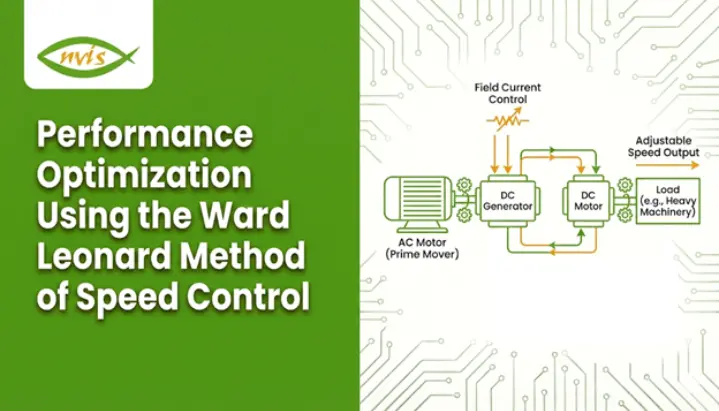
The AC motor operates at a fixed rate. It drives the DC generator. The output voltage varies by varying the field current in the generator. This variable voltage is supplied to the DC motor, thereby regulating its speed.
Principle of Ward Leonard Method of Speed Control
The Ward Leonard method of speed control is based on the principle of using a motor-generator set to provide precise control of a DC motor’s speed. A common Ward Leonard system has a constant-speed AC motor (prime mover) that drives a DC generator. This generator produces controlled DC voltage which is fed into the DC motor which is driving the load.
The fundamental idea of the Ward Leonard method is to control motor speed by adjusting the generator field current. This adjustment alters the output voltage of the generator that consequently controls the voltage of the load armature. The speed of a DC motor is directly proportional to the armature voltage applied, so a fine and accurate control of voltage yields a smooth and accurate control over speed.
The generator field circuit often includes a variable resistor (rheostat) to make fine adjustments to the excitation current. The generator output voltage is regulated by increasing or decreasing field excitation, which allows the load motor to run at a steady and continuously variable speed.
In essence, the Ward Leonard system operates on controlled electrical energy transfer based on the motor-generator system. This design provides high speed stability, precise control, and reliable operation across a wide range of industrial applications.
Advantages of the Ward Leonard System
The Ward Leonard system offers several key advantages that make it highly effective for industrial applications.
- Precision Speed Control
The ability to offer very accurate and continuous speed variation is one of the main benefits of the Ward Leonard method. The motor speed can be smoothly raised or lowered as needed which makes this system have a lot of flexibility in the way it controls. This precision is particularly useful in applications where it is necessary to have controlled and stable motion, e.g. in elevators. - Smooth Operation
The Ward Leonard system enables smooth acceleration and deceleration, allowing loads to be lifted and lowered gradually. This minimizes mechanical stress, wear and tear on parts and increases the life of equipment. - Regenerative Braking Capability
One significant benefit of the Ward Leonard method of speed control is its ability to enable regenerative braking. During braking or deceleration of the motor-driven load, the motor can be used as a generator and convert mechanical energy back into electrical energy and inject it into the supply system. This enhances the general efficiency of energy. - High Reliability
Ward Leonard system is highly renowned in terms of durability and reliable performance. Its powerful motor-generator configuration renders it appropriate to use in those applications where continuous working and high level of reliability are needed. - Operational Flexibility
The Ward Leonard method can be modified to suit motors of varying power ratings and working conditions due to the modular design of the system. This has made it easy to use in many sectors of industries.
Applications of the Ward Leonard System
The Ward Leonard system has been highly effective in those industries where motor speed control requires accuracy, stability and reliability. The Ward Leonard method of speed control provides precision and smooth operation, which is appropriate to heavy-duty and performance-critical applications.
- Elevators
The speed and movement of the elevator cars have traditionally been controlled by the Ward Leonard method. Smooth acceleration, deceleration, and accurate stopping ensure safe and comfortable floor-to-floor transitions. - Steel Rolling Mills
The Ward Leonard system is widely applicable in the management of motors that run rolling equipment in steel manufacturing. Proper shaping, thickness, and general quality of the product depends on proper control of speed and consistency. - Mining Equipment
Ward Leonard method of speed control is used in mining operations to control conveyor belts, hoists, and other heavy machinery. Its robust construction ensures safe and efficient operation even under harsh working conditions. - Paper Mills
Paper production involves maintaining a steady speed in various stages of processing. The Ward Leonard system assists in ensuring that there is consistent tension, quality, and production efficiency by accurately regulating the speed of motors. - Ship Propulsion Systems
The Ward Leonard method has been applied to the control of electric motors in ship propulsion systems in some marine uses. Its precise speed control enables effective maneuvering and reliable performance in demanding marine environments.
Comparison of Ward Leonard Method with Other Speed Control Methods
Aspect | Ward Leonard Method | Field Control Method | Armature Voltage Control Method | Rheostatic Control Method |
Principle | Generator-based armature voltage control (motor-generator set) | Field current control | Direct armature voltage variation | Armature resistance control |
Speed Control Range | Wide and smooth | Moderate to wide (mainly above rated speed) | Limited | Limited |
Efficiency | Good | Good | Moderate to good | Poor (high power loss in resistors) |
Maintenance | Moderate (brushes & commutators) | Low | Low | High |
Dynamic Response | Excellent | Good | Moderate | Poor |
Regenerative Braking | Possible | Not common | Not common | Not common |
Typical Applications | Heavy-duty industrial applications | General-purpose drives | Light-duty applications | Light-duty and low-cost systems |
Performance Optimization Using the Ward Leonard Method
Performance optimization refers to improving speed regulation, torque response, acceleration control, system stability, and overall operational efficiency. The Ward Leonard method of speed control is particularly effective in achieving these improvements because of its high precision in voltage control and a strong motor-generator system.
Smooth, Stepless Speed Control
The Ward Leonard system produces a continuous and smooth variation of the voltage between zero and the rated voltage, unlike the resistive methods of control which consume power and provide only a limited range of this variation. This ensures:
- No sudden jerks during starting or stopping
- Minimal mechanical stress on equipment
- Improved product quality in precision-driven processes
This capability of gradually changing speed makes the Ward Leonard technique suitable in the application when a smooth motion and a fine control is needed.
Wide Speed Range
The Ward Leonard system provides a wide span of speed control: by using a combination of armature voltage control and field weakening:
- Below rated speed: Achieved through controlled reduction of armature voltage
- Above rated speed: Achieved through field weakening
This wide operating range enables flexible performance across varying industrial requirements.
High Starting Torque
During startup, the Ward Leonard method of speed control allows full armature current to be applied at low voltage. This results in:
- High starting torque
- Smooth and controlled acceleration
- Reduced mechanical shock to the load
Such characteristics are essential in heavy-load applications such as rolling mills and cranes.
Excellent Speed Regulation
Because the generator voltage in the Ward Leonard system can be finely adjusted, speed variations due to load changes are minimal. This leads to:
- Improved process accuracy
- Better surface finish quality
- Greater production consistency
Stable speed under fluctuating loads is one of the strongest advantages of the Ward Leonard method.
Rapid Dynamic Response
Adjustments in generator field current immediately influence motor voltage, allowing the system to respond quickly to changing conditions. This enables:
- Fast speed corrections
- Efficient braking
- Smooth and rapid reversal of rotation
Before the development of modern solid-state drives, the dynamic performance offered by the Ward Leonard method was unmatched in industrial motor control applications.
Conclusion
The Ward Leonard system is a breakthrough in the development of motor speed control. The use of a motor-generator connection and armature voltage control provides the Ward Leonard speed control method with smooth, stepless speed control, high starting torque, a wide operating range, and excellent dynamic response. These characteristics predisposed it to be a powerful choice of heavy industrial control like rolling mills, cranes, elevators, and mining machinery.
The capability of the Ward Leonard method to sustain constant performance under different load conditions is one of its best strengths. The system provides the lowest possible speed changes, controlled acceleration and reliable braking due to a precise voltage control and fast response to changing field currents. This has a direct positive influence on the quality of processes, equipment life and safety in its operation.
Although modern solid-state drives have replaced it in most new installations due to their smaller size and higher efficiency, the Ward Leonard system remains relevant in legacy systems and engineering education. Its principle of operation is the conceptual basis of most modern drive technologies.
FAQs
The Ward Leonard method of speed control is a DC motor speed control technique that uses a motor-generator set to vary the armature voltage of the motor. By adjusting the generator field current, the system achieves smooth and precise speed regulation.
The Ward Leonard system controls speed by varying the output voltage of a DC generator that supplies power to the DC motor. Since motor speed is directly proportional to armature voltage, changing generator excitation allows accurate and stepless speed control.
The Ward Leonard method offers smooth speed variation, high starting torque, excellent speed regulation, wide speed range, regenerative braking capability, and strong dynamic response making it ideal for heavy industrial applications.
The Ward Leonard system is commonly used in elevators, steel rolling mills, cranes, mining equipment, paper mills, and ship propulsion systems where precise and stable motor speed control is essential.
Although modern electronic drives such as VFDs have replaced most new installations, the Ward Leonard method of speed control is still found in legacy industrial systems and remains an important concept in electrical engineering education.