







Head Office
141-A, Electronic complex, Pardesipura,Indore - 452010 India
Phone: +91 73899 00887 , +91 98932 70303
Email:info@nvistech.com
Toll Free
+91 73899 00887
Working Hours
We are happy to meet you during our working hours. Please make an appointment.
- Monday-Saturday: 9:00 AM - 5:30 PM (IST)
- Sunday: Closed
Head Office
141-A, Electronic complex, Pardesipura,Indore - 452010 India
Phone: +91 73899 00887 , +91 98932 70303
Email:info@nvistech.com
Toll Free
+91 73899 00887
We are happy to meet you during our working hours. Please make an appointment.
- Monday-Saturday: 9:00 AM - 5:30 PM (IST)
- Sunday: Closed
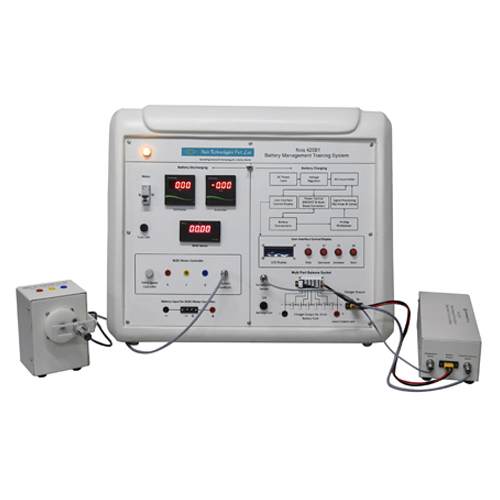
Battery Management Training System
Nvis 425B1
Product Description
Battery Management Systems (BMS) are used to monitor and control battery banks used in many industries and widely plays a vital role in the application of Electric Vehicle Industries. Nowadays, with a dominance of Lithium Ion (Li-Ion) batteries in most energy storage applications, BMS have become the essential device in Electrical Vehicle (EV) from both a functionality and safety perspective, making them an important part of battery management system training.
A BMS allows users to monitor individual cells within a battery pack over parameters such as battery charging and discharging rates, state of charge estimation, state of health estimation, cell voltage, temperature, current etc. As cells work together to release energy to the load, it is crucial to maintain stability throughout the whole pack or else cells may get damaged. This is where a battery management system (BMS) comes into play for safe operational working of the system.
Nvis 425B1 demonstrates a battery management system which is integrated with a controller for actively monitoring the critical parameters like voltage, charging and discharging current, temperature along with continuously monitors each cell voltage in a battery pack and performs cell balancing if voltage difference between cells exceeds the threshold value makes the system complete understanding. The system is ideal for BMS system training and practical understanding of battery management applications.
Product Features
- Suitable for testing of for 3 to 6 Series Cells Lithium Ion (Li-Ion)
- LCD for measurement of Voltage, Current & Temperature
- Diagrammatic representation of BMS to understand its internal architecture
- Designed by considering all the safety standards
- Onboard thermistor for temperature measurement
- Special designed BS10 Connectors for safe operation
Scope of Learning
- Understand the fundamentals of Battery Management Systems (BMS) and their role in electric vehicles and energy storage systems.
- Learn battery monitoring techniques, including voltage, current, temperature, State of Charge (SOC), and State of Health (SOH).
- Study battery charging, discharging, and cell balancing for safe battery operation.
- Explore the architecture and working principle of a battery management system through practical experiments.
- Gain hands-on experience in battery management system training for testing and analyzing lithium-ion battery packs.
- Develop practical skills for BMS system training in EV, renewable energy, and battery technology laboratories.
Why Choose Nvis Battery Management Training System?
- Designed for comprehensive battery management system training in engineering colleges, universities, and technical institutes.
- Provides hands-on BMS system training with real-time monitoring of battery parameters.
- Demonstrates essential BMS functions, including cell balancing, voltage monitoring, current measurement, and temperature sensing.
- Supports practical learning with a clear diagrammatic representation of the BMS architecture.
- Built with integrated safety features and industrial-grade components for reliable laboratory use.
- Suitable for EV, battery technology, and renewable energy education, helping learners gain practical industry-relevant skills.
FAQs
1. What is a Battery Management System (BMS)?
A Battery Management System (BMS) is an electronic system that monitors and controls rechargeable battery packs. It manages parameters such as voltage, current, temperature, State of Charge (SOC), and State of Health (SOH) to ensure safe and efficient battery operation.
2. What is the Battery Management Training System used for?
The Battery Management Training System is used for battery management system training and helps students understand BMS architecture, battery monitoring, cell balancing, charging, and discharging processes through practical experiments.
3. Who can use the Battery Management Training System?
This training system is ideal for engineering colleges, universities, technical institutes, EV training centers, and research laboratories conducting BMS system training and battery technology courses.
4. What parameters can be monitored using this BMS trainer?
The system allows users to monitor important battery parameters, including cell voltage, charging and discharging current, temperature, State of Charge (SOC), State of Health (SOH), and cell balancing.
5. Why is battery management system training important?
Battery management system training helps learners understand how BMS protects lithium-ion battery packs, improves battery performance, enhances safety, extends battery life, and supports applications in electric vehicles, renewable energy systems, and energy storage technologies.
- Request Quote
- Technical Specification