





• Nvis Technology
  • Nvis Technology
  • Nvis Technology
  • Nvis Technology
  • Nvis Technology
  • Nvis Technology
Nvis Technology

Head Office

141-A, Electronic complex, Pardesipura,Indore - 452010 India

Phone: +91 73899 00887 , +91 98932 70303

Email:info@nvistech.com

Request a Quote

Looking for a quality and affordable builder for your next project?


    Nvis Technology

    Toll Free

    +91 73899 00887

    We are happy to meet you during our working hours. Please make an appointment.

    • Monday-Saturday: 9:00 AM - 5:30 PM (IST)
    • Sunday: Closed

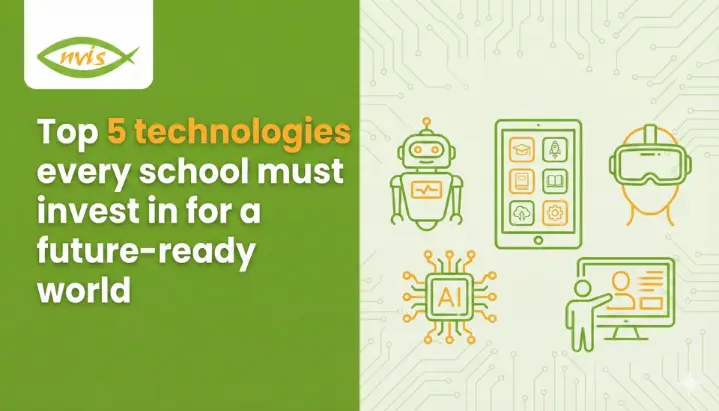
    Top 5 technologies every school must invest in for a future-ready world

    Every generation grows up shaped by the skills and tools of its time. For today’s students, those skills are shaped by the tools and innovations they interact with every day; smart devices, automated systems, clean energy solutions, and intelligent apps that seem almost magical. What feels ordinary to them is actually their first step into the world of emerging technologies.

    In this environment, the classroom becomes more than a place to study concepts. It becomes a space where ideas can be tested, prototypes can be built, and questions can lead to real discoveries. When students experiment with a simple sensor, observe how sunlight powers a small device, or try coding a basic program, they are not just learning; they are understanding how the world works and how they can contribute to it.

    India’s push toward creativity, innovation, and experiential learning, as signalled in NEP 2020, makes it clear that schools must help students explore the technologies that will shape their future. Early exposure equips children with confidence, curiosity, and the ability to think in new directions.

    With this spirit of exploration in mind, here are the five technologies every school student should begin discovering to build a strong foundation for future learning and innovation.

    Top 5 Technologies Every Student Should Learn

    1. Artificial Intelligence (AI)

    AI is increasingly entering mainstream school education. With CBSE formally introducing AI as a skill subject and the National Curriculum Framework (NCF 2023) encouraging computational thinking from middle school onward, students today are engaging with AI earlier than ever. Even simple school-level projects, like image sorting, pattern recognition, or chatbot creation, help them understand how machines learn and make decisions.

    Why it matters for school students:

    • Builds computational and logical reasoning
    • Encourages responsible thinking around data and ethics
    • Helps students understand the technology shaping global innovation
    1. Robotics

    Robotics blends coding, electronics, mechanics, and design; making it one of the most engaging ways for students to learn by doing. Schools with robotics labs or innovation clubs see high student participation because robotics gives learners something tangible to build, test, and improve.

    Why it matters for school students:

    • Strengthens engineering thinking and creativity
    • Develops teamwork and real-world problem-solving
    • Reinforces science and math concepts through hands-on application
    1. Internet of Things (IoT)

    IoT helps students understand how “smart” systems work; devices that sense, connect, and respond. From smart home models to weather-monitoring setups, IoT projects are among the most common in school science fairs. It teaches students the fundamentals of hardware, software, and connectivity all at once.

    Why it matters for school students:

    • Builds systems and design thinking
    • Encourages real-life innovation
    • Introduces cybersecurity awareness and digital responsibility
    1. Renewable Energy & Clean-Tech

    Clean energy has become central to classroom discussions on sustainability, climate action, and responsible innovation. With India accelerating its renewable energy expansion, schools are increasingly encouraging students to explore solar kits, mini wind models, and energy projects. Clean-tech is now one of the most exciting domains for young learners, blending science with purpose.

    Why it matters for school students:

    • Nurtures environmental responsibility
    • Connects science concepts with global sustainability goals
    • Offers early pathways into emerging green careers
    1. Digital Electronics & Circuit Design

    Digital electronics gives students a hands-on understanding of how technology works at its core, from logic gates to simple sensors. It forms the foundation of robotics, IoT, and embedded systems, helping students develop confidence in building and troubleshooting basic circuits.

    Why it matters for school students:

    • Strengthens STEM fundamentals
    • Encourages experimentation and inquiry
    • Acts as a gateway to advanced technology learning

    Each of these technologies supports the development of critical skills such as analytical thinking, design logic, creativity, and digital literacy. When students begin exploring them early, it lays the groundwork for deeper STEM engagement as they progress through their schooling. These skills do not develop in isolation, they grow through consistent exposure, exploration, and guided experimentation. That is why introducing these technologies early becomes essential.

    Why Schools Should Introduce These Technologies Early

    When students experience technology through building, experimenting, and solving problems, they develop habits of curiosity and confidence. Early exposure to these fields:

    • Makes learning more meaningful and connected
    • Builds higher-order thinking and creativity
    • Improves comfort with STEM subjects
    • Helps students discover interests that may shape future careers

    These technologies help shape future problem-solvers and innovators. While the need for these technologies is clear, schools often require practical, student-friendly learning tools to implement them effectively.

    Making Technology Learning Practical & Accessible

    Nvis Technologies is a leading provider of STEM education tools, school lab solutions, and hands-on learning systems that make technology accessible and engaging for young learners.

    • Ready-to-use STEM kits
    • Training systems for robotics, electronics, IoT, and renewable energy
    • Activity-based learning tools for interactive classrooms
    • Curriculum-aligned resources that support teachers in delivering practical learning

    Nvis empowers schools to introduce complex technologies in simple, practical, and interactive ways.

    Building Tomorrow’s Innovators Today

    Students today do not just want to understand technology; they want to build it. By introducing these technologies early, schools help students develop curiosity, creativity, and future-ready skills.

    With Nvis Technologies as a learning partner, schools can turn classrooms into spaces where ideas come alive and students grow into confident creators and innovators.

    Explore school-ready lab solutions from Nvis Technologies.

    Tags: AI in Education, Digital Electronics, Experiential Learning, Future Skills, IoT in Schools., Renewable Energy Learning, Robotics, School Innovation, STEM education

    Why Practical STEM Education Is Essential for Future-Ready Schools

    As India reimagines its school education ecosystem under the NEP 2020, there’s a growing call to move beyond rote learning and bring STEM subjects—Science, Technology, Engineering, and Mathematics—to life through hands-on, real-world experiences. For students in secondary and higher secondary levels, practical training is no longer a “good-to-have”—it’s a necessity. These formative years demand more than textbooks and theory; they require dynamic environments that foster problem-solving, critical thinking, and applied curiosity.

    With the CBSE’s mandate to set up Composite Skill Labs, schools are at a pivotal juncture. The opportunity? To build immersive, future-ready STEM labs that not only align with academic goals but also equip students for the rapidly evolving tech-driven landscape. But how does a school go about setting up such a lab? What goes into making it sustainable, effective, and relevant to industry needs?

    Let’s explore the why and how of building impactful STEM labs in schools—along with expert insights on what truly makes them work.

    What makes STEM training truly effective

    Practical STEM training isn’t optional—it’s mandatory. It helps students connect classroom theory with real-world applications by programming microcontrollers,

    building robots, simulating sensor data, or experimenting with AI. This hands-on learning nurtures deep understanding, not just recall.

    But it’s not just about the tools. A STEM lab becomes truly effective when it transforms into a space of exploration and innovation. The focus must shift from showcasing equipment to embedding it meaningfully in everyday learning. The most impactful labs act as makerspaces—dynamic environments where students are encouraged to think, experiment, and build with purpose.

    CBSE’s Composite Skill Labs andate: Why It matters for STEM education

    The Central Board of Secondary Education (CBSE), in alignment with the National Education Policy (NEP) 2020, has made a significant move by mandating Composite Skill Labs across schools. This is a powerful acknowledgement of the need for applied learning in the K-12 space.

    But the question remains—how can schools implement this vision meaningfully?

    It starts with strategic planning. Schools must assess their current curriculum, identify relevant technologies, and build a phased roadmap for lab development. Teacher training is pivotal; educators must be equipped not just to operate new tools, but to integrate them into lesson plans effectively. Furthermore, safety protocols, assessment methodologies, and documentation systems must all be established from day one.

    Also read: Is your school ready for Composite Skill Labs? Here’s how we can help

    How industry partnerships are transforming school STEM labs

    Many schools struggle with post-installation inertia. Equipment lies unused, teachers feel underprepared, and the lab—initially envisioned as a hub of innovation—slowly gathers dust. This is often the result of a transactional vendor relationship, where once the equipment is delivered, support ends.

    The solution lies in knowledge partnerships. Schools must collaborate with industry leaders who offer more than products—partners who provide a complete ecosystem: from lab design and installation to teacher training, mentorship programs, and even student internships.

    Such partnerships ensure continuity and relevance. They help educators stay aligned with emerging trends like IoT, Artificial Intelligence, Drones, and Industrial Automation. They also open up exposure pathways for students—connecting classroom learning with industry realities.

    Get deeper insights into the importance of practical STEM education, how to set up future-ready composite labs, and the role of long-term industry collaboration. Watch the video here – [Video link ]

    The cost of underutilization

    • Low usage, high investment: Many institutions invest heavily in lab infrastructure but fail to use it effectively due to a lack of operational know-how.
    • Missed learning opportunities: When tools sit idle, students miss out on hands-on experiences that make STEM subjects real and relevant.
    • The solution:
      • Post-installation support is crucial.
      • Regular refresher trainings, curriculum-aligned activities, and usage audits can bridge this gap.
      • Educators must also embrace continuous learning and actively integrate lab tools into classroom practice.

    A transformative learning environment

    When implemented thoughtfully, STEM labs can be transformative. Students begin to see themselves not just as learners, but as creators, thinkers, and problem-solvers. They learn to engage with the world as it is—and imagine it as it could be.

    Imagine a classroom where a student builds a weather station from scratch, monitors data on an IoT dashboard, and then writes a paper on climate patterns. Or a student who designs a drone for agricultural surveillance and iterates on it after testing in real conditions. This is not fiction—it is already happening in well-equipped, future-forward schools across India.

    Investing in the future, one lab at a time

    In the final analysis, practical STEM education is not just about career readiness; it is about nation building. It is about nurturing a generation that is not afraid to ask questions, challenge norms, and design solutions. A generation that is agile, innovative, and deeply rooted in scientific thinking.

    Schools that embrace this shift are not just keeping up with the times—they are defining them.

    The future is not in the pages of a textbook. It’s in the hands of a student holding a soldering iron, coding a sensor, or assembling a robot. It’s time we recognize that—and invest accordingly.

    Tags: CBSE Mandate, Composite Skill Labs, Experiential Learning, India Education, Industry Partnerships, NEP 2020, Practical Learning, School Education, Skill Development, STEM education