







Table of Contents
An electronic lab cannot run without a dependable Power Supply . Whether you are a student assembling your first circuit, a hobbyist working on a microcontroller project, or an engineer setting up a university or small R&D lab, the correct power source can influence accuracy, safety, and the speed of learning.
This guide categorizes the most important types of bench, programmable, and variable Power Supplies and provides real-world advice that is easy to understand by beginners in order to make the correct selection of the appropriate unit that suits your requirements.
Understanding the Importance of the Right Power Supply
One of the most significant choices made in the establishment of an electronics, research and development, or learning laboratory is the choice of the Power Supply. A power supply is not just a machine that delivers a voltage but it is the base that makes sure your experiments are correct, components stay protected and prototypes behave as expected. As an engineering major, a hobbyist, or a professional researcher, the choice of the right unit has a direct influence on the performance, safety, and productivity.
Whether it is bench power supplies that are intended to be used in everyday prototyping to programmable power supplies that are then used in automated test configurations, or even the very versatile Variable Power Supplies used for learning and experimentation, the choices can be daunting. This guide makes the choice of power supply easy enough in that you are sure to choose the most suitable power supply according to your specific laboratory needs.
Why the right power supply matters
A power supply does more than just deliver voltage. It provides a predictable, safe source of energy so that measurements are accurate and components are protected. Using the wrong type or a poorly specified unit can cause:
- Unreliable measurements due to voltage ripple or noise.
- Damaged components from overcurrent or overvoltage conditions.
- Slower development cycles because you don’t have the features needed for repeatable tests.
Picking the right lab Power Supply dramatically improves experiment reproducibility, safety, and developer confidence.
Quick overview of the main types
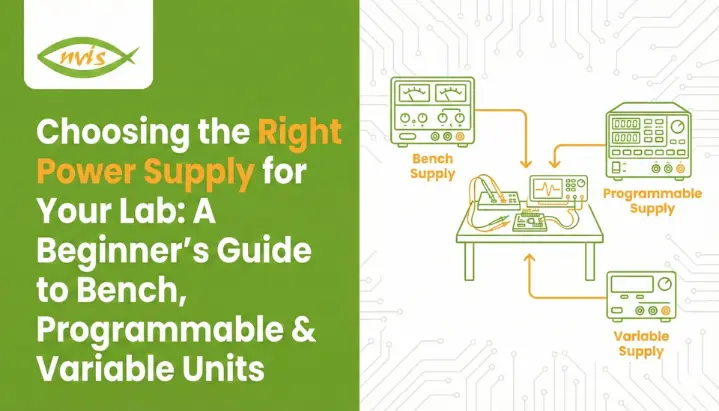
- Bench power supplies – general-purpose desktop units with one or more outputs, intuitive controls (analog knobs or digital interface), and features aimed at prototyping and education.
- Programmable power supplies– designed to be controlled by a computer or test system; they support scripting, remote control (USB/LAN/GPIB), and precise, repeatable outputs for automated testing.
- Variable power supplies – a category often overlapping with bench supplies; emphasizes continuously adjustable voltage/current so users can sweep values for experiments or teaching.
Practically these categories are overlapping: a large number of bench supplies are variable, and a large number of programmable supplies are physically mounted on the bench. The distinctions are concentrations, i.e. manual convenience (bench), automation and repeatability (programmable), and variable range to learn and experiment (variable).
Variable Power Supplies
3 × 0–12V, 40A DC Power Supply – Nvis 1240P
Nvis 1240P is a high-current, triple-output DC Power Supply designed for power electronics, motor testing, and advanced laboratory applications.
Know More
DC Programmable Power Supply – Nvis 1305P
Nvis 1305P offers precise, programmable voltage and current control, making it ideal for automation, R&D, and long-duration test setups.
Know More
AC Power Supply – Nvis 230P
Nvis 230P is a reliable AC Power Supply built for electrical experiments, AC circuit training, and controlled AC testing environments.
Know More
Key specs you must understand
It is important to understand the specifications that directly affect performance, accuracy, and safety before selecting the appropriate Power Supply to use in your lab. These specifications define the extent of compatibility between the supply and your projects, component security and dependable and consistent power to test and experiment.
1. Output Voltage Range
This is the range of voltages the power supply can deliver (e.g., 0–30V). Choose a supply with a range that covers all your typical circuits, with additional headroom for future projects.
2. Output Current Capacity
Measured in amperes (A), this defines the maximum current the supply can deliver. Always select a supply with 20–30% higher current than your highest expected load to avoid stress or overheating.
3. Power Rating (Wattage)
Voltage × Current = Power. This tells you the total capability of the power supply. Higher-power units can support demanding loads like motors, RF circuits, or power electronic prototypes.
4. Regulation (CV & CC Modes)
Constant Voltage (CV): Maintains a stable voltage even if load changes.
Constant Current (CC): Protects components by limiting current to a set value.
Understanding how to switch between CV and CC is critical for safe testing.
5. Ripple & Noise
Even DC outputs contain small fluctuations. Low ripple and noise are essential for sensitive analog circuits, microcontrollers, and communication systems. High ripple can distort signals and affect measurement accuracy.
6. Load & Line Regulation
Load regulation: How well the voltage stays constant as the load varies.
Line regulation: How stable the output remains when the input power changes.
Better regulation means more precise results.
7. Number of Outputs (Channels)
Single-channel supplies are ideal for simple circuits, while dual or triple outputs are useful for powering multi-rail systems (e.g., 5V, 12V, -12V simultaneously).
8. Display & Resolution
High-resolution digital displays help you set voltage and current more accurately. This is especially important for precision testing, low-power circuits, and educational environments.
9. Protection Features
- OVP (Over-Voltage Protection)
- OCP (Over-Current Protection)
- OTP (Over-Temperature Protection)
- Short-circuit protection
Programmable power supplies: when automation and precision matter
With increased complexity in electronics projects, repeatability, automated power control with high accuracy is needed. This is where the programmable power supplies differ with the traditional bench units. Engineers and researchers are able to automate voltage and current settings, run timed sequences and collect detailed performance information which significantly improves testing efficiency and reliability compared to manually adjusting knobs.
Programmable supplies are particularly useful in laboratories that need uniformity in repeat cycles of a test, or where there is a need to test the behavior of devices under different power conditions.
What makes them different
- Remote control via software or SCPI commands.
- Ability to run scripts that change voltages/currents over time (sweeps, ramps, profiles).
- Often higher precision and richer telemetry (logging voltage, current, temperature).
Features to prioritize
- Communication ports compatible with your test setup (USB/LAN/GPIB).
- Support for SCPI or a vendor API for scriptable control.
- Fast transient response and tight regulation for power electronics testing.
- Logging and built-in test sequences.
Example use-cases
- Battery testing with automated charge/discharge cycles.
- Manufacturing test rigs where devices are validated through scripted tests.
- Research experiments requiring repeatable, time-based voltage/current profiles.
Comparison Table (Beginner-Friendly)
| Characteristic | Bench Power Supply | Programmable Power Supply | Variable Power Supplies |
|---|---|---|---|
| Best for | Prototyping, education | Automated tests, R&D | Teaching, experiments |
| Manual control | Excellent | Possible (less focus) | Excellent (fine control) |
| Automation | Limited | Strong | Limited |
| Precision | Good | Very good / excellent | Good |
| Typical price | Low–medium | Medium–high | Low–medium |
| Safety features | Usually included | Advanced options | Usually included |
| Recommended when | You want quick hands-on work | You need repeatable, scripted control | You want to sweep and learn behaviors |
Safety best practices (non-negotiable)
- Always check polarity before connecting; reverse polarity can destroy parts.
- Use banana leads or safety-shrouded connectors for bench work.
- Keep exposed connectors and wiring neat to avoid shorts.
- Use current-limited startup when connecting new or unknown loads.
- Turn off supplies before making major wiring changes.
- For student labs: label rails and leave a prominent guide on safe operating ranges.
Maintenance & calibration tips
- Keep ventilation unobstructed—supplies generate heat.
- Periodically inspect leads and connectors for wear.
- Calibrate periodically if you need measurement-grade accuracy (institutional labs typically recalibrate annually).
- Store in a dry, dust-free environment when not in use.
Final recommendations
If you’re just starting and need hands-on learning: buy a solid bench or variable power supply with at least 0–30V/0–3A and good protection features. This combination covers most student projects.
If you plan to automate tests or need repeatable profiles: prioritize a programmable power supply with the communication ports you will use (USB or LAN) and scriptability (SCPI).
For mixed needs (education + occasional automation), consider a mid-range programmable bench supply that offers both manual controls and remote interfaces.
Choosing the right Power Supply is an investment in safer, faster, and more accurate experimentation.Most beginners find that a variable power supply with basic control features offers the best balance of flexibility, safety, and ease of learning, safety, and learning. The more sophisticated your projects are or the more automation that has been added, the more programmable supplies that can be added to your bench can assist in scaling your testing, minimize human error, and produce repeatable results.
As a final note, Nvis Technologies offers advanced engineering education, research, and lab solutions for universities, industries, and technical institutions to universities, industries and technical institutions.
Frequently Asked Questions (FAQs)
1. What is the difference between a bench power supply and a variable power supply?
A bench power supply is a general-purpose laboratory device used for everyday prototyping and testing.
A variable power supply specifically allows users to continuously adjust voltage and current over a wide range,
making it ideal for experimentation, learning, and testing circuit behavior under different conditions.
Many bench supplies are also variable, but not all variable supplies are intended for advanced lab applications.
2. How do I choose the right voltage and current rating for my power supply?
First, determine the maximum voltage and current required by your project. Then add a 20–30% safety margin
to ensure reliable operation and avoid stressing the power supply. For example, if your circuit requires
12V and 1A, choose a unit rated for at least 15V and 1.3A or higher.
3. When should I choose a programmable power supply instead of a basic bench unit?
A programmable power supply is recommended when your work involves automation, SCPI scripting, or precise,
repeatable power sequences such as battery testing, endurance testing, or automated production workflows.
For general prototyping or student laboratories, a standard bench or variable power supply is usually sufficient.
4. Why are ripple and noise important in a power supply?
Ripple and noise are unwanted AC fluctuations present on a DC output. Excessive ripple can cause interference,
unstable measurements, or malfunction in sensitive circuits such as ADCs, sensors, and RF modules.
Low-ripple power supplies are essential for precision and analog electronics work.
5. What safety features should I look for in a lab power supply?
Key safety features include Over-Voltage Protection (OVP), Over-Current Protection (OCP),
Over-Temperature Protection (OTP), and short-circuit protection. These features safeguard both
your electronic components and the power supply, especially when testing new or unknown circuits.