







TL;DR
- The blog targets engineering students, technical institutions, trainers in industries and education decision-makers seeking to align academic programs with the emerging industrial demands in the field of lab automation and smart manufacturing.
- Automation labs, in contrast to the traditional labs, replicate real industrial conditions with the help of high-quality lab automation systems and lab automation software, allowing the students to acquire the real-world, job-oriented experience.
- Automated lab training creates opportunities to work as Automation Engineer, Control Systems Engineer, Robotics Technician, and Process Automation Specialist, all of which are in increasing demand.
- Investment in the contemporary lab automation systems will improve industry relationships, increase the placement rate, research innovation, and institutional reputation in the competitive education world.
Lab automation systems are at the core of this transformation Manufacturing plants are transforming into smart factories. Accurate robotics and smart surveillance are essential to pharmaceutical businesses. Experimentation that is data-driven is taking place in research institutions. Lab automation is at the core of this transformation.
As organizations adopt advanced technologies, the demand for professionals skilled in lab automation systems, robotics, control engineering, and intelligent software platforms continues to grow. However, there is a significant gap between what traditional academic laboratories teach and what modern industries expect from graduates.
In contrast to traditional laboratories where the emphasis is laid on theory and manual processes, automation laboratories mimic the industrial real-life situations. They equip students with practical skills in lab automation software, programmable systems, robotics, and integrated control technologies aligned with industry demands.
Industry-leading equipment providers such as Nvis support automation training by offering logic analyzers, LCR meters, IC testers, and data acquisition systems that enhance diagnostics and decision-making capabilities. The company also provides customized industrial automation solutions, which incorporate sensors and control systems to streamline processes and optimize productivity.Nvis provides industries with the power to establish operational excellence and growth sustainability through innovation and quality-based solutions.
Related Articles
- Choosing the Right Power Supply for Your Lab: A Beginner’s Guide to Bench, Programmable & Variable Units
- How Practical Labs Make Technical Education and Skilling Industry-Driven
- Why Your Electrical Training Lab Needs Safety Earthing Training Work Bench Today
Understanding Lab Automation in Industry Education
Automation labs are advanced learning environments that bridge the gap between academic theory and real industrial practice. These labs are equipped with integrated lab automation systems that closely replicate modern industrial operations, unlike traditional labs, which primarily involve manual processes and isolated experiments.
Automation labs replicate real-world production and research environments to provide students with practical exposure to the tools, workflows and technologies that they will experience in their professional settings. This hands-on method greatly enhances readiness to work, and equips students with the ability to operate in a full framework of a lab automation system.
In a well-equipped automated lab, students develop the ability to:
- Design and set up automated workflows- Students learn how to map processes, define operational sequences, and develop structured automation logic. This involves knowing about the flow of materials, incorporation of sensors and real-time monitoring in integrated lab automation systems.
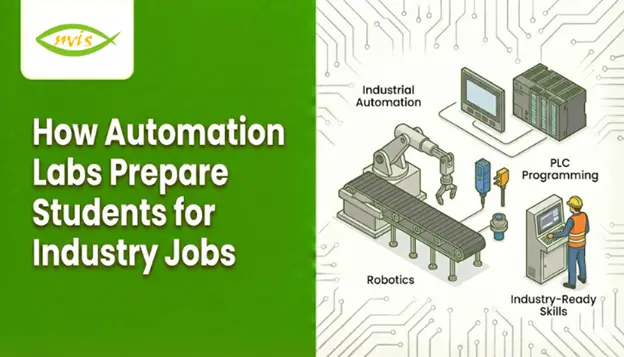
- Program control systems- Students gain practical experience in programming with PLCs, HMIs, and industrial controllers, which would be relevant in using the lab automation systems. They create, debug, and maintain control logic which controls machines and production processes.
- Use robotics and intelligent equipment – Robots that are frequently used in automation laboratories are robotic arms, conveyors, smart inspection, and collaborative robots. Learners gain experience in configuration, calibration, safety protocols, and motion programming – competencies that are highly demanded in manufacturing and technology-driven sectors.
- Analyze process data – The current lab automation environment produces large amounts of operational data. Students get to know how to analyze system metrics, identify areas of inefficiency, and implement data-driven approaches to process optimization.
- Integrate hardware with lab automation software – One of the critical industry competencies is the ability to connect physical equipment and soft platform of advanced lab automation software. Students are trained on how to set up communication protocols, how to manage data acquisition systems and how to provide smooth integration of software applications and hardware components.
Automation Labs Prepare for Industry Jobs
Automation laboratories equip students with skills aligned directly with current industry requirements. Using the real systems of lab automation and sophisticated lab automation software, students can obtain practical experience in programming, system integration, robotics, and process monitoring.
They simulate real industrial conditions, enabling students to design automated workflows, troubleshoot system faults, and optimize performance within a complete automation ecosystem.
Consequently, graduates come into the workforce with employment-related experience, skills, and competence in solving problems and the self-confidence to make an impact right away in automation-related fields.
Practical Skills Developed in Automation Labs
The true strength of automation labs lies in skill development.
1. Systems Thinking
Students learn to see automation not as isolated machines but as interconnected ecosystems. This systems-level understanding prepares them for roles involving integration and process optimization.
2. Technical Programming Proficiency
Working with lab automation software, students become proficient in:
- PLC programming
- HMI design
- Communication protocols (Modbus, Ethernet/IP, Profibus)
- Industrial networking
Employers highly value these practical programming skills.
3. Troubleshooting and Diagnostics
Automation systems are complex. Learning to identify and resolve issues is critical.
Students practice:
- Debugging control logic
- Sensor calibration
- Fault analysis
- System performance evaluation
This builds confidence and job readiness.
4. Project Management and Collaboration
Automation labs typically use project-based learning models. Students work in teams to design and implement complete automation projects.
This fosters:
- Communication skills
- Documentation practices
- Time management
- Cross-disciplinary collaboration
These soft skills are equally important in industry.
Career Opportunities After Automation Lab Training
Graduates trained in automation labs gain practical experience in lab automation systems, robotics, and lab automation software, which will be very competitive in the job market. The practical experience that they get in dealing with real-time industrial systems equips them with a variety of technical jobs, such as:
- Automation Engineer – Designs, develops, and maintains advanced lab automation systems for manufacturing and research facilities.
- Control Systems Engineer – Programs and optimizes PLCs, HMIs, and integrated lab automation system architectures.
- Robotics Technician – Configures, operates, and maintains robotic equipment within automated production environments.
- Process Automation Specialist – Improves operational efficiency by implementing intelligent lab automation solutions.
- Manufacturing Systems Engineer – Integrates hardware and lab automation software to streamline smart factory workflows.
- Quality Control Automation Analyst – Uses automated inspection systems and data analytics to ensure product consistency and compliance.
Employers highly value candidates with hands-on experience in automated labs because they require minimal onboarding, understand industrial processes, and can adapt quickly to production environments. This hands-on exposure significantly improves employability and long-term career growth.
The Competitive Advantage of Automation Labs
Automation-based labs give students a strong advantage in today’s competitive job market by aligning academic training with real industry requirements. Students who acquire hands-on experience with lab automation systems and professional laboratory automation software become more adaptable to the industrial setting because they are already familiarized with the integrated workflows and operations of the system. This practical exposure reduces onboarding time, lowers training costs, and improves productivity from day one. Consequently, those institutions that have an infrastructure of automation system laboratories tend to record higher employability rates, producing more confident, skilled, and job-ready graduates prepared for the dynamic world of lab automation.
How Educational Institutions Benefit
Investing in automation labs provides multiple strategic advantages for educational institutions:
- Stronger Industry Partnerships
Institutions with advanced lab automation systems are more likely to collaborate with companies for internships, live projects, research initiatives, and campus placements. - Enhanced Research & Innovation
Modern lab automation system infrastructure supports applied research, prototype development, and innovation-driven projects across engineering and technology disciplines. - Improved Academic Reputation
Offering training in industry-grade lab automation software and real-world automation technologies enhances institutional credibility and market positioning. - Better Placement Outcomes
Students trained in hands-on lab automation environments are more job-ready, leading to stronger placement records. - Attracting High-Quality Applicants
A well-equipped automated lab signals future-ready education, drawing ambitious students seeking practical and career-focused learning.
Conclusion:
The future of industry is automated, intelligent, and interconnected, and therefore automation labs are a necessity in contemporary education. Conventional learning alone is not sufficient to prepare students for modern workplaces, which are technology-driven. Automation labs can also be used to supplement the theory and practice divide through hands-on experience with lab automation systems and robotics, as well as high-end lab automation software.
A well-equipped automation lab enables students to design solutions, manage workflows, optimize processes, and adapt to emerging technologies within a complete automation framework. This benefits the students as it provides them with better career opportunities, institutions as it makes them more relevant and industries with the ability to get skilled, job-ready professionals trained in real-world lab automation environments.
FAQs
An automation lab is a modern training lab where students learn using real lab automation systems and tools instead of only theory or manual experiments.
Students learn programming, robotics operation, system integration, troubleshooting, and how to use lab automation software in real-world setups.
Hands-on experience with a complete lab automation system makes students job-ready and helps them adapt quickly to industry environments.
Students can become Automation Engineers, Control Engineers, Robotics Technicians, or work in other roles related to lab automation and smart manufacturing.
Colleges with advanced automation labs improve student placements, build strong industry partnerships, and offer more practical, career-focused education.