







TL;DR
- This is a blog for the beginners of engineering and physics, freshers and competitive exam aspirants (GATE, JEE, NEET, SSC JE, RRB JE) who want to understand the concept of a torsional pendulum at an easy level in a simple manner.
- Many students find this topic confusing at first because the body rotates by twisting about its axis instead of swinging side to side like a simple pendulum.
- Think of twisting a wire with your hand. The more you twist it, the more it resists. When you let go, it twists back, goes a little too far, and keeps moving back and forth for a while.
- A torsional pendulum has a time constant of T = 2π√(I/κ) where I is the moment of inertia of the suspended object and κ (kappa) is the torsional constant of the wire.
- This concept is used in mechanical watches, the Cavendish experiment, and some scientific instruments. It is also a common topic in GATE, JEE, and other engineering exams.
A torsional pendulum is a rigid body suspended by a thin wire or fibre. Instead of swinging, it rotates back and forth by twisting the wire. The wire’s elasticity creates a restoring torque that brings the body back to its original position. This topic is important in physics and engineering courses and is commonly asked in exams like GATE, JEE, and NEET.
This blog explains what a torsional pendulum is, how it works, its time period formula, how it differs from a simple pendulum, and where it is used in real life. You’ll also find a solved example and exam tips to help you understand the concept instead of just memorizing the formula.
Also read
- Sumpner’s Test of Transformer: Working Principle, Circuit, and Procedure
- What Is a Radial Distribution System? Working Principle & Advantages
- Ring Main Distribution System: Working Principle, Advantages
What Is a Torsional Pendulum?
Think about twisting a wet towel after washing it. What happens when you hold one end and twist the other end of a towel? The towel pushes back because it wants to untwist. When you let go, it twists in the opposite direction. It keeps moving back and forth for a while before it finally stops.
The principle behind a torsional pendulum is the same as that of the towel, except that the “towel” is a thin wire, and the twisting effect applied to the pendulum is called torque.
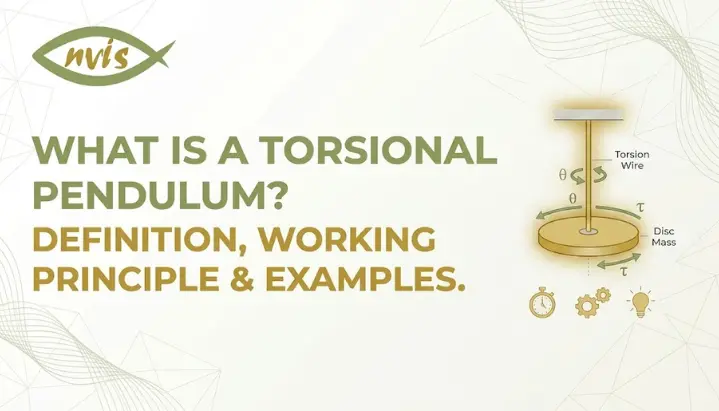
A torsional pendulum is a rigid object, such as a disc or rod (a disc, rod or any symmetrical body) attached by means of a thin wire or fibre to a point at the top. Now, with the body slightly twisted around the wire’s axis, when it is released, the twisted wire produces a restoring torque that pulls the body back toward its original position. Because of its inertia, the body does not stop at its starting position. It moves a little past it, twists the wire in the opposite direction, and continues repeating the motion. This back and forth oscillatory movement is called torsional oscillation.
The key difference is that the object does not swing like a playground swing. Instead, it rotates around a fixed vertical axis but rather rotates around a fixed vertical axis, and this is what distinguishes the whole motion from the simple pendulum that most students are first introduced to in school physics.
Working Principle Behind a Torsional Pendulum
To understand what is happening physically, it helps to separate two ideas that are easy to mix up when you’re new to this: torque and torsion.
Torque is simply a twisting force. You can think of it as the turning version of a push or pull. Torsion means the resistance a wire or shaft creates when you try to twist it. When you twist wire in a torsional pendulum by a small angle θ (theta), wire develops an internal restoring torque that tries to bring it back to an untwisted state. This works much like Hooke’s law for springs, where stretching a spring generates a restoring force proportional to displacement.
For torsion, the restoring torque is:
τ = −κθ
In this case, the restoring torque is τ (tau) and angle of twist (in radians) is θ and the torsional constant of wire is κ which depends on the wire’s material, thickness, and length. A negative sign is just saying that torque is always in the opposite direction of the twist, which is why it is referred to as “restoring” torque.
After twisting and releasing the body, this torque restores the body toward its equilibrium position. Just as the swinging pendulum has momentum that propels it beyond its lowest position, the rotating object here has rotational inertia that propels it beyond the equilibrium angle, in the opposite direction. This is repeated, resulting in periodic, smooth oscillations: angular simple harmonic motion.
If we apply Newton’s second law for rotation, we get an equation that describes the motion. It follows the same pattern as simple harmonic motion but uses rotation instead of straight-line movement, it’s just written in angular terms.
Time Period of a Torsional Pendulum: Formula
Once the equation of motion is set up, comparing it with a standard simple harmonic motion equation gives a clean formula for the time period, time taken to complete one full oscillation.
T = 2π√(I/κ)
Where:
- T is time period, measured in seconds
- I is moment of inertia of suspended body about axis of rotation, measured in kg·m²
- κ is torsional constant of wire, measured in N·m/rad
This formula tells you something important that’s easy to miss on first read: time period does not depend on the angle you twist your body through, as long as that angle stays small. Whether you twist the disc by 5 degrees or 15 degrees, it takes the same amount of time to complete one oscillation. This property is called isochronism, which means the time period stays the same for small twists. This is one reason mechanical watches can keep accurate time, since a wristwatch obviously can’t rely on gravity driven swinging while strapped to someone’s wrist.
Also worth noting: angular frequency ω (omega) of oscillation is given by ω = √(κ/I), and frequency f = 1/T. These three quantities, T, ω, and f, all describe same oscillation from different angles, and GATE and JEE numericals often ask you to convert between them.
Worked Numerical Example
Let’s apply formulas to a typical exam style problem, since seeing calculation once makes concepts far easier to recall later.
Problem: A disc has a moment of inertia of 0.05 kg·m² about its suspension axis. It is suspended from a wire with a torsional constant of 2 N·m/rad. Find the time period of the torsional pendulum.
Step 1: Write down known values. I = 0.05 kg·m² κ = 2 N·m/rad
Step 2: Substitute into formula. T = 2π√(I/κ) T = 2π√(0.05/2) T = 2π√(0.025) T = 2π × 0.158 T = 0.993 seconds (approximately 1 second)
Step 3: Interpret result. disc completes one full oscillation, twist one way, back through center, twist other way, and back to center, in roughly 1 second. If you doubled the moment of inertia (say, by attaching extra mass to the disc’s rim), the time period would increase by a factor of √2, since T is proportional to the square root of I.
Questions like this are common in GATE, JEE Main, and university exams, and the trick most students miss is forgetting to take the square root of the entire fraction I/κ before multiplying by 2π.
Torsional Pendulum vs Simple Pendulum: What’s Difference?
Students often confuse torsional and simple pendulums because both move back and forth and have similar time period formulas. But the reason they move is completely different and understanding this difference is very helpful in exam MCQs.
| Feature | Simple Pendulum | Torsional Pendulum |
| Type of motion | Swings side to side (linear angular displacement) | Rotates back and forth about a fixed axis |
| Restoring force | Gravity (component of weight) | Torsion in wire (elastic restoring torque) |
| Formula for time period | T = 2π√(L/g) | T = 2π√(I/κ) |
| Depends on | Length of string (L) and gravity (g) | Moment of inertia (I) and torsional constant (κ) |
| Works in zero gravity | No, gravity is essential | Yes, since gravity plays no role in restoring torque |
| Real world example | Pendulum clock, playground swing | Mechanical watch balance wheel, Cavendish experiment |
The most important difference to remember is this: a simple pendulum needs gravity to work, while a torsional pendulum does not depend on gravity at all. That’s exactly why torsional oscillators are used inside wristwatches, which move around constantly and can’t rely on a steady gravitational swing the way a wall clock can.
Real World Applications of Torsional Pendulums
This is the part where many students finally understand the concept because they see where it is used in real life.
Mechanical watches: balance wheel inside a mechanical watch is a small torsional pendulum, with a coiled hairspring providing restoring torque instead of a long wire. Because the oscillation period doesn’t depend on gravity or orientation, this is what lets a watch keep accurate time whether it’s lying flat on a table or strapped to a moving wrist.
Cavendish experiment: In 1798, Henry Cavendish used a torsion balance, essentially a torsional pendulum with two small masses on a suspended rod, to measure incredibly weak gravitational attraction between lead spheres. This experiment gave the first accurate measurement of universal gravitational constant G, and by extension, mass of Earth. extreme sensitivity of a torsional pendulum to tiny torques is what made this measurement possible at all.
Measuring modulus of rigidity: In physics and engineering labs, torsional pendulum experiment is a standard practical used to determine modulus of rigidity (shear modulus) of a wire’s material. By measuring the time period for known moments of inertia, students can work backward to calculate the wire’s torsional constant, and from that, material’s rigidity modulus. This exact experiment appears in most engineering physics lab manuals across Indian universities.
Finding moment of inertia of irregular bodies: Since I and κ are directly related through time period formula, a torsional pendulum setup can also be used other way around, to determine unknown moment of inertia of an irregularly shaped object by comparing its oscillation period to that of a known reference body.
Sensitive scientific instruments: Modern torsion balances are still used in precision measurements of tiny forces and in experimental physics. Gravitational wave detectors primarily use laser interferometry rather than torsion balances. Torsion balances are still used in modern physics experiments because a thin torsion fiber can detect extremely small twisting forces that many other sensors cannot measure.
Torsional Pendulum in GATE, JEE, NEET, and University Exams
In exams, questions about torsional pendulums usually come in a few common types generally fall into a few predictable categories, and knowing patterns in advance saves a lot of preparation time.
Conceptual MCQs often ask about the nature of the motion. A torsional pendulum undergoes angular simple harmonic motion because the restoring torque is directly proportional to the angular displacement.”Some MCQs test whether you know restoring torque comes from torsion, not gravity.
Direct numerical problems give you I and κ (or enough information to calculate them) and ask for time period, frequency, or angular frequency, exactly like the worked example above.
Derivation based questions, common in university semester exams and GATE Physics, ask you to derive expressions for a time period starting from the restoring torque equation, similar to how you’d derive T = 2π√(m/k) for a spring mass system.
Comparison questions test whether you can distinguish a torsional pendulum from a simple or physical pendulum, usually through a scenario based question rather than a direct definition.
For GATE Physics and Mechanical Engineering aspirants specifically, this topic connects closely with shafts and torsional stiffness in machine design, so understanding torsional pendulum well also helps when related topics show up later in strength of materials or vibrations papers.
Conclusion
A torsional pendulum is a rotational oscillator that is suspended from a wire that produces a restoring torque that is proportional to the angle of twist. Its time period, T = 2π√(I/κ), is independent of gravity, which is why it is used in mechanical watches, as well as in the Cavendish experiment to measure the gravitational constant of earth.
Try to understand the idea instead of memorizing the formula. The same concept appears in many other topics in physics and engineering. Now attempt to work on the numerical example above alone, then work through a few practice problems with varying values of I and κ, to start getting comfortable before the next exam.
FAQs
A torsional pendulum is a rigid object, such as a disc or rod, suspended by a thin wire. The wire resists twisting and pulls the object back, making it rotate back and forth, causing repeated rotational oscillation.
The time period is given by T = 2π√(I/κ), where I is the moment of inertia of the suspended body and κ is the torsional constant of the wire.
A simple pendulum swings due to gravity, while a torsional pendulum rotates due to elastic restoring torque of a twisted wire. A torsional pendulum doesn’t need gravity to function, which is why it’s used in wristwatches.
Yes, it is angular simple harmonic motion, since restoring torque is directly proportional to angular displacement, following the same mathematical pattern as linear SHM, just applied to rotation instead of straight line movement.
Torsional pendulums are used in mechanical watch balance wheels, historic Cavendish experiment for measuring gravitational constant, physics lab experiments to determine a wire’s modulus of rigidity, and modern precision torsion balances used in scientific research.
As long as angular displacement stays small, restoring torque remains proportional to angle (following Hooke’s law for torsion), which keeps motion in true simple harmonic form. This property, called isochronism, means oscillation always takes the same time regardless of how far the body was twisted initially.