







Head Office
141-A, Electronic complex, Pardesipura,Indore - 452010 India
Phone: +91 73899 00887 , +91 98932 70303
Email:info@nvistech.com
Toll Free
+91 73899 00887
Working Hours
We are happy to meet you during our working hours. Please make an appointment.
- Monday-Saturday: 9:00 AM - 5:30 PM (IST)
- Sunday: Closed
Head Office
141-A, Electronic complex, Pardesipura,Indore - 452010 India
Phone: +91 73899 00887 , +91 98932 70303
Email:info@nvistech.com
Toll Free
+91 73899 00887
We are happy to meet you during our working hours. Please make an appointment.
- Monday-Saturday: 9:00 AM - 5:30 PM (IST)
- Sunday: Closed
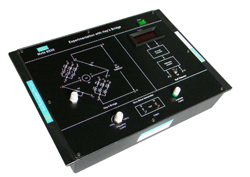
Experimentation with Hay`s Bridge
Nvis 6535
Product Description
The Nvis 6535 Experimentation with Hay’s Bridge is a useful training system designed for measuring the value of unknown inductance. This setup helps students understand the concept and working of A.C. bridges through practical experimentation. Hay’s bridge (also known as Hays bridge) is a modification of Maxwell’s bridge and is particularly suitable for measuring inductance in coils with a high Q-factor. By achieving a null balance condition, the unknown inductance can be accurately determined using the Hay’s bridge method. The Nvis 6535 includes an inbuilt differential amplifier, AC-to-DC converter, and digital panel meter (DPM) for precise null detection. It also features an integrated sine wave generator with adjustable amplitude and frequency, ensuring ease of operation and accurate results during experiments. This system serves as an ideal platform to enhance education, training, and practical understanding of Hay’s bridge applications.
Product Features
- In-built sine wave generator
- Adjustable frequency and Amplitude of Sine Wave
- Digital display for Null detection
- 10 turn potentiometer for balancing the bridge
- Easy illustration of Hay`s bridge
- Online product tutorial
Scope of Learning
- Determination of unknown inductance and Q-factor using Hay’s bridge method.
FAQs
What is a Hays bridge?
Hays bridge (or Hayes bridge) is an A.C. bridge that is used to measure the inductance of high-Q coils. It is an adapted form of the bridge of Maxwell.
What is the purpose of the Hays bridge experiment?
The Hays bridge experiment is conducted to measure the unknown inductance and Q-factor of an inductor by a balanced bridge technique.
How does Hay’s bridge work?
The bridge of Hay is based on the null deflection principle, in which the bridge is balanced by varying known components until no current passes through the detector, and the unknown inductance can be determined.
What are the advantages of using a Hays bridge?
Hays bridge is very appropriate in measuring inductors of high Q-factor and is more accurate than other bridges such as Maxwell bridge in such circumstances.
What is the difference between Hays bridge and Maxwell bridge?
Although both are applicable in the measurement of inductance, Hays bridge is more applicable in high Q-factor inductors, and Maxwell bridge is more applicable in low Q-factor inductors.
- Request Quote
- Technical Specification