






Head Office
141-A, Electronic complex, Pardesipura,Indore - 452010 India
Phone: +91 73899 00887 , +91 98932 70303
Email:info@nvistech.com
Toll Free
+91 73899 00887
Working Hours
We are happy to meet you during our working hours. Please make an appointment.
- Monday-Saturday: 9:00 AM - 5:30 PM (IST)
- Sunday: Closed
Head Office
141-A, Electronic complex, Pardesipura,Indore - 452010 India
Phone: +91 73899 00887 , +91 98932 70303
Email:info@nvistech.com
Toll Free
+91 73899 00887
We are happy to meet you during our working hours. Please make an appointment.
- Monday-Saturday: 9:00 AM - 5:30 PM (IST)
- Sunday: Closed
Understanding Characteristics of DIAC, TRIAC & SCR
Nvis 6530A
Product Description
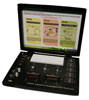
The Nvis 6530A Understanding Characteristics of DIAC, TRIAC & SCR is a widely used laboratory trainer designed to demonstrate the fundamentals and working of DIAC, TRIAC, and SCR devices. It enables students to study the characteristics and behavior of these key components used in power electronics.
Using this system, students can plot V–I characteristics, helping them understand device behavior under different biasing conditions. The trainer includes an inbuilt power supply and onboard resistors of various values. A breadboard area is also provided for constructing additional circuits using external components.
The Nvis 6530A serves as an ideal platform for enhancing education, training, and practical understanding of power electronic devices.
Product Features
- Generalized design
- In- built Power supply of +15, +35V and -35V
- DPM Based highly preceised on-board Voltmeter & Ammeter
- Breadboard
- Provided with different values of resistances
- 10 turn potentiometer
- Online product turotial
Scope of Learning
- To study and plot the V-I Characteristics of DIAC with Positive and Negative biasing
- Study and observation of Break over voltage (V ) and V Symmetry of BO BO DIAC
- To study and plot the V-I Characteristic of TRIAC with Positive and Negative biasing
- Study of Gate Current Triggering of TRIAC
- To study the phenomena of Holding Current and Latching current in TRIAC
- To Study and plot V-I Characteristic of SCR Study of Gate Current Triggering of SCR
- To study the phenomenon of holding current and latching current in SCR Under
FAQS
1. What are DIAC and TRIAC and why are they important?
DIAC and TRIAC are semiconductor devices widely used in power electronics for switching and controlling AC signals. Understanding diac and triac characteristics helps students learn how these devices regulate voltage and current in practical circuits.
2. What are the V-I characteristics of a DIAC?
The V-I characteristics of DIAC show its bidirectional behavior with a specific breakover voltage. Studying vi characteristics of diac helps in understanding how it conducts current only after reaching a threshold voltage in both directions.
3. What are TRIAC characteristics in power electronics?
TRIAC characteristics define how the device operates under different voltage and current conditions. Learning triac characteristics and triac vi characteristics helps students understand triggering, conduction, and switching behavior in AC circuits.
4. How do you study V-I characteristics of TRIAC?
The V-I characteristics of TRIAC are studied by applying positive and negative biasing and observing current flow with gate triggering. This helps analyze triac vi characteristics and understand its performance in different quadrants.
5. What is the purpose of studying DIAC, TRIAC, and SCR together?
Studying DIAC, TRIAC, and SCR together provides a complete understanding of switching devices in power electronics. It helps compare vi characteristics of triac, vi characteristics of diac, and SCR behavior for practical circuit applications.
- Request Quote
- Technical Specification