







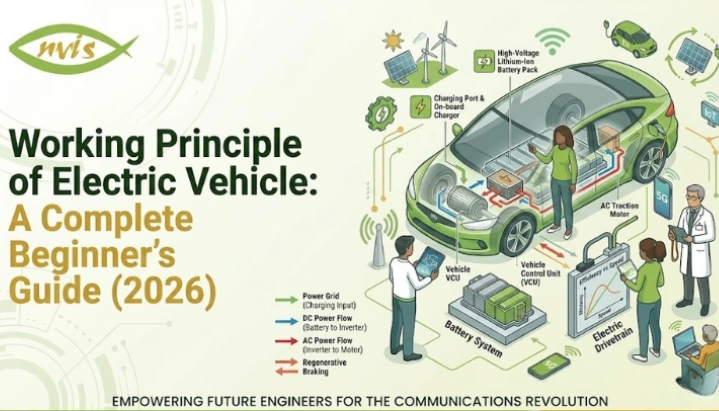
TL;DR
This guide explains the working principle of electric vehicles in simple terms from how the battery stores energy to how the motor converts it into motion. Whether you are a student, fresher, or tech enthusiast, this blog breaks down every key concept step by step, without assuming prior knowledge.
5 Key Points
- This blog is for university students, freshers, and first-time learners exploring electric vehicle technology. This guide simplifies EV concepts without sacrificing technical accuracy.
- The electric vehicle working principle is built on one core idea: converting stored electrical energy into mechanical motion using a motor, controller, and battery.
- Unlike petrol engines with thousands of moving parts, EVs have around 20 moving components making them simpler, cleaner, and cheaper to maintain over time.
- Regenerative braking is one of the most innovative features of EVs; it recaptures energy during deceleration and sends it back to the battery, extending driving range.
- Understanding the working principle of EV technology today opens doors to careers in automotive engineering, clean energy, embedded systems, and sustainable mobility.
India sold more than 2.3 million EVs in 2025, representing around 8% of the nation’s new vehicle registrations. This figure continues to rise in 2026
The parking lots are being filled with Tata Nexon EVs as well as Mahindra’s new electric SUVs. Ola and Ather’s e-2Ws can be seen on the streets every day. Delhi, Mumbai and Nagpur have public bus services operating electric buses. In 2025 alone, the number of EVs sold globally reached 20 million, accounting for 25% of all new vehicles sold globally.
However, here’s an interesting question: Do you know the workings of an electric vehicle?
Most people believe that it operates on a battery and a motor and that is correct, but it still doesn’t tell the entire story. EV technology is the culmination of an accurate and intricate system that operates seamlessly, from accelerating to braking.
It is clearly explained in this guide, progressively and without jargon. For those considering EV for the first time, you’ve come to the right place.
What Is an Electric Vehicle?
An electric vehicle uses electricity as its primary source of power instead of fossil fuels such as petrol or diesel.
A conventional internal combustion engine (ICE) vehicle uses petrol or diesel as fuel to generate heat which is then transformed into mechanical energy through a multitude of mechanical events including the movement of pistons, crankshafts, camshafts and exhaust systems. It’s always a lossy process: part of the energy that is released when you burn something is not used to make things move.
An EV doesn’t involve combustion at all. Instead, three fundamental systems perform propulsion: a battery pack containing electrical energy, an electric motor that translates the electrical energy into rotary power, and a controller that controls the entire propulsion system. A petrol car is equipped with around 2,000 moving mechanical parts, whereas a Battery Electric Vehicle (BEV) typically has only around 20 moving parts in its drivetrain
A basic working principle of electric vehicle technology is the direct conversion of electrical energy into mechanical energy, which is cleaner and also much more energy-efficient than combustion.
Core Components of an Electric Vehicle and Their Functions
In order to grasp the working principle of an EV, it’s essential to comprehend each of its key components and their functions. Consider these to be organs of a car, each with a specific function, and the system fails when the organ malfunctions.
1. Battery Pack: Fuel Tank of an EV
The energy journey starts in any electric vehicle with a battery pack.
Modern EVs use a much larger and more advanced version of the lithium-ion batteries found in smartphones. These packs are made up of thousands of individual battery cells assembled in modules, then into a battery pack under the vehicle chassis.
The battery stores energy in chemical form and is charged using Direct Current (DC). During charging, electrical energy is converted into chemical energy inside the battery cells whether it is at home or at a public charging station.
capacity of the battery is measured in kilowatt-hours (kWh). The higher the kWh rating, the more energy stored, which is the more range available when driving. For instance, the battery in Tata Nexon EV Max is 40.5 kWh, offering a range of around 437 km on a full charge, based on standard test conditions. The Mahindra BE 6e, features a 79 kWh battery pack with a claimed range of around 680 km under test condition.
2. Battery Management System (BMS): Brain Behind Battery
It’s not good enough to have just a battery pack. There is also a need for a monitoring and protection system to be maintained at all times.
BMS monitors the voltage, temperature and charge of each battery cell. It prevents over charging or over discharging of any cell which can cause battery damage or safety hazards.
BMS also calculates two important metrics:
- State of Charge (SoC): How much energy is currently stored essentially the battery percentage shown on your dashboard.
- State of Health (SoH): overall condition of battery relative to its original capacity, which degrades slightly over time.
If anything goes wrong a cell overheating, voltage spiking beyond limits BMS triggers a fault alert and can shut down the affected section to protect the system.
3. Inverter: Language Translator of EV
This is a technical hint which most novices are unaware of.
battery stores and delivers DC (Direct Current) electricity. However, most electric motors employed in vehicles, including AC induction and Permanent Magnet Synchronous Motors (PMSM) operate at AC (Alternating Current).
This is what the inverter does.
The inverter takes the Direct Current from the battery and changes it to Alternating Current which powers the motor. It does so by a technique known as Pulse Width Modulation (PWM) where the current is switched on and off very frequently to simulate an alternating wave. The inverter also regulates speed and torque of the motor in real time by varying the frequency and amplitude of this wave.
An inverter can be considered as a translator between two languages of electricity. If not, the battery and motor would not be able to communicate to each other.
4. Electric Motor: Where Electricity Becomes Motion
The electric motor is the heart of EV working principle. It’s the one thing that actually propels a car.
The motor is based on the principles of electromagnetism. Alternating current passing through the coils produces a rotating magnetic field. This field will interact with a magnet or induced current in the rotor of the motor, making it spin. The drivetrain delivers that rotary force known as torque to wheels.
There are several types of motors used in EVs:
- Brushless DC (BLDC) Motors: High efficiency, compact, and low maintenance. Commonly used in electric scooters and bikes.
- Permanent Magnet Synchronous Motors (PMSM): Deliver high torque density and fast responsiveness. Found in premium EVs like Tesla Model 3.
- AC Induction Motors: Durable and cost-effective. Often used in commercial vehicles and buses.
There is one key benefit to electric vehicle motors; they provide 100% of its torque from a complete stop whereas petrol engines have to fire up to achieve full torque. That is why EVs feel so quick and responsive during acceleration.
5. Power Control Unit (PCU) / Controller: Decision-Maker
The entire system is held together with a controller.
Pressing the Accelerator Pedal does not directly increase the power to the motor. You are telling the controller how much electric energy to extract from the battery, you are telling the inverter what to do and you are telling the motor how fast to spin.
controller adjusts power delivery using current feedback from your pedal position, vehicle velocity, battery state-of-charge and other sensor data. It’s a layer that makes decisions and decides what exact electrical instructions to give.
Controllers are sophisticated microprocessor-based systems that frequently include safety features, energy optimisation algorithms, diagnostics and more.
EV Working Principle: Step-by-Step Energy Flow
Now that you understand individual components, let us trace complete energy flow in a moving electric vehicle. This is where the working principle of EV technology becomes genuinely clear.
Step 1 – Energy Storage: The battery pack stores electrical energy in DC form, charged from an external power source (home socket or charging station).
Step 2 Signal from Driver: You press accelerator. A sensor detects pedal position and sends a signal to the controller.
Step 3 Controller Response: controller processes signal and determines how much current to draw from battery.
Step 4 Inversion: inverter converts DC current from battery into AC current and adjusts its frequency to control motor speed.
Step 5 Motor Rotation: AC current flows into an electric motor, creating a rotating magnetic field. rotor spins, generating torque.
Step 6 Power Transfer: torque is transmitted through drivetrain (and a single-speed transmission in most EVs) to wheels, propelling vehicles forward.
Step 7 Thermal Management: Throughout this process, the thermal management system monitors temperatures across battery, inverter, and motor, using coolant circuits to prevent overheating.
The entire chain from battery to wheel happens in milliseconds, continuously and seamlessly.
Regenerative Braking: EV’s Most Clever Feature
The working principle of an electric vehicle is one of the most innovative, which is called regenerative braking and it needs to be explained in its own right.
When a vehicle brakes in a conventional car, the kinetic energy of the moving vehicle is lost by friction between the brake pads and discs, which is converted to heat. That heat will be lost.
EVs do something different.
An electric motor now becomes a brake when the foot is lifted off the accelerator or pressed on the brake pedal. Rather than consuming electricity to create motion, the motor temporarily acts as a generator during braking. The wheels drive the motor, which then produces electricity and sends it back to the battery. This electricity goes back to the battery and is stored.
result? You are regaining the energy that is lost.
In some driving situations, especially in stop-and-go urban driving, regenerative braking can extend an EV’s driving range by up to 20%. It also minimizes brake pad wear and tear, which helps to lower the overall maintenance cost.
This is one of the main reasons that EVs are particularly well suited to urban driving environments like the Bengaluru, Mumbai, or Delhi cities where frequent braking is not a loss of energy for the vehicle, but an opportunity to recover it.
How EV Charging Works: From Grid to Battery
It is not possible to comprehend the working principle of electric vehicles unless one understands what happens when energy is introduced into batteries.
EVs come equipped with a charging port and an onboard charger. Onboard charger is used when you connect to a power source to transform incoming AC power from the grid to your battery’s DC power. Unlike AC chargers, DC fast chargers (Level 3) bypass the onboard charger and supply DC power directly to the battery at much higher speeds.
EV charging is broadly categorised into three levels:
Level 1 Charging: In countries like the US, it uses a standard 120-volt household socket. In India, slow charging is usually done through a standard 230-volt domestic outlet. Adds roughly 8-15 km of range per hour. Suitable for overnight charging.
Level 2 AC Fast Charging: Uses a dedicated 240-volt charging unit (home wall box or public AC charger). Adds approximately 40-80 km of range per hour. most common charging method for daily use.
Level 3 DC Fast Charging: Delivers DC power directly to battery at high wattage (50 kW to 350 kW). Can charge a battery to 80% in 20-45 minutes depending on vehicle and charger rating. Available at highway charging stations and commercial hubs.
An interesting aspect is that while fast charging, the BMS learns and regulates charging speed when approaching the 80-100% charge rate to protect battery health and reduce thermal stress. That is why the remaining 20% of the charge time is always longer than the initial 80%.
Types of Electric Vehicles: Not All EVs Are Same
Many people don’t know that the term “electric vehicle” is used to describe a wider variety of vehicles than most. Recognizing differences is a vital aspect of comprehending comprehensive EV working principle panorama.
Battery Electric Vehicle (BEV)
This is the most basic EV! BEVs are powered by 100% electricity that is stored in a battery pack. No fuel tank, no internal combustion engine and no tailpipe emissions. They include Tata Nexon EV, Hyundai Ioniq 5 and the Tesla Model 3. The range of BEVs is usually 200-500 km, depending on battery size.
Hybrid Electric Vehicle (HEV)
HEVs are hybrid vehicles that have a petrol and electric motor, as well as a small battery. The battery is charged using regenerative braking and there is no plug-in charging for the engine. The electric motor helps the engine when accelerating to help conserve fuel. The Toyota Camry Hybrid is a popular model to be sure.HEVs usually provide limited pure-electric driving capability, but they do generate considerable fuel savings.
Plug-in Hybrid Electric Vehicle (PHEV)
PHEVs are considered an intermediate step toward full electrification. They’re also larger than HEVs, and can be charged with a plug-in to a socket. At present, the PHEVs are capable of operating in pure electric mode for a maximum of 30 to 80 km and then switching to petrol engine. This makes them more convenient for Indian consumers with range anxiety and low access to public charging stations.
Fuel Cell Electric Vehicle (FCEV)
FCEVs are fuelled by hydrogen. The onboard fuel cell uses hydrogen and oxygen to produce electricity to operate an electric motor. There is only water vapour emitted. The FCEVs are in their infancy in India, but the path is one to watch in the mass transport sector like trucks and buses.
Why EV Working Principle Matters for Students and Freshers
Knowing EV working principles is not only useful as general knowledge but also as a skill that could be useful in your future career, especially for engineering/technology students, but even for students in business.
India’s EV industry is becoming one of the country’s fastest-growing sources of new jobs. Companies such as Tata Motors, Ola Electric, Ather Energy, Mahindra Electric, and newer entrants like BYD India, are actively hiring in the mechanical engineering, embedded systems, battery technology, power electronics, software and supply chain management domains as of 2026. In 2025, electric four-wheelers sales jumped 76.9% YoY and the trend is catching momentum to hire significantly.
Charging infrastructure development, grid management, battery recycling, and electric vehicle data analytics are also key areas seeing growth as a result of the transition to electric mobility.
Academically speaking, EV technology is in an environment that is multi-disciplinary (electrical, mechanical, computer, and materials). The interactions between these systems provide you with a solid conceptual background to further your studies in specialised courses, research projects or internships in this field.
The concept of EV systems has become mainstream now. It is the basis of a growing industry that will shape transportation over the next few decades.
Conclusion
The working of electric vehicles is based on a single consistent process: electrical energy stored in a battery pack is fed through an inverter, transformed to the correct shape, and then sent to an electric motor that generates mechanical power required to move wheels. A controller is responsible for controlling all the stages of this flow in real-time and BMS will make sure that the battery continues to operate safely during the process. Regenerative braking completes the energy loop by capturing energy as the vehicle slows down, and then storing it.
This is a system that is precision and efficient, not combustion and heat. It’s more than just an alternative to petrol cars, it’s a total engineering revolution in transportation that will soon become mainstream on the planet and in India.
This is an opportunity for students to develop this understanding if they are starting to delve into this field. This will be expanded into career-relevant skills through a deeper study of battery chemistry, power electronics, and motor control systems.
FAQs
The key in the working principle of an electric vehicle is to convert the stored electrical energy in the battery to mechanical energy through the use of an electric motor. A controller will control the flow of electricity with driver input and an inverter will convert DC power to AC power for the operation of the motor. The outcome is smooth and efficient propulsion, and no direct emissions.
A petrol vehicle The heat being generated in an I.C.E. burning fuel and converting the heat to mechanical work is an inefficient process. The working principle of the EV is completely different from combustion, as it directly converts electrical energy into mechanical energy with a great efficiency. The EV also has much fewer moving parts and therefore requires much less maintenance.
Regenerative braking is a braking technology that allows the electric motor to work in reverse as it slows the vehicle down and acts as a generator. It is able to transform the vehicle’s kinetic energy into electrical energy and store it in a battery. This process can increase the driving range of an EV by as much as 20% in city driving conditions, and will also help to decrease physical brake component wear.
Most modern electric vehicles have lithium-ion battery packs, which are of a similar but much larger size than those found in smartphones. These packs are made up of thousands of individual cells that are packaged into modules. Lithium Iron Phosphate (LFP) batteries are also being adopted by some newer EVs, whose increased thermal stability and longer cycle life make them better.
There are four primary types of BEVs: fully electric, Hybrid Electric Vehicles (HEVs), which have a petrol engine and a self-charging electric motor; Plug-in Hybrid Electric Vehicles (PHEVs), which have both plug-in electric range and petrol back-up; and Fuel Cell Electric Vehicles (FCEVs), which use hydrogen to generate electricity onboard.
Absolutely. As of 2026, India’s electric vehicle sector is one of the fastest-growing industries in the country. EV sales crossed 2.3 million units in 2025 and continue rising. Understanding the working principle of EV technology creates career opportunities across automotive engineering, power electronics, battery technology, software, and infrastructure development. It is a foundational skill set for decades of sustainable mobility already underway.