







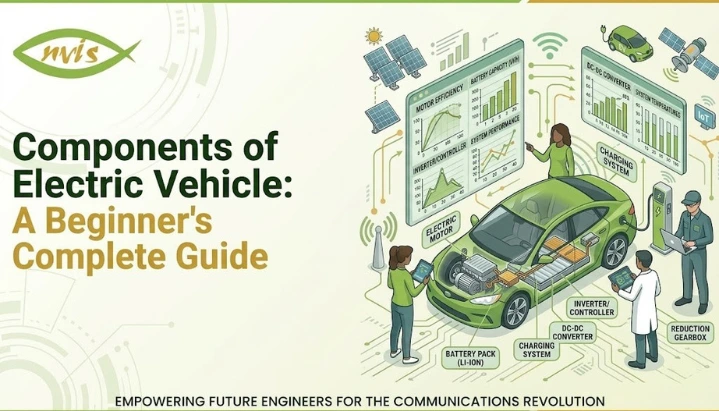
TL;DR
- This blog is for university students, freshers, and technology learners. This guide explains what are the main components of electric vehicle systems without assuming any prior engineering knowledge.
- Electric vehicles replace traditional combustion engines with a battery-powered electric motor system, a fundamental shift that changes almost every part of how a vehicle works.
- The core components of an electric vehicle include the traction battery pack, electric motor, inverter, onboard charger, and controller, each playing a distinct and critical role.
- Understanding how EV components interact from energy storage to motion to normal regulation helps you grasp why EVs are more efficient, lower in maintenance, and better for the environment.
- The EV industry is one of fastest-growing technology sectors globally, and knowing these components gives you a solid foundation for careers in automotive engineering, energy, or sustainable technology.
The switch to EVs is one of the biggest engineering transformations in modern transport. Conventional ICE (internal combustion engine) vehicles rely on burning fossil fuels to generate mechanical power, while EVs use a completely different energy chain that is all based around the storage, conversion and management of electrical energy.
This shift is not simply about replacing one energy source with another. This shift requires a completely new set of components designed to operate together within an integrated electrical system. The knowledge of the components of EV architecture is not just about being technically interested, but is essential for any aspiring engineer in the automotive industry, sustainable energy, power electronics, or EV policy.
The EV market is growing rapidly around the world, as battery prices drop, emission mandates from governments increase and charging station investments are pouring in. With EVs gaining traction, engineers, students, and consumers alike would benefit from understanding the primary elements of an EV system as well as how they work together.
This guide provides fundamental information on the key sections of an electric vehicle system in a non-technical and easy-to-understand manner. This article explains the role and purpose of each component, whether you are a student, a curious learner or a potential EV tech enthusiast.
What Makes an Electric Vehicle Different
It is important to understand the bigger picture before jumping into components.
A standard car uses an internal combustion engine (ICE) to power the vehicle. It produces mechanical energy and helps in the movement of vehicles by burning petrol or diesel. It involves hundreds of moving parts such as pistons, crankshafts, gearboxes, and exhaust systems, while also producing carbon emissions as a byproduct.
An electric vehicle gets rid of all that. Rather than use fuel to spin a motor, it uses electricity from a battery pack to spin an electric motor. The wheels are powered by the motor. It’s the basic concept.
This creates a simpler energy chain with fewer parts, less friction, lower maintenance, and no direct emissions. Creating a car based on electric power, however, comes with its own set of engineering difficulties and hence the components of EV design become especially interesting.
Major Components of Electric Vehicle Systems
Let us now go through each of the main components of electric vehicle architecture, one by one.
1. Traction Battery Pack
The traction battery pack is the most important component of an electric vehicle. It stores the electrical energy required to power the motor and operate the vehicle
It’s like a fuel tank in a normal car but it stores a charge of electricity. A battery pack is made up of hundreds or thousands of individual lithium-ion cells grouped into modules, which are assembled into a full pack.
Batteries are rated by their energy capacity, in kilowatt-hours (kWh). The higher the kWh rating the longer the driving range. For instance, a 75 kWh battery will enable a vehicle to cover more distance in one charge, than a 40 kWh battery.
The battery pack also supplies direct current (DC) power to other vehicle components. Its biggest advantage is the ability to store energy produced during the process of regenerative braking, which we’ll discuss later in this guide.
2. Electric Motor (Traction Motor)
The electric motor is the muscle of the electric vehicle.
An electric motor converts electrical energy into mechanical rotational force that turns the wheels. This is the component that propels the car forward and backward.
This is a function of the combustion engine on a traditional car. However, an electric motor is much more efficient to do this. In a combustion engine, only 20 to 40 per cent of fuel energy is converted into useful motion. In contrast, electric motors can convert more than 90 per cent of electrical energy into mechanical movement.
There are two common types of electric motors used in EVs:
- AC (Alternating Current) motors are widely used because they are efficient, reliable, and require less maintenance. Tesla Model 3, for instance, uses an AC induction motor.
- DC (Direct Current) motors Less common in modern EVs but still used in some applications.
Many high-end EVs use two or more electric motors, one for the front axle and one for the rear axle which gives the vehicle all-wheel drive and much better performance.
3. Power Inverter
This is where it gets a little technical, but don’t worry, it’s not too bad.
A traction battery stores energy in the form of DC electricity. However, most high power electric motors used in EVs operate on alternating current (AC) electricity. How then does a car do this? The power inverter will do that.
The inverter is a power module that converts the direct current from the battery, into alternating current for the motor. It also works during regenerative braking, where the motor acts as a generator and the inverter helps transfer recovered electrical energy back to the battery.
The inverter is not only a type-switching device. It also regulates the frequency and voltage of electricity sent to the motor, resulting in a varying speed and torque of the motor. This means that the inverter is involved in the acceleration of the vehicle and its running efficiency.
4. Onboard Charger (OBC)
Electricity from the grid (when plugged into the wall socket or public charging station) is alternating current or AC. However, the battery keeps the DC. In order to charge the battery, it must be converted from AC to DC power. That is the role of the onboard charger.
This conversion is performed by an onboard charger that is located inside the vehicle and is used during Level 1 and Level 2 charging. It controls charging speed, keeps track of battery health, and ensures the electric current the battery receives is of proper voltage and current.
It should be noted that DC fast chargers (such as those at highway charging stations) don’t use the onboard chargers at all. Fast charging times are much faster, because you are providing high power DC electricity directly to the battery.
5. Charge Port
EV connects to an outside power source via a charge port. It’s kind of like a fuel cap on a regular car, but with a cable.
Each manufacturer has a different location of the charge port. On some EVs, it is located at the front, while on others it may be placed at the rear or on the side. Charge ports need to be compatible with the charging standards used in your region. For instance, Type 2 connectors are widely used in Europe, and CCS (Combined Charging System) connectors enable both AC and fast DC charging.
Wireless charging is another feature that is still new on most consumer EVs, but is supported by some.
6. DC-DC Converter
This is a component that many people new to EV technology may overlook , but it is very practical.
A traction battery is a high voltage battery, typically 200 to 800 volts depending on the vehicle. However, the low voltage inside of the car lights, dashboard screens, the power window, the audio system and the horn are all powered by a 12 volt battery.
The DC-DC converter reduces high-voltage DC from the traction battery to 12-volt DC for low-voltage accessories. It also charges the auxiliary battery.
If not for a DC-DC converter, you’d have to have a separate power source for the car’s electronics, something that would be unnecessarily bulky and complicated.
7. Auxiliary Battery
Each EV is equipped with a secondary battery as well as the primary battery for propulsion. This type of battery is known as an auxiliary battery and usually consists of a standard 12-volt battery that would be found in a standard car.
The auxiliary battery powers essential low-voltage systems before the main traction battery becomes active. This covers such items as onboard computers, door locks, lights and low voltage components that must function whether or not the vehicle is moving.
The auxiliary battery is kept charged by a DC-DC converter during normal operation. It can be thought of as a backup power system for the vehicle’s electronics.
8. Controller (Electronic Control Unit / VCU)
The controller is the brain, while the battery is the heart and the motor is the muscle.
The Vehicle Control Unit (VCU), also called the Electronic Control Unit (ECU), acts as the central decision-making system of an EV. It continuously monitors driver inputs such as accelerator position, brake pressure, battery condition, motor speed, and many other variables to make real-time decisions about power distribution throughout the vehicle.
When you press the accelerator pedal, the controller tells the battery to send power through the inverter to the motor, resulting in vehicle movement. When you ease off, it controls the regenerative braking process. It also enforces safety limits to prevent overcharging, overheating, and over-discharging of the battery.
In addition to VCU, modern EVs will also employ a dedicated Battery Management System (BMS), which is there to specifically manage all of the traction battery cells. It will ensure that the cells have even charging and discharging, keeping the battery healthy and increasing its life.
9. Thermal Management System
Don’t subject batteries or electronics to extreme temperature variations. Overheating can create hazardous conditions, and excessively high temperatures can significantly reduce performance. In extremely cold conditions, the battery becomes less efficient and delivers reduced driving range.
A thermal management system maintains the temperature of all components within an optimal range. It consists of liquid cooling circuits, heat exchangers, radiators and in some cases heating elements, that help regulate temperatures in battery packs, motors, inverters, and power electronics.
The system also manages the heat generated during regenerative braking and other high-power operations. It is essential that the right temperature is achieved during this process to ensure efficiency and safety.
Some high-tech EVs also feature heat pumps, which are systems used in home heating that can efficiently warm the cabin even in cold weather conditions without spending too much battery.
10. Regenerative Braking System
It is one of the most ingenious aspects of today’s electric cars, and when you grasp how it works, you’ll be amazed at the efficiency that’s built into these cars.
A conventional car converts the kinetic energy of a moving vehicle into heat when the brakes are applied, due to friction between the brake pads. This heat is lost energy.
Regenerative braking harnesses energy that would otherwise be lost in an EV. When the driver lifts off the accelerator or applies the brakes, the electric motor temporarily acts as a generator. It takes the vehicle’s kinetic energy and changes it back to electrical energy, which passes through the inverter and is stored in the vehicle’s battery pack.
This is done simultaneously: it slows down the vehicle (as normal braking does), and it partially charges the battery. Regenerative braking can make a significant improvement to the driving range of an EV on city roads where frequent stops are common.
11. Transmission
Older vehicles rely on a multi-speed automatic transmission to maintain the optimum power range of the engine at various speeds. Electric motors don’t require this since they provide a steady torque over a broad range of speeds. That is why most EVs utilize a solitary speed transmission, a far simpler setup.
A single-speed transmission transfers power from the motor to the wheels using a fixed gear ratio. This reduces the need for complex gears and clutch systems
It is this simplicity that helps EVs to be so smooth and responsive to drive. No power loss due to gear changes.
How All Components of Electric Vehicle Work Together
Now that you know each component individually, it helps to understand complete energy flow.
Here is a simplified version of what happens when you drive an EV:
- The charge port and onboard charger bring electricity in from the grid and store it in a traction battery pack.
- When you press the accelerator, the controller signals the battery to release energy.
- Electricity flows from battery to inverter, which converts DC to AC.
- An electric motor receives AC electricity and converts it into mechanical energy.
- The transmission delivers mechanical energy to the wheels, causing the vehicle to move.
- DC-DC converter continuously powers accessories and keeps the auxiliary battery charged.
- A thermal management system monitors temperatures and keeps everything within safe limits.
- When you slow down, the regenerative braking system recovers kinetic energy and sends it back to the battery.
- The Battery Management System watches over every cell to ensure health and safety at all times.
Every one of the components of electric vehicle systems plays a role in that chain. Remove any one of them, and the vehicle cannot function safely or efficiently.
Why Understanding Electric Vehicle Components Matters?
EVs are more than just a trend , they represent a paradigm shift in how we power our transportation, and the trend is accelerating.
The International Energy Agency (IEA) Global EV Outlook report indicates that the EV market will see significant growth year on year, as battery costs continue to drop and governments push for cleaner transportation. India is investing heavily in EV infrastructure and promoting EV adoption through the Faster Adoption and Manufacturing of Electric Vehicles (FAME) scheme
This is an actual opportunity for students and young professionals. Knowing the major parts of EV systems is essential for the automotive industry, battery engineering, power electronics, embedded electronics, and sustainable energy professions.
As a consumer, this information can be helpful when you’re weighing the range of an EV, the charging options, or which EV is the right one for you.
Conclusion
Electric vehicles are sophisticated systems that combine electrical, mechanical, and thermal engineering. Every component, from the traction battery pack that stores energy to the inverter that converts it and the Battery Management System that protects it, serves a specific purpose in the EV energy chain. All of these components are interconnected, and their effectiveness depends on how efficiently they work together.
This change from combustion to electric propulsion is not merely an engineering replacement. It represents a paradigm shift in energy storage, propulsion, cooling, and regenerative systems within vehicle operation. This knowledge of key elements of electric vehicle systems offers a conceptual base for fruitful discussion of this technology in an academic, professional or practical setting.
Understanding these basic components is becoming increasingly important, especially for engineers, but also for anyone wishing to understand the technology that defines the future of transportation, as the use of electric vehicles is growing rapidly everywhere and an EV sector is building up in India.
Frequently Asked Questions
The key components of an EV system are the traction battery pack, electric motor, power inverter, onboard charger, charge port, DC-DC converter, auxiliary battery, controller, Battery Management System, thermal management system , and single-speed transmission. Each component serves a particular function for energy storage, conversion or management.
The traction battery pack is typically the most important element in an EV design. It carries all the energy required to propel a vehicle, and directly affects vehicle range, vehicle performance and the total cost of ownership. The EV industry is moving forward largely due to battery technology.
The electric motor converts to a generator when the driver slows down or applies the brakes. The motor uses kinetic energy to provide electrical energy, which is not wasted as heat (as happens with friction brakes). This electricity is then fed back through the inverter to the traction battery for later use. Regenerative braking allows for longer driving range – especially in urban environments.
Electric motors can provide continuous torque at all speeds and unlike combustion motors are required to run in a limited range of RPMs. This eliminates the need for EVs to have a multi-speed gearbox to ensure that the motor operates within its optimal range. There is no need for a complex multi-speed gearbox because a single-speed transmission is sufficient for most EVs, and there’s a reduction in mechanical complexity and maintenance.
BMS is an electronic control system, which controls and manages each individual cell in a traction battery pack. It also ensures even charging and discharging of the cells, avoids over charging and over-discharging, keeps track of temperature, and reports battery health information to the vehicle’s primary controller. A properly designed BMS will be crucial for battery life and vehicle safety.
Most modern EV traction batteries are designed to last around 8–15 years or approximately 200,000 miles under normal usage conditions. Battery performance gradually degrades over time rather than failing suddenly, but it will deteriorate over time. Warranties on EV battery packs are available and are offered by many manufacturers for 8 years or 100,000 miles, whichever is reached first.