







TL;DR
- This blog is for engineering students, EV enthusiasts, and freshers in India who want to understand SOC and SOH in BMS, what these parameters mean, how a Battery Management System estimates them, and why accurate estimation is critical for safe and efficient EV operation.
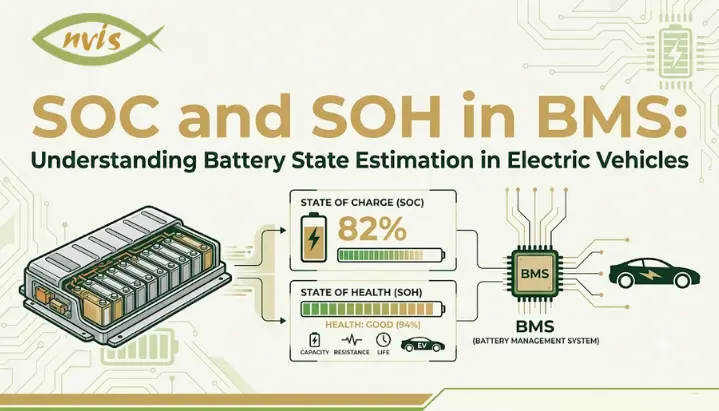
- SOC (State of Charge) tells you how much energy is left in the battery right now, like a fuel gauge. SOH (State of Health) tells you how much total capacity the battery still has compared to when it was new.
- Estimating SOC and SOH in a battery is far harder than it looks; these values cannot be measured directly and must be calculated using algorithms that combine voltage, current, and temperature data in real time.
- Modern BMS systems use a progression of methods from simple Coulomb Counting to Extended Kalman Filters and AI-driven machine learning models, each improving on accuracy and adaptability but requiring more computational power.
- SOC and SOH algorithm development is one of most technically demanding and high-paying BMS specializations in India’s EV sector.
There is a single number displayed on every electric vehicle dashboard that drivers check more anxiously than anything else: battery percentage. That reading is not a direct measurement. BMS cannot stick a probe into a battery cell and read the remaining energy way you measure liquid in a tank. Instead, it estimates figures continuously using a combination of sensor data, electrochemical models, and sophisticated algorithms. Getting this estimation wrong has real consequences for drivers, for battery longevity, and for safety.
SOC and SOH in BMS are two most important state parameters that every Battery Management System must continuously compute and communicate. SOC in BMS is a real-time energy gauge. SOH is a long-term health metric. Together, accuracy of their estimation determines whether an EV can maximize its range, protect its battery from harmful conditions, and give drivers reliable information to make decisions. This blog explains both concepts from the ground up, walks through how modern BMS systems estimate them, and connects this technical knowledge to practical career opportunities in India’s fast-growing EV industry.
Also Read
- How Battery Management System Training Helps Students
- Understanding Regenerative Braking Through Hands-on EV Training Labs
- Working Principle of Electric Vehicle Explained Guide
What Is SOC in BMS? Real-Time Energy Gauge
Think about the fuel gauge in a conventional petrol car. When the tank is full, it reads 100%. When it is empty, it reads 0%. gauge directly reflects the amount of fuel remaining. The state of Charge in a battery works on the same intuitive principle, but the physics underneath are fundamentally different.
SOC is defined as the ratio of the battery’s remaining available charge to its current usable capacity, expressed as a percentage, expressed as a percentage. A battery at 75% SOC has three-quarters of its usable energy remaining. A battery at 20% SOC is approaching a lower protection limit enforced by BMS to prevent deep discharge damage.
The critical word here is “estimate.” Unlike a fuel tank where you can measure liquid volume directly, a battery’s stored energy is locked inside an electrochemical system. There is no sensor that can directly read SOC. BMS must infer it indirectly by measuring external observable parameters it can access primarily voltage, current, and temperature and computing SOC from them using algorithms.
This estimation challenge is what makes SOC in BMS a genuinely difficult engineering problem. Battery voltage does have a relationship with SOC; a fuller battery sits at higher voltage but this relationship is highly non-linear, temperature-dependent, and shifts as battery ages. BMS must account for all these variables simultaneously, in real time, across every driving and charging scenario, Production EV BMSs generally aim for SOC estimation errors within a few percentage points under normal operating conditions of true value.
Why does accuracy matter this much? An overestimated SOC reading might let a driver attempt a trip that battery cannot actually complete, leading to a stranded vehicle. An underestimated SOC might trigger an early protective cutoff, wasting usable range. And an inaccurate SOC reading misleads BMS’s own internal algorithms for cell balancing, charging management, and protection logic creating a cascade of errors across the entire battery control system.
What Is SOH in BMS? Long-Term Health Metric
If SOC answers the question “how much energy is left right now,” then SOH answers an equally important question: “how much energy can this battery hold at all, compared to when it was new?”
State of Health is defined as ratio of battery’s current maximum capacity to its original rated capacity when new, expressed as a percentage. A battery with 85% SOH can hold 85% of energy it could store on the day it left the factory. The remaining 15% has been permanently lost to gradual degradation processes such as lithium inventory loss, electrode aging, and SEI layer growth.
industry-standard end-of-first-life threshold for an EV battery is 80% SOH. This is the point at which accumulated capacity loss becomes noticeable enough to significantly affect real-world driving range. It is also standard against which EV battery warranties in India are typically measured. Most manufacturers guarantee that their battery will retain at least 70 to 80% SOH for 8 years or a specified mileage.
SOH can be expressed through two lenses. capacity-based SOH compares current maximum charge capacity against original rated capacity in ampere-hours. This is the most common definition used by manufacturers and service engineers. Resistance-based SOH tracks the battery’s internal resistance, which increases as battery ages due to thickening of the SEI layer on anode, electrolyte decomposition, and electrode material degradation. Rising internal resistance reduces the battery’s ability to deliver high currents cleanly, causing voltage to sag under load and peak power to diminish even if capacity has not fallen as dramatically.
Both lenses together give engineers a complete picture of battery aging. Capacity fade tells you how much energy storage has been lost. Resistance increase tells you how much power delivery capability has been compromised. In a well-designed BMS, SOH monitoring tracks both.
Why SOC and SOH Are Coupled and Why That Makes Estimation Harder
One of the subtler challenges in BMS design is that SOC and SOH in a battery are not independent. They influence each other in ways that complicate accurate estimation of either.
Consider what happens as a battery ages and its SOH declines. The battery’s true maximum capacity is now lower than rated value. If BMS is still using original rated capacity to calculate SOC, its SOC estimates will drift away from reality. A battery with 80% SOH that is fully charged only holds 80% of its original energy capacity. If the BMS continues using the original rated capacity instead of the updated degraded capacity in its SOC calculations, SOC estimates can become inaccurate and drift from the battery’s true usable state.
Conversely, an outdated SOH figure causes errors in the SOC algorithm. When a BMS knows that a battery’s actual capacity has degraded, it must update the denominator used in SOC calculation accordingly. This is why modern BMS systems run SOC and SOH estimation algorithms jointly, feeding each other’s outputs as inputs. Accurate SOH feeds into SOC algorithm to keep fuel gauge accurate over battery’s life. And accurate SOC history feeds into SOH algorithms to identify capacity fade trends over hundreds of cycles.
This coupling is also relevant for range estimation. The driving range EV dashboard displays are not computed from SOC alone.It is estimated using remaining battery energy (which depends on both SOC and SOH) together with predicted energy consumption, driving conditions, and vehicle efficiency models. A degraded battery with poor SOH displays both a shorter maximum range and a faster-falling SOC percentage as it discharges, which can feel surprising to owners who do not understand connection.
How BMS Estimates SOC in a Battery From Simple to Sophisticated
The engineering challenge of estimating SOC in BMS has produced a range of methods, each with different trade-offs between simplicity, accuracy, computational cost, and robustness to real-world conditions.
Coulomb Counting Foundational Method
Coulomb Counting is the simplest and most widely used baseline method for SOC estimation. The principle is elegant: if you know how much charge went into the battery during charging and how much has come out during discharging, you can calculate remaining SOC by tracking net cumulative current over time.
In practice, BMS uses a current sensor to measure current flowing in and out of the battery pack every few milliseconds. It integrates this current over time (multiplied by efficiency factors) to update SOC figures continuously. The method is computationally simple, requires no battery model, and works in real time.
The weakness of Coulomb Counting is error accumulation. Current sensors have small measurement errors, and these errors integrate over time along with current itself causing SOC estimates to drift away from true value across a full charge-discharge cycle. The method also requires an accurate initial SOC to start from, and it has no self-correcting mechanism to compensate for accumulated drift. In a real vehicle that is charged and driven daily, uncorrected Coulomb Counting can produce SOC errors of 5 to 10% after a few weeks of operation.
Most BMS implementations use Coulomb Counting as primary real-time tracking method but combine it with a correction step based on voltage measurements when the battery is at rest.
Open Circuit Voltage Method Calibration Anchor
When a lithium-ion battery has been at rest for a sufficient period with no current flowing, it reaches electrochemical equilibrium and its terminal voltage stabilizes at Open Circuit Voltage (OCV). This OCV has a well-characterized relationship with SOC; each chemistry (NMC, LFP, NCA) has its own OCV-SOC curve established through laboratory testing.
By measuring OCV when a vehicle has been parked for long enough, BMS can look up corresponding SOC directly from this curve and use it to reset the Coulomb Counting accumulator, correcting any drift that has built up since last calibration.
The limitation is practical: OCV method only works when the battery is truly at rest, which does not happen during driving or active charging. It also requires vehicles to be parked for some time typically 30 minutes to several hours depending on chemistry before voltage fully stabilizes. LFP batteries present a particular challenge here because their OCV-SOC curve is very flat across a wide range of SOC, meaning small voltage measurement errors translate to large SOC errors during OCV-based calibration.
Extended Kalman Filter Adaptive Estimator
Extended Kalman Filter, or EKF, is the most widely deployed advanced SOC estimation method in production EV Battery Management Systems. It addresses limitations of both Coulomb Counting and OCV methods by combining their strengths within a mathematical framework that handles noise, uncertainty, and non-linearity.
Kalman Filter is fundamentally a recursive estimation algorithm. It maintains an internal model of the battery , typically an equivalent circuit model that represents the battery’s electrical behavior using resistors and capacitors and runs a continuous prediction-and-correction loop. At each step, it predicts what battery voltage should be based on its current SOC estimate and equivalent circuit model. Then it compares that prediction against actual measured voltage. The difference between the two is “innovation” , new information that updates SOC estimates.
“extended” version handles non-linear relationships between battery voltage and SOC that plain Kalman filters cannot manage, using linearization techniques at each update step. The result is an estimator that is robust to measurement noise, self-correcting against accumulated Coulomb Counting drift, and capable of tracking SOC accurately even through dynamic driving conditions, hard acceleration, regenerative braking, varying temperatures.
EKF can converge, EKF can converge toward an accurate SOC estimate even when the initial SOC estimate is significantly incorrect. EKF can converge toward an accurate SOC estimate even when the initial estimate is significantly incorrect. This robustness to initial conditions is critical for vehicles that have been parked for an extended time or in conditions where no OCV rest measurement was possible.
Machine Learning and AI-Based Methods Next Frontier
As EV fleets have grown and battery datasets have become richer, data-driven approaches using machine learning have entered BMS design for SOC and SOH estimation. Methods including LSTM (Long Short-Term Memory) neural networks, Gaussian Process Regression, and hybrid models that combine physics-based algorithms with ML layers are 97% accuracy in several published research studies in research settings.
The advantage of ML-based methods is their ability to capture complex, non-linear patterns in battery behavior that analytical models approximate imperfectly including subtle effects of battery aging, temperature variation, and chemistry-specific quirks. A well-trained LSTM network can learn from millions of charge-discharge cycles across a fleet of vehicles, effectively building an empirical model of battery behavior that improves over time with more data.
The challenge is computational: neural networks require more processing power than Kalman filters, which can strain microcontrollers embedded in BMS hardware. This has driven research into hybrid architectures using lighter ML models to correct or adapt classical filter-based estimators rather than replacing them entirely. Hybrid AI approaches combining physics-based models with ML layers have demonstrated SOH estimation accuracies approaching 97%, making them increasingly practical for production systems where OTA (Over-the-Air) updates can push improved algorithm versions to vehicles already in the field.
Several automotive engineering firms, including Tata Elxsi, have publicly highlighted work on advanced BMS platforms that incorporate improved SOC and SOH estimation capabilities for EV applications alongside conventional sensor monitoring, enabling more accurate range prediction and longer-term battery health tracking under Indian operating conditions.
How BMS Estimates SOH in a Battery
SOH estimation is fundamentally different from SOC estimation in one important way: SOH changes slowly over months and years, not moment to moment. This means algorithms tracking it operate on longer time scales and use different signals.
Capacity-Based SOH Estimation
The most direct approach to measuring SOH is to periodically perform a full charge-discharge cycle under controlled conditions and measure how much charge the battery actually accepts and delivers. Comparing this measured capacity to original rated capacity gives capacity-based SOH.
In a real EV, performing a full controlled cycle just to measure capacity is impractical. Instead, BMS systems reconstruct equivalent information from daily driving and charging data. When a vehicle is charged from a known low SOC to a known high SOC, BMS integrates current flow to measure how much charge was actually delivered and compares this to what original battery specifications would predict for the same SOC window. Doing this repeatedly across many charging sessions builds a statistical picture of how the battery’s actual capacity is changing over time.
Internal Resistance Tracking
Alongside capacity fade, rising internal resistance is another primary indicator of battery aging and a key input to resistance-based SOH estimation. As a battery ages through SEI layer growth, electrode degradation, and electrolyte decomposition, its internal resistance climbs. This shows up as increasing voltage drop under high-current loads, reduced peak power delivery, and greater heat generation during charging and discharging.
BMS tracks internal resistance through electrochemical impedance analysis applying a known current pulse and measuring immediate voltage response and through more sophisticated electrochemical impedance analysis in advanced systems. Comparing present internal resistance to beginning-of-life internal resistance gives a health indicator that complements capacity-based SOH and is particularly useful for detecting power fade in batteries that have not yet lost much total capacity.
Adaptive and AI-Driven SOH Estimation
Because SOH evolves slowly and depends on accumulated usage history, machine learning approaches are especially well-suited to SOH estimation. AI models trained on large battery aging datasets can learn to predict current and future SOH from patterns in voltage, temperature, and current data that develop subtly over hundreds of cycles.
Research combining machine learning with physics-based aging indicators has demonstrated SOH estimation accuracy above 97% on real-world battery datasets. growing availability of cloud-connected BMS systems where vehicle telemetry data from thousands of cars feeds into centralized machine learning models is accelerating this capability. Fleet-level SOH modeling enables manufacturers to predict battery replacement needs ahead of failure, optimize warranty management, and identify chemistry or usage patterns that accelerate aging in specific geographic or climatic conditions.
SOC and SOH Estimation in Indian EVs Real-World Context
India’s unique operating conditions create specific challenges for SOC and SOH estimation that are not fully addressed by algorithms developed for European or North American climates.
Battery voltage and OCV-SOC relationship are both temperature-dependent, and India’s wide temperature range from sub-zero winters in Himalayas to 48-degree Celsius summers in Rajasthan and Gujarat means BMS algorithms must be robustly calibrated across a far wider thermal envelope than temperate-climate markets require. An OCV-SOC lookup table calibrated at 25 degrees Celsius introduces SOC estimation errors when used at 45 degrees. Algorithms that correctly compensate for temperature across the full Indian range are a genuine engineering differentiator.
Ather 450X is an example of an Indian EV where SOC accuracy has been emphasized as a feature. Ather Energy’s BMS provides highly granular real-time battery state data to riders through its connected dashboard and companion app, with software and thermal management working together to improve battery monitoring and estimation accuracy by keeping cells within a well-characterized temperature range. Real-world incidents involving inaccurate range estimation have highlighted why SOC estimation accuracy is critical. In connected EV platforms, OTA firmware updates can improve estimation algorithms without requiring hardware changes demonstrating advantage of connected, updatable BMS software architectures.
Tata Motors and Tata Elxsi have collaborated on EV software and battery-management technologies, including work related to battery monitoring, battery-management software, and connected EV technologies, which integrates SOC and SOH estimation with OTA update capability. OTA-capable EV platforms make it possible for manufacturers to improve battery-management software over time through firmware updates where supported, refined through accumulated fleet data and algorithm improvements pushed wirelessly to all vehicles.
LFP chemistry, dominant in Indian EVs, presents a specific SOC estimation challenge due to its flat OCV-SOC curve. In NMC batteries, voltage changes significantly with SOC, giving OCV-based correction methods a clear signal to work with. In LFP, OCV changes by only about 0.1 volts across a wide mid-SOC range, making it very difficult to calibrate SOC accurately from voltage alone. LFP BMS designs therefore rely more heavily on Coulomb Counting accuracy and on Kalman Filter-type algorithms that can extract SOC from subtle dynamics of voltage response rather than from static OCV level.
Why SOC and SOH Estimation Is Technically Difficult
It is worth pausing to appreciate why SOC and SOH estimation in BMS systems is a genuinely hard engineering problem, not a straightforward measurement task.
The core difficulty is that quantities of interest stored energy and battery health are internal states of an electrochemical system that can only be inferred from external measurements. Voltage, current, and temperature are only signals available. Yet each of these measurements is imperfect: current sensors have noise and drift, temperature sensors may not reflect actual cell-core temperature, and voltage is a function of both SOC and internal resistance (which itself changes with temperature, aging, and current history in complex ways).
Battery behavior is also highly non-linear. The same voltage reading might correspond to different SOC values depending on whether the battery is charging or discharging (hysteresis), recent current history (relaxation effects), temperature, and battery’s age. These non-linearities must all be modeled and accounted for in the estimation algorithm.
And unlike most engineering systems, batteries change their fundamental characteristics over time as they age. An algorithm perfectly calibrated for a new battery becomes progressively less accurate as the same battery ages, which is why SOC and SOH estimation must be adaptive, continuously updating its internal model parameters to match the battery’s changing behavior.
This combination of unmeasured internal states, imperfect sensors, non-linear behavior, and time-varying characteristics is what makes SOC and SOH in battery systems a rich area for both academic research and practical engineering innovation.
Career Opportunities in SOC and SOH Algorithm Development for Students
For engineering students in India, SOC and SOH estimation represents one of most technically sophisticated and highly compensated specializations within BMS engineering domain.
BMS Algorithm Engineers who develop SOC and SOH estimation algorithms are among the most sought-after technical roles in India’s EV ecosystem. Companies including Tata Elxsi, Ather Energy, Ola Electric, Ultraviolette Automotive, Log9 Materials, Mahindra Electric, and Bosch India are actively building BMS software teams and recruiting engineers with estimation algorithm expertise. Ultraviolette Automotive explicitly lists algorithm development for SOC, SOH, and SOP (State of Power) estimation as a core responsibility in its BMS engineer job descriptions, alongside testing with hardware-in-the-loop (HIL) systems and compliance with AIS and ISO safety standards.
technical skills that employers in this space look for span several disciplines. Strong mathematical foundations in estimation theory understanding Kalman Filters, state-space models, and basics of system identification are essential. MATLAB and Simulink proficiency is expected for algorithm prototyping and model-based development, with embedded C or Python required for translating algorithms into BMS firmware. Electrochemistry fundamentals help engineers build better equivalent circuit models and understand why their algorithms behave the way they do in real cells. Knowledge of automotive communication protocols like CAN bus is needed for integrating BMS algorithms with vehicle-level systems.
Machine learning expertise is becoming increasingly valuable in this space. Engineers who can combine classical Kalman Filter methods with LSTM networks or Gaussian Process Regression models, and who understand how to validate and deploy these on embedded hardware with limited computational resources, represent a genuinely scarce profile with strong salary premiums. According to industry data, Engineers with expertise in SOC/SOH estimation, battery modeling, and control algorithms are generally considered among the more specialized BMS professionals, often commanding competitive salaries depending on their experience and employer within BMS engineering, reflecting depth and scarcity of this expertise.
For students building toward this specialization, recommended portfolio projects include implementing a Coulomb Counting plus OCV correction SOC estimator for a small LFP cell pack and logging accuracy against a reference, building an Extended Kalman Filter SOC estimator in MATLAB/Simulink with a Thevenin equivalent circuit model and validating it against synthetic current profiles, and developing a capacity-fade SOH tracker using publicly available NASA or Oxford battery aging datasets. These projects demonstrate both theoretical understanding and practical implementation ability exactly what BMS engineering teams look for in interviews.
Examples of organizations offering BMS-related training include Mobility Academy (ASDC-certified, IIT Guwahati EICT affiliated), Decibels Lab’s Master Course in BMS Algorithm Development covering MATLAB, Simulink, and Kalman Filter implementation, and IIT Madras and IIT Delhi battery research groups for students interested in academic research paths. For self-learning, a combination of Battery University resources for electrochemistry, MIT OpenCourseWare estimation theory materials, and MATLAB’s own battery modeling tutorials covers most of the foundational knowledge needed to start contributing meaningfully to this field.
Conclusion
SOC and SOH in BMS are not just dashboard numbers or technical abbreviations. They represent core estimation intelligence that makes safe, reliable, and efficient EV operation possible. Every kilometer of range displayed on an EV dashboard, every protective intervention that stops a battery from overcharging, and every warranty assessment made about a battery’s remaining life depends on how accurately BMS estimates these two parameters.
The estimation challenge is real and significant. Battery electrochemistry is non-linear, temperature-dependent, and time-varying in ways that make direct measurement impossible and algorithmic inference genuinely difficult. progression from Coulomb Counting through OCV correction to Extended Kalman Filters and AI-driven hybrid models reflects decades of research and engineering effort to close the accuracy gap between what sensors can observe and what drivers and engineers need to know.
For students and engineers in India, this domain connects foundational mathematics estimation theory, state-space models, probability with practical electrochemistry and embedded systems engineering. It is a technically demanding specialization with strong career prospects in a sector that is growing rapidly and urgently needs skilled talent. Companies building India’s next generation of EVs need engineers who understand not just that SOC and SOH must be estimated, but precisely how that estimation works, what causes it to fail, and how to make it better.
Build fundamentals. Implement a Kalman Filter in MATLAB. Understand your LFP flat-curve SOC problem. Learn BMS CAN protocols. And position yourself for one of most intellectually rich and practically important roles in India’s electric mobility future.
FAQs
SOC in BMS stands for State of Charge, real-time percentage of energy remaining in a battery relative to its current maximum capacity. It functions like a fuel gauge for an EV, telling the driver how much energy is left and informing BMS’s decisions about charging limits, power delivery, and protective cutoffs. SOC cannot be measured directly and must be estimated using algorithms that process voltage, current, and temperature sensor data.
SOC (State of Charge) represents the present energy level of a battery as a percentage of its current capacity; it changes every few minutes with driving and charging. SOH (State of Health) represents a battery’s current maximum capacity as a percentage of its original rated capacity when it changes slowly over months and years as battery ages. SOC answers “how much is left now?” and SOH answers “how much can this battery hold in total compared to when it was new?”
BMS uses multiple complementary methods. Coulomb Counting integrates current over time to track SOC continuously. Open Circuit Voltage measurements correct accumulated drift when the vehicle is at rest. Extended Kalman Filters combine both approaches within a mathematical framework that handles measurement noise and non-linearity, providing robust real-time SOC estimation even under dynamic driving conditions. SOH is estimated by tracking capacity fade over multiple charge-discharge cycles and by monitoring growth of internal resistance over time.
LFP (Lithium Iron Phosphate) batteries have an extremely flat Open Circuit Voltage versus SOC curve voltage changes by only about 0.1 volts across a wide mid-range SOC window. This makes OCV-based SOC correction very unreliable for LFP, since small voltage measurement errors translate to large SOC estimation errors. LFP BMS designs compensate by relying more heavily on high-accuracy Coulomb Counting, adaptive Kalman Filter algorithms that extract SOC from dynamic voltage response rather than static OCV level, and more frequent full-cycle calibrations.
SOC and SOH estimation are coupled in a modern BMS. Accurate SOH is needed to keep SOC estimation correct as battery ages; if BMS still uses original rated capacity as denominator while actual capacity has fallen, SOC readings become misleading over time. Conversely, tracking SOC precisely over many cycles is how BMS builds data needed to estimate SOH. Both estimations also feed into range prediction, charging strategy optimization, cell balancing decisions, and warranty health reporting.
BMS Algorithm Engineers specializing in SOC and SOH estimation are among highest-demand profiles in India’s EV sector. Companies like Tata Elxsi, Ather Energy, Ultraviolette Automotive, Ola Electric, Mahindra Electric, and Bosch India recruit engineers with expertise in Kalman Filter implementation, MATLAB/Simulink model-based development, and machine learning applications for battery state estimation. This specialization is often associated with higher compensation due to the combination of battery modeling, embedded systems, and estimation-algorithm expertise. Students should build portfolio projects around Coulomb Counting, EKF SOC estimation in MATLAB, and capacity-fade SOH tracking using public battery aging datasets.