





TL;DR
- This blog is for engineering students, freshers, and GATE/SSC JE aspirants who want to understand what a microcontroller in IoT actually does and how to build a working sensor to cloud project from scratch.
- Many smart devices, such as fitness trackers and smart streetlights, rely on microcontrollers to sense, process, and respond to information.
- Choosing the right IoT development board depends on your project’s processing, connectivity, power, and peripheral requirements rather than simply following the most popular option.
- Building even one complete sensor to cloud project teaches skills directly relevant to GATE, SSC JE, RRB JE, and entry level embedded and IoT roles in India.
Many smart devices, such as fitness trackers and smart streetlights, rely on tiny embedded chips to sense, process, and respond to information. In many iot microcontroller devices, this role is handled by a microcontroller. Understanding how microcontrollers work is therefore useful for engineering students interested in IoT and embedded systems. This blog explains what a microcontroller does for an iot device, how to choose one that’s best suited for your needs and build an entire iot project from sensors through cloud computing. At this stage, you will have an understanding of concepts and a working prototype that you can present and discuss during an interview.
Also read,
- 8051 Microcontroller: Architecture, Pins, Working & Uses
- STM32 Microcontroller Guide: How It Works, Programming, and Applications
- Swinburne Test of DC Machine: Procedure & Working
What Is a Microcontroller in IoT ?
A microcontroller used in an IoT device is an integrated circuit that combines a processor core, memory, and peripherals such as GPIO, timers, communication interfaces, and sometimes ADCs on a single chip. It’s designed for performing particular controls and processing functions effectively instead of doing general-purpose computing tasks.
A microcontroller is a component commonly used inside an embedded system and can act as the local controller for an IoT device. It can collect information like temperature, humidity, motion, gas sensor readings; process this information to respond as per programmed parameters. For instance, it may convert an electrical signal from a sensor into a temperature value, activate a fan when the temperature exceeds a set limit, and send the processed data to another device or cloud service using protocols such as MQTT or HTTP.
The microcontroller is ideal for iot because it’s small, cheap and low power consuming. Unlike a typical microprocessor-based system, where memory and peripherals may be provided as separate components, a microcontroller integrates a processor, memory, and many peripherals on a single chip. It reduces total hardware needed for building an iot device.
basic role of a microcontroller in an IoT system can therefore be summarized in three stages:
- Collect data: Read information from connected sensors.
- Process data: Convert and analyze sensor readings according to programmed logic.
- Control or communicate: Trigger an action locally or send processed information to another device, gateway, or cloud service.
Thus, microcontrollers provide local intelligence that allows an IoT device to sense its environment, process information, and respond or communicate accordingly.
Why Microcontrollers Matter So Much in IoT Development
This is an interesting question to sit on for a while. Why not just use a regular computer chip for every IoT device. An intelligent drinking water bottle with a reminder function does not require an integrated processor like that found on gaming laptop computers.
This is where the role of a microcontroller in IoT becomes clear. IoT gadgets are usually powered by batteries; they are tiny and need to last for months/years without any repairs. A microprocessor-based system typically requires more supporting hardware and may consume more power than a microcontroller-based design, making microcontrollers a practical choice for many simple, battery-powered IoT devices.
The microcontroller solves it through being designed for that purpose. Many microcontrollers offer low-power sleep modes that can reduce current consumption significantly, while still providing enough processing capability for sensor logic, decision-making, and communication. Low power, low cost and just enough computing is what made IoT development explode the way it did over the past decade.
Scalability is another important factor. Smart city projects may use ten thousand sensors on streetlights, water pipes and traffic lights. Deploying a full computer at every sensing point would often add unnecessary cost, power consumption, and complexity. Microcontrollers are practical for many mass-deployed IoT endpoints where low power, low cost, and local control are important, from college-level projects to industrial monitoring systems.
What Is MQTT in IoT?
MQTT (Message Queuing Telemetry Transport) is an efficient messaging protocol that is commonly used for communication between iot devices, applications, and servers. Publish-subscribe is an example of this communication pattern where a device publishes information on a particular topic that other computers/applications can subscribe for receiving this information.
An MQTT-based IoT application uses an intermediary called a broker to receive messages from publishers and deliver them to subscribers. A sensor node like an iot device (microcontroller) publishes sensor data to a topic like home/livingroom/temperature. MQTT broker receives this message, then forwards it to every client that is subscribed for this particular topic. This allows publishers and subscribers to exchange information without communicating with each other directly.
IoT applications are well suited to use of MQTT as they have low network traffic needs, low bandwidth requirements. It is useful to microcontrollers, battery-powered devices, and systems running on limited or unreliable networks. MQTT also has some small fixed protocol overhead, although the total message size depends on the topic, payload, and other protocol fields.
For instance, an ESP32 based weather station can measure the temperature every ten seconds and publish the reading to home/livingroom/temperature. The MQTT broker receives this information, then sends it on to subscribers like an app and dashboard. Once the dashboard receives the published data, you can view the latest temperature readings online without repeatedly checking the sensor itself.
Thus, MQTT is an effective means to communicate between iot devices/applications by publishing/subscribing/sharing information about sensors via a lightweight topic-based messaging protocol.
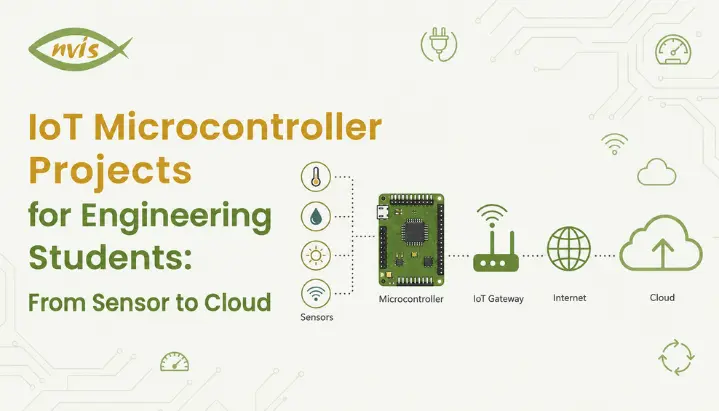
How the Sensor-to-Cloud Pipeline Works
Before touching any code, it helps to understand the full journey your data takes in a typical IoT development project. Picture posting a letter. You write it, drop it in a letterbox, it travels through a sorting system, and eventually reaches someone who reads it and reacts. IoT data follows the same logical journey.
Stage 1: Sensing
A sensor is a device that observes something in the physical world and converts it into an electrical signal. Sensors can provide either analog or digital output. For example, an MQ-2 and many soil-moisture sensors can provide analog readings, while the DHT22 communicates digitally with the microcontroller. The microcontroller reads the sensor output and converts or interprets it into useful values.
Stage 2: Processing
This is where microcontrollers in IoT earns its keep. When a sensor provides an analog voltage, the microcontroller can use its ADC, or analog-to-digital converter, to convert that voltage into a digital value that the program can process. Digital sensors such as the DHT22 do not require the same ADC conversion step. It then applies logic. Is the temperature too high? Is the soil too dry? Should an alert be triggered?
Stage 3: Connectivity
Once the microcontroller decides data is ready to be sent, it hands it off to a communication module. This could be a built-in Wi Fi radio, as in ESP32, or an external module connected to a microcontroller that lacks built-in wireless, like a classic Arduino Uno paired with an ESP8266.
Stage 4: Cloud and Visualization
MQTT or HTTP requests carry your data from microcontroller in IoT to cloud platform, where it gets stored, graphed, and made available for users to see on a dashboard or app. This is the part that makes the IoT feel magical, watching a live graph update on your phone because a sensor in your room just took a reading.
Most competitor tutorials stop at “sensor sends data to cloud” without explaining how that handoff actually works. One common way to handle the communication between IoT devices, gateways, applications, and cloud services is MQTT. Other approaches, including HTTP and CoAP, are also widely used depending on the application.
Choosing Right Microcontroller for Your IoT Project
This is where many students get stuck. There are many development boards available, and different tutorials often recommend different options. The choice becomes easier once you know what your project actually requires.
Ask three questions to start with. Is there a built-in wireless capability? Does it have to run for months on a small battery? Does the project require precise timing or real-time control, such as controlling a motor’s speed?
If your requirement is “I need Wi-Fi and want to build a working prototype quickly,” an ESP32 is usually a strong choice for an IoT project. Wi-Fi, Bluetooth support is available, it has a dual core processor, and it is easy to use for beginners with Arduino IDE. This makes the ESP32 a popular choice for college-level IoT development projects.
If your project prioritizes precise timing, real-time control, or advanced peripheral support and you are comfortable using a separate wireless module, an STM32 board can be a suitable choice. STM32 boards, many of which use ARM Cortex-M cores, offer a wide range of peripherals and strong real-time control capabilities. They are commonly used in motor control, industrial automation, and precision measurement applications, which matters for projects involving motor control or precision measurement.
For beginners who want to learn microcontroller programming before moving into wireless projects, the Arduino Uno can be a straightforward starting point.
| Microcontroller | Built in Wi Fi/Bluetooth | Best For | Approx. Price (India) | Learning Curve |
| Arduino Uno | No | Learning basics, sensor interfacing | Rs 450 700 | Easiest |
| ESP32 | Yes (Wi Fi + Bluetooth) | IoT projects, cloud connectivity, home automation | Rs 350 600 | Easy to Moderate |
| ESP8266 (NodeMCU) | Yes (Wi Fi only) | Budget IoT projects, simple sensor to cloud setups | Rs 200 350 | Easy |
| STM32 (Blue Pill/F4 series) | No (needs external module) | Motor control, industrial automation, precision projects | Rs 300 1200 | Moderate to Advanced |
| Raspberry Pi Pico W | Yes (Wi Fi) | Python based IoT projects, custom I/O timing | Rs 500 700 | Easy to Moderate |
A quick clarification many students ask about: is a Raspberry Pi a microcontroller? No, a Raspberry Pi is a microprocessor based single board computer running a full operating system like Linux, while Raspberry Pi Pico is genuinely a microcontroller board. This distinction often shows up in exam questions and interviews, so it is worth remembering clearly.
How to Calculate IoT Battery Life
Numbers help to remember things better so let’s try out some math problems that may appear on an GATE/SSC JE exam and are also relevant for project design.
Suppose you are building a soil moisture monitoring node using an ESP32 that will run on a 2000 mAh battery. Assume the ESP32-based node draws 160 mA during the active five-second period, and this active phase lasts 5 seconds every reading cycle. Between readings, it enters deep sleep mode, drawing only 10 microamps for the remaining 595 seconds of a 10 minute cycle.
- Calculate the average current consumption first.
- Active phase charge per cycle = 160 mA × (5/3600) h ≈ 0.222 mAh.
- Sleep phase charge per cycle 0.01 mA multiplied by equals 0.00165 mAh.
- Total charge per 10 minute cycle 0.222 plus 0.00165 equals approximately 0.2237 mAh.
- Number of cycles in 24 hours 144 cycles, since there are 144 ten minute intervals in a day.
- Total daily consumption 0.2237 x 144 = approximately 32.2 mAh per day.
The theoretical battery life is approximately 62 days, assuming the battery can deliver its full rated capacity and the ESP32 consistently follows the stated current profile. In practice, battery life will be lower because of battery characteristics, voltage regulation losses, Wi-Fi behavior, sensor consumption, and temperature.
This one calculation shows precisely how important deep sleep modes are for actual IoT development. Without sleep mode, the same ESP32 running continuously at 160 mA would drain a 2000 mAh battery in approximately 12.5 hours. That difference, 62 days versus half a day, is the entire reason power management is treated as a core skill in embedded systems and IoT interviews.
How to Build a Sensor-to-Cloud IoT Project
Let’s put everything together into a project structure you can actually build. We will use a temperature and humidity monitoring system, a common and genuinely useful starting project for IoT development.
Components needed: An ESP32 board, a DHT22 temperature and humidity sensor, a breadboard, jumper wires, and a free ThingSpeak or Blynk cloud account.
Step 1: Wire sensor. Connect DHT22’s data pin to a GPIO pin on ESP32, and connect its power and ground pins accordingly. This is the sensing stage of our pipeline.
Step 2: Write reading logic. Using Arduino IDE, write code that reads temperature and humidity values from DHT22 every few seconds. This is the processing stage, where raw sensor data becomes usable numbers.
Step 3: Connect to Wi Fi. Add code that connects ESP32 to your Wi Fi network using your network credentials. Without this step, the microcontroller has no way to reach the outside world.
Step 4: Publish to cloud. Use the platform’s supported API or library to send your readings to a cloud channel or dashboard. Depending on the platform and implementation, the data may be transmitted using HTTP or MQTT.
Step 5: Visualize data. Log in to your ThingSpeak dashboard and watch live graphs update as your sensor sends new readings. If you want to go further, set a threshold, such as an alert if humidity crosses 80 percent, and trigger an email or app notification.
Once you have built this one project end to end, you understand the entire IoT development pipeline well enough to extend it into more advanced ideas, such as a smart irrigation system, an air quality monitor, or an energy consumption tracker for your hostel room.
Microcontrollers in IoT and Industry Relevance in India
For engineering students in India, microcontroller and IoT skills are relevant beyond classroom projects because they are used across embedded, industrial, automotive, and connected-device applications; it’s also relevant for job opportunities and government projects related to the electronics industry.
India’s growth in electronics manufacturing, connected devices, and electric mobility has increased the relevance of hardware, firmware, embedded systems, and connectivity skills. IoT product companies may require engineers with skills in microcontroller programming, sensor interfacing, firmware development, and cloud connectivity.
Organizations such as ISRO, DRDO, BEL, and BHEL work on systems involving embedded electronics, instrumentation, control, monitoring, and related technologies. The specific processors and architectures used vary by project. Although industrial and government systems use hardware and design practices far more sophisticated than a classroom ESP32 project, the basic engineering workflow sensing, processing, communication, testing, and validation remains relevant.
In terms of the private sector, iot development has become one of its specializations among core electronics and computer science jobs done by big companies like automakers that develop connected vehicles and smart factories that use industrial iot for predictive maintenance.
GATE, SSC JE, and RRB JE Exam Relevance
If you are preparing for competitive exams, microcontroller and embedded systems concepts are particularly relevant to GATE Electronics and Communication Engineering and Instrumentation Engineering preparation.
Microprocessor and microcontroller concepts are relevant to GATE preparation, particularly for students studying digital systems, computer organization, and related electronics topics. Check the latest official GATE syllabus for the exact topic coverage, and questions frequently touch on interfacing, memory organization, and input output handling. For GATE Instrumentation Engineering, microprocessor/microcontroller and interfacing-related topics should be studied according to the current official syllabus.
For relevant technical exams such as GATE and RRB JE, students should review fundamentals such as microprocessor and microcontroller concepts, digital electronics, ADC/DAC, and interfacing where these topics are included in the applicable syllabus. Important areas may include basic microcontroller architecture, differences between microprocessors and microcontrollers, ADC/DAC characteristics, and fundamental embedded-system concepts, difference between microprocessors and microcontrollers, ADC and DAC characteristics, and fundamental embedded system concepts. These questions are usually conceptual rather than heavily numerical, which means a strong grasp of definitions and practical understanding, exactly what this blog has built so far, goes a long way.
A practical exam strategy: do not just memorize that a microcontroller has a CPU, RAM, ROM, and I/O on a single chip. Understand why that integration matters, as we covered in earlier sections, because exams increasingly frame questions around application and reasoning rather than pure recall.
Career and Salary Guidance for Aspiring IoT Engineers
Once you have a working IoT development project under your belt, it becomes a genuine asset for placements and interviews, not just a lab submission.
Freshers entering IoT and embedded roles in India can typically expect starting salaries in the range of Rs 3 to 8 LPA, depending on the company, your project portfolio, and your grasp of both hardware and cloud side skills. Roles at larger product companies and multinational corporations tend to sit at the higher end of this range, especially for candidates who can demonstrate hands-on project experience rather than just theoretical knowledge.
As you gain experience, typically in the 4 to 7 year range, with experience, professionals who combine embedded development with cloud integration, IoT protocols, security, or industrial IoT skills may qualify for more advanced roles with higher compensation. Specializing further into edge computing, firmware security, or industrial IoT tends to open even higher paying senior roles later in a career.
For students specifically, practical advice is this: a single well documented sensor to cloud project, complete with a GitHub repository, a short demo video, and a clear explanation of your design choices like power calculation we walked through earlier, often matters more in interviews than a long list of half finished project titles on a resume.
Conclusion
Understanding a microcontroller in IoT is really about understanding one small but powerful idea: a tiny, efficient chip can sense the physical world, make sense of that data, and connect it to the cloud, all while running on a fraction of the power a regular computer would need. We walked through what a microcontroller actually does, why it matters for iot microcontroller at scale, how data travels through sensor to cloud pipeline using protocols like MQTT, and how to choose the right board for your specific project. We also worked through a real battery life calculation and a complete project structure you can build today.
The best next step is not to read another article, it is to order a DHT22 sensor and an ESP32 board, and build the project we outlined above. Once you see your own sensor data update live on a cloud dashboard, IoT development stops being an abstract topic and becomes a skill you genuinely own. Share your first project results or questions in comments, and start building.
FAQs
A microcontroller in IoT is a small, self-contained chip that reads data from sensors, processes it, and either acts on it directly or sends it to the cloud through a communication module. It combines a processor, memory, and input output pins on a single chip, making it ideal for compact, battery powered IoT devices.
ESP32 is generally the best starting point because it has built in Wi Fi and Bluetooth, works with beginner friendly Arduino IDE, and is affordable enough for student projects. If you want to first understand microcontroller programming without wireless features, an Arduino Uno is a solid teaching board before moving to ESP32.
No, a standard Raspberry Pi is a microprocessor based single board computer that runs a full operating system like Linux. Raspberry Pi Pico, however, is genuinely a microcontroller board, and this distinction is worth remembering for exams and interviews.
MQTT is a lightweight publish subscribe protocol that lets a microcontroller in IoT send data to a specific topic, which any subscribed application or dashboard can instantly receive. It is designed for constrained networks, with relatively low protocol overhead and support for lightweight messaging, which makes it ideal for battery operated IoT devices.
Yes, Microcontroller and embedded-system concepts are relevant to some GATE and technical-exam syllabi, but the exact coverage varies by examination and year. Always check the current official syllabus for the exam you are preparing for. Questions may cover areas such as microcontroller architecture, ADC/DAC characteristics, and microprocessor-versus-microcontroller differences.
Freshers can typically expect starting salaries between Rs 3 and 8 LPA in IoT and embedded roles in India, depending on company and strength of their project portfolio. Salaries tend to grow significantly with experience, particularly for engineers who develop strong cloud integration and protocol expertise like MQTT and CoAP.


