






TL;DR
PMSM motor stands for Permanent Magnet Synchronous Motor, an advanced AC motor that uses permanent magnets in its rotor to deliver high efficiency, precise control, and compact power. This guide explains how it works, why it outperforms traditional motors, and where it is used in the real world.
5 Key Points
- This blog is for engineering students, freshers, and technology learners who want to understand PMSM motors from scratch with no prior motor knowledge required.
- PMSM motor full form is Permanent Magnet Synchronous Motor, a type of AC motor where the rotor uses permanent magnets instead of electromagnets or rotor windings.
- The rotor of a PMSM rotates in perfect sync with the stator’s rotating magnetic field, which gives it precise speed and torque control that traditional induction motors cannot match.
- PMSM motors are more energy-efficient than induction motors because they eliminate rotor copper losses entirely for the same reason electric vehicles like Tesla and other EVs rely on them.
- Understanding PMSM motors is foundational knowledge for anyone pursuing careers in electric vehicles, robotics, industrial automation, or power electronics.
Introduction
Electrical motors have played a key role in industrial and technological progress for more than 100 years. Induction motors were used in factories, and modern motors are used in today’s electric vehicles and robots. One of the most important innovations of the last few decades has been the Permanent Magnet Synchronous Motor or PMSM motor.
PMSM motor has been widely applied in a large number of high-performance applications such as electric vehicles, electric bicycles, and robotics due to its high efficiency, small size, and precise controllability. It is used for electric vehicle power trains, servo systems, industrial automation, aircraft actuators and medical instruments applications that demand performance, reliability and energy efficiency.
This guide is a systematic introduction to PMSM motors which include full form, PMSM definition, construction, working principle, types, advantages, limitations, control techniques and applications. The aim is to develop a comprehensive and technically sound knowledge of this type of motor technology, step by step, without any prior specialization in electrical machines.
What is a PMSM Motor?
A Permanent Magnet Synchronous Motor (PMSM) is an AC synchronous electric motor whose rotor magnetic field is created by permanent magnets, instead of by rotor windings or induced current.
Synchronous” is a name given to a characteristic of this motor, namely the rotor speed is a perfect match to the rotating magnetic field generated by the stator. This speed is called synchronous speed and is directly proportional to the frequency of AC supply and number of magnetic poles of the motor.
The difference between a PMSM and induction motor is that a PMSM motor uses a rotor that is made of high-strength permanent magnets, usually of the Neodymium Iron Boron (NdFeB) variety, to provide a constant magnetic field for the rotor. This avoids any need for electrical excitation for the rotor altogether.
The outcome is a motor that delivers high efficiency, high torque, minimal rotor losses and accurate speed and position control in one, compact machine.
PMSM Motor Full Form
The full form of PMSM is Permanent Magnet Synchronous Motor. This name is a direct description of each of the fundamental characteristics of machine:
- Permanent Magnet rotor field is produced by permanent magnets, not by electrically energized coils
- Synchronous rotor speed is synchronized with frequency of stator’s rotating magnetic field
- Motor machine converts electrical energy into mechanical rotational energy
When learning full form, you get an instant conceptual base. All its defining properties are directly connected to every key behavior of this motor, its efficiency advantage, its control requirements and its torque characteristics.
How Does a PMSM Motor Work?
To understand how a PMSM motor works, you first need to understand two basic concepts: stator and rotor.
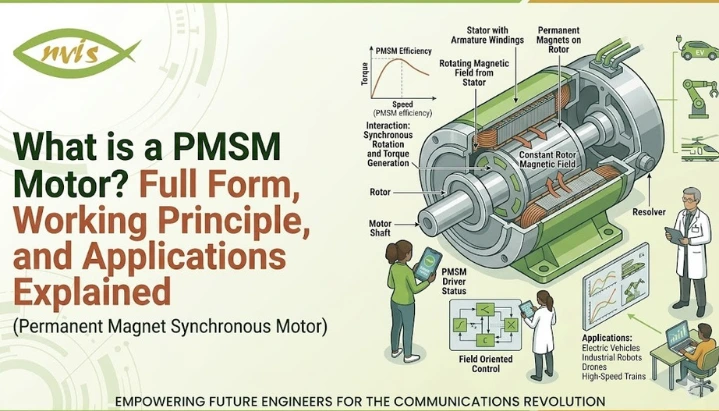
Stator is the stationary outer part of a motor. It contains copper windings connected to an AC power supply. When alternating current flows through these windings, it creates a rotating magnetic field inside the motor.
The rotor is the part that spins and is inside. A PMSM is a machine in which the rotor is designed with permanent magnets inside or attached. These magnets produce a permanent magnetic field (without requiring any external power).
Switching on the motor will result in the following:
- The current that flows through the stator windings produces a rotating magnetic field.
- Permanent magnets on the rotor are attracted to this rotating field and try to align with it.
- The rotor follows the spinning field so that it remains aligned with the field.
- The rotor is rotating at the same speed as the magnetic field of the stator. So this is what ‘synchronous’ means.
Imagine the rotor magnets continuously aligning themselves with the rotating magnetic field produced by the stator. The revolving magnet (rotor) drives the revolving ring of magnets (stator field) in the same direction with the same speed, due to the interaction between the two. The basic principle of operation of a PMSM motor is synchronized motion.
Construction of a PMSM Motor
A PMSM motor is built around two main physical components.
Stator
Stator is made of laminated steel sheets wound with three-phase copper windings. These windings are wound around the inner circumference of the motor housing. These windings, when connected to 3-phase AC supply, generate a rotating magnetic field which is to be used to turn the rotor.
Rotor
This is the difference between PMSM and most other motors. The rotor contains high-strength permanent magnets. The most commonly used magnet materials are:
- Neodymium Iron Boron (NdFeB) most widely used, offering strongest magnetic field per unit of volume
- Samarium Cobalt (SmCo) excellent for high-temperature environments
- Ferrite lower cost, but weaker magnetic performance
Depending on how magnets are arranged, PMSM motors are classified into two main types.
Surface-Mounted PMSM (SPMSM)
In this design, the permanent magnets are permanently attached to the outer surface of the rotor. Easier to make, and better at low speeds. This design is less appropriate, however, for very fast speed machines due to the increased exposure of the magnets.
Interior PMSM (IPMSM)
In this case, magnets are placed within the rotor core. This is a stronger design, is more capable of high speed and has more torque per volume. Interior PMSM motors are commonly used in electric vehicles for this reason.
What Makes PMSM Motors Different from Induction Motors?
Basic electrical machines have been taught, and if you have, you have most likely come across an induction motor. It is one of the most popular motors used worldwide. So what makes a PMSM motor different and in many cases, better?
One of the main differences lies in the rotor design and method of magnetic field generation.
Induced current is used in an induction motor to create the magnetic field in the rotor. This process, called electromagnetic induction, works fine but it comes with a cost. induced current flowing through the rotor creates heat, known as rotor copper losses. The wasted heat directly lowers efficiency.
This is no longer a problem with a PMSM motor. The rotor already has permanent magnets, so there is no need to have induced current. No losses due to the rotor copper. A greater portion of the input electrical energy is transformed to useful mechanical output.
This means that PMSM motors are typically 2-5% more efficient than similar induction motors. While this is a relatively small amount, at an industrial level, it means considerable energy and cost savings.
Further, a PMSM can deliver a high level of torque with very low speeds since no rotor current is needed, which is important for electric vehicle performance and precision servo systems.
Key Advantages of PMSM Motors
It is not just a coincidence that PMSM motors are being used by more industries. These motors possess unique advantages that make them a popular choice for today’s demanding and high-performance applications.
High efficiency: No electrical excitation of the rotor means that there are no copper losses in the rotor. The PMSM motors are commonly used in energy-saving applications with efficiencies of over 90%, resulting in a direct reduction in energy use and operational costs.
High Power Density: PMSM motors have a much higher power to size and weight ratio than conventional motors. Their small size and output is perfect for drones, robotics, portable electronics and electric vehicles, where space and weight restrictions are paramount.
PMSM has precise speed and torque control characteristics, which means that the motor speed is directly related to the frequency of the supply current. PMSM motors can be coupled with other modern control technologies such as Field Oriented Control (FOC) or vector control and achieve precise speed and torque performance even with varying loads.
Brushless Design: Unlike conventional DC motors, PMSM motors do not use brushes or slip rings and do not feature any brushes or slip rings which can wear out. This not only reduces maintenance, but also prolongs the life and makes them cleaner to use.
Wide Speed Range: PMSM motors are able to operate efficiently at a wide range of speeds, from very slow speed to high speed. This versatility allows them to be used in numerous variable-speed applications such as pump drives and compressors.
Low Noise and Vibration: Smooth magnetic field action between stator and rotor guarantees that the motor has a very low vibration and noise level when compared to the other motor types.
Limitations of PMSM Motors
As with any technology, there are some drawbacks to PMSM motors, which engineers and learners need to be aware of.
Higher Initial Cost: Permanent magnets, particularly rare-earth magnets such as neodymium, cost a lot of money. This will increase the initial price of a PMSM motor over an equivalent induction motor. This is balanced, however, by lower operating costs and longer life over time.
Unlike Self-Starting: Not Self-Starting: A PMSM cannot start directly from a fixed-frequency AC supply and is not able to start-up directly from a fixed-frequency AC power supply. It requires a variable-frequency drive (VFD) or an electronic controller to get started and control its operation. This further complicates the system and increases the price.
Temperature Sensitivity: Permanent magnets may lose their magnetic properties when they are heated to excessive temperature. Heat is an important factor in motor design that should be considered in order to ensure long-term reliability. .
Complex Control Requirements :To achieve the full performance potential of a PMSM, appropriate control electronics and algorithms must be used. This is not a plug-and-play motor; it requires setup and tuning of the drive system.
Applications of PMSM Motors
Efficiency, size and control have turned the PMSM motors into the heart of many of the most significant technologies of today.
Electric Vehicles (EVs): This is perhaps the most apparent one. Modern EVs require high torque for rapid acceleration, efficient regenerative braking, and extensive speed range which PMSM motors satisfy. Interior PMSM motors are employed by the majority of top EV manufacturers for their drive train.
Industrial Robotics and Automation: Robotic arms, CNC machines, and automated assembly lines rely on accurate and repeatable motion. Industrial automation demands speed and position accuracy, which PMSM motors and servo drives are able to provide.
HVAC Systems Heating, ventilation, and air conditioning compressors and fans increasingly use PMSM motors to meet energy efficiency regulations and reduce electricity consumption.
Aerospace: Power-to-weight ratio is important in aerospace applications. PMSM motors offer the high performance needed in a light package for use in actuators, flight control surfaces and in auxiliary systems.
Medical Equipment: Medical equipment must be operated quietly, smoothly and precisely, such as surgical robots, MRI machines, infusion pumps and diagnostic instruments. The PMSM motors are able to satisfy these requirements reliably.
Wind Turbines: Direct-drive wind turbines use large-scale PMSM generators to convert wind energy into electrical power with high efficiency and low maintenance. Large scale PMSM generator to convert the wind power into the electric power with high efficiency and low maintenance.
Consumer Electronics & Appliances: The use of PMSM technology also can be found in high-end washing machines, air conditioners and hard disk drives, where power consumption is reduced and performance increased.
PMSM vs BLDC Motor: What is the Difference?
Many students have questions regarding the difference between PMSM motor and BLDC (Brushless DC) motor as both the motors are brushless and permanent magnets are used in both.
The only difference is the form of the back EMF (electromotive force) that they create:
- A BLDC motor produces a trapezoidal back EMF waveform and is typically controlled with square-wave commutation.
- A PMSM motor produces a sinusoidal back EMF waveform and operates with sinusoidal current control, which results in smoother torque output and lower noise.
From the practical point of view, PMSM motors provide smoother operation and reduced torque ripple, which is more suitable for precision servo applications. BLDC motors are more straightforward to control and cheaper to use for things such as fans and pumps where it is not as important as absolute smoothness.
PMSM Motor Control Techniques
To make a PMSM motor perform optimally, there is a need for the motor to be equipped with an intelligent drive system. There are two types of control methods in use in industry:
Field Oriented Control (FOC) Also known as vector control, FOC is a method of controlling stator currents that separates torque and flux control. This enables the torque and speed of the motor to be set independently as in a separately excited DC motor. FOC is a common control method for high performance PMSM applications.
Direct Torque Control (DTC): DTC controls torque and flux directly based on the appropriate voltage vectors. It generally provides faster dynamic response than FOC, although it may produce higher torque ripple, but may include more torque ripple.
Either method calls for the immediate measurement of a motor’s position and speed; this is usually done with shaft-mounted encoders or resolvers.
Conclusion
The PMSM motor is one of the most important developments in electric motor technology. It eliminates rotor losses, has higher efficiency and allows precise control, all within a compact, maintenance-free package.
Housed in everything from electric vehicles to robotic arms, from medical devices to wind turbines, PMSM motors are quietly driving technologies that are hallmarks of modern engineering.
Knowing the full form of PMSM motor, construction, working principle, and applications is a basic knowledge for engineering students and technology learners for their career in power electronics, EV technology, robotics and industrial automation.
The increasing transition to electrification and energy efficiency in the world will only increase demand for engineers that have knowledge of and can work with PMSM technology.
FAQS
The full form of the PMSM motor is Permanent Magnet Synchronous Motor. A type of AC motor, it utilizes permanent magnets in the rotor to produce a steady magnetic field, which allows for precise and efficient speed control.
The biggest difference is the rotor design. In an induction motor induced currents are responsible for the magnetic field and this gives rise to rotor copper losses. A PMSM motor is a type of motor that employs permanent magnets, which means that there are no rotor copper losses, and that the motor is more efficient and has a greater degree of control.
PMSM motors offer high torque at low speeds, excellent efficiency across a wide speed range, and compact power density, all critical requirements for electric vehicle drivetrains. They also support efficient regenerative braking, helping extend the vehicle’s range.
No, a PMSM motor is not self-starting from a fixed AC supply. It requires a variable-frequency drive or electronic controller to ramp up from zero speed and synchronize the rotor with the stator field.
Two main types are Surface-mounted PMSM (SPMSM), where magnets are placed on the rotor surface, and Interior PMSM (IPMSM), where magnets are embedded inside the rotor. IPMSM designs offer better mechanical robustness and are preferred for high-speed applications like EV drivetrains.
The most commonly used magnet material is Neodymium Iron Boron (NdFeB), valued for its extremely high magnetic strength in a compact volume. Samarium Cobalt (SmCo) is used in high-temperature environments, while ferrite magnets are used in cost-sensitive, lower-performance applications.