





• Nvis Technology
  • Nvis Technology
  • Nvis Technology
  • Nvis Technology
  • Nvis Technology
  • Nvis Technology
Nvis Technology

Head Office

141-A, Electronic complex, Pardesipura,Indore - 452010 India

Phone: +91 73899 00887 , +91 98932 70303

Email:info@nvistech.com

Request a Quote

Looking for a quality and affordable builder for your next project?


    Nvis Technology

    Toll Free

    +91 73899 00887

    We are happy to meet you during our working hours. Please make an appointment.

    • Monday-Saturday: 9:00 AM - 5:30 PM (IST)
    • Sunday: Closed

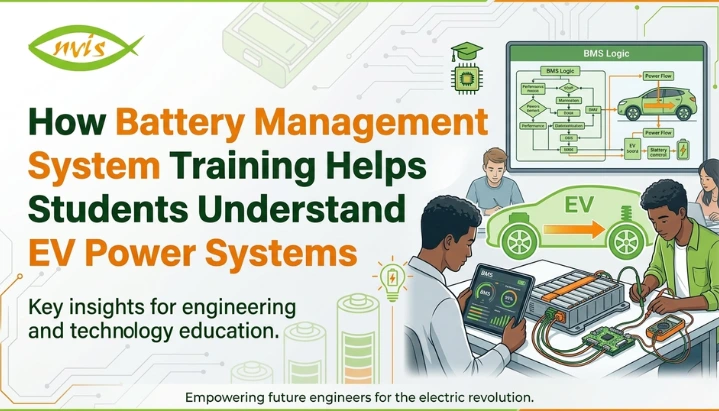
    How Battery Management System Training Helps Students Understand EV Power Systems

    TL;DR

    • This blog is ideal for engineering students, diploma learners, and aspiring EV professionals who want to understand battery management system concepts and gain practical skills through bms system training.
    • With the rise of electric vehicles, understanding EV power systems and effective battery management is becoming essential for future careers.
    • A battery management system ensures battery safety, performance, and lifespan by monitoring key parameters and preventing failures.
    • Bms system training bridges the gap between theory and practice by providing hands-on learning, real-time diagnostics, and system understanding.
    • Skills in battery management open career opportunities in EV design, battery engineering, and energy storage, making students industry ready.

    The electric vehicle revolution is no longer a distant future; it’s happening right now. As EVs become mainstream, the technology powering them is growing more sophisticated by the day. At the core of every electric vehicle lies one critical system that keeps everything running safely and efficiently: the Battery Management System (BMS).

    Whether you’re a student exploring a career in EVs, an engineer looking for upskills, or simply someone curious about how electric vehicles work, understanding the BMS is non-negotiable. It’s the brain behind the battery monitoring, protecting, and optimizing every charge cycle to ensure your vehicle performs at its best.

    In this blog, we’ll break down everything you need to know about Battery Management Systems from how they work and why they matter, to the types of EV batteries they manage and the exciting career opportunities that come with mastering them. We’ll also explore why BMS system training has become one of the most valuable investments a student can make in today’s fast-growing EV industry.

    Related Blogs:

    What is a Battery Management System?

    A battery management system is an important electronic system that monitors and regulates the functionality of battery packs in electric vehicles. It provides safe and efficient operation through constant monitoring of parameters like voltage, current and temperature. Moreover, it also carries out important roles such as balancing cells and safety measures to avoid problems such as overcharging or overheating. To ensure battery health, enhance efficiency, and increase the lifespan of EV batteries, it is necessary to manage batteries effectively.

    The significance of a battery management system is even more evident when students learn about it in bms system training. This training helps them understand how these systems work in real-world scenarios, whether it is to monitor battery conditions or to deal with faults. Students acquire the technical skills needed to maximize the performance of EVs and maintain safety by learning the practical aspects of battery management, which makes them industry-ready in the expanding electric vehicle market.

    What are EV Power Systems?

    The electric vehicle power systems are made up of several important components that collaborate to provide efficient and reliable performance. The electrical energy is stored in the battery pack, the motor transforms this energy into mechanical movement, the controller controls the flow of power and the functioning of the motor, and the charging system restores the battery. For students, it is important to understand how these components interact particularly when they are learning higher concepts by bms system training and having hands-on experience with EV technologies.

    The battery management system is at the heart of this system and is commonly known as the brain of the battery pack. It ensures proper battery management by monitoring battery conditions, optimizing performance, and maintaining safety. The battery performance directly influences the overall performance of the EV, such as range, speed, and lifespan. With the help of bms system training, students will be able to comprehend more how a battery management system affects energy flow and makes the overall EV power system more efficient.

    Types of batteries in electric vehicles- There are various kinds of batteries in electric vehicles, and each has its own peculiarities in terms of performance, price, and safety. Understanding these battery types is important for effective battery management, especially for students undergoing bms system training, as each battery requires specific monitoring and control strategies in a battery management system.

    Lithium-Ion Batteries -The most common type of battery used in modern EVs is lithium-ion batteries because they have a high energy density, are lightweight, and have a long life. They are compatible with rapid charging and are highly efficient, which is why they are suitable for electric passenger cars. These batteries require a strong battery management system to check the temperature and avoid overheating.

    Nickel-Metal Hydride Batteries In earlier hybrid cars, NiMH batteries were widely employed. They are more robust and safer than some of the alternatives but less energy-dense than lithium-ion batteries. Correct battery handling can be used to ensure that they perform well and avoid memory effect problems.

    Lead-Acid Batteries One of the oldest types of batteries is lead-acid batteries, which are still in use in low-speed EVs and auxiliary systems. They are cheaper but heavier and have shorter lives. The control of the battery management system is required to prevent overcharging and enhance their short cycle life.

    Solid-State Batteries Solid-state batteries are a new technology that is expected to have a higher energy density, faster charging, and enhanced safety. They also employ solid rather than liquid electrolytes, which minimizes the chances of leakage or fire. With the development of this technology, more advanced BMS system training will be necessary to learn how they can be integrated into EV systems. To students, bms system training on these batteries offers them practical information on how a battery management system can adjust to various battery chemistries and how it can be optimally operated.

    Why do we need a Battery Management System for Electric vehicles Electric vehicles require a battery management system, particularly due to the safety hazards associated with lithium-ion batteries, which are efficient and commonly used. Battery failure or even fire hazards can be caused by issues such as overcharging, thermal runaway, ageing, and wear. To avoid these scenarios, proper battery management will help to keep batteries within safe limits, enhancing reliability and contributing to safer e-mobility. This makes the battery management system a vital element in contemporary EV design.

    Within an EV battery pack, there are many cells and modules that work under different conditions, and it is hard to track their performance separately. Here the BMS is important as it constantly monitors the health, temperature, and charging characteristics of each cell. The system can identify abnormalities and implement corrective measures in real time, which makes the system safe and efficient. With the help of BMS system training, students will be able to learn how these systems work in practice and help to create reliable electric vehicles.

    Current Trends of Battery Management System for Electric VehiclesBattery management systems in electric vehicles are evolving rapidly as automotive companies embrace smarter and more efficient technologies. The creation of intelligent BMS is one of the key trends, as it involves sophisticated algorithms and machine learning to optimize battery performance according to usage patterns and environmental factors. This type of battery control does not only enhance efficiency but also minimizes failures, which assists automakers to increase reliability and customer satisfaction. The other important development is the incorporation of wireless communication and predictive technologies. Current battery management system solutions have also added Over-the-Air (OTA) updates, which enable rapid system enhancements without physical access. Moreover, predictive algorithms are used to analyze real-time data to identify possible problems before they arise, which lowers maintenance expenses and enhances the life of the vehicle. With the help of bms system training, students will be able to keep up with these trends and acquire practical knowledge of next-generation EV technologies.

    Why Students Need BMS System Training

    As the electric vehicles are rapidly expanding, the number of skilled EV engineers and technicians who are familiar with sophisticated systems such as the battery management system is on the increase. Nevertheless, there is a disconnect between theory and practice among many students, particularly in areas such as battery management and real-world EV operations. This gap highlights the need to provide students with practical exposure to contemporary technologies.

    This is where bms system training comes in very handy. It offers hands-on learning with actual equipment, enabling students to acquire industry-related skills, including battery monitoring, diagnostics, and safety management. This type of training not only enhances their knowledge of the battery management system but also enhances their employability by equipping them to handle real-world challenges in the emerging EV industry.

    Practical Learning Through BMS Training

    BMS system training provides students with practical experience in the form of lab-based experiments and simulations, which allow them to learn how a battery management system operates in practice. Rather than just studying theory, students can use real BMS hardware and software, enabling them to observe battery behavior, monitor performance, and use effective battery management techniques in controlled settings.

    This practical method also allows students to acquire data acquisition and analysis skills, which allows them to interpret battery parameters like voltage, current, and temperature. They also get to know how to detect and troubleshoot typical battery problems, which are safe and efficient. Bms system training equips students with the confidence to work with actual EV battery systems in the industry through such experience.

    How BMS Training Improves Understanding of EV Power Systems

    Bms system training assists students to fill the gap between theory and practice by providing them with practical exposure to the actual functioning of EV systems. It allows them to see how energy moves in an electric car, between the battery pack and the motor and other parts, and the significance of effective battery management in ensuring performance.

    This training also enables students to understand how the choices made by a battery management system directly influence such important aspects as efficiency, safety, and battery life. By working with real data and system behavior, they develop a system-level understanding of EV architecture, making it easier to analyze, optimize, and troubleshoot complete EV power systems in real-world scenarios.

    Career Opportunities After BMS System Training

    EV Design Engineer
    Work on designing and optimizing electric vehicle systems, including integrating the battery management system into overall EV architecture.

    Battery Engineer
    Specialize in battery design, testing, and performance improvement using advanced battery management techniques.

    Energy Storage Specialist
    Focus on large-scale energy storage systems, applying knowledge of battery management system technologies beyond EVs.

    EV Maintenance Technician
    Diagnose and repair EV battery systems, using practical skills gained through bms system training.

    Choosing the Right BMS Training Program

    In choosing a bms system training program, one should take into consideration factors that guarantee both practical and industry-relevant learning. An effective program must have practical training modules where students can be exposed to actual equipment and how a battery management system works in a real-life situation. Also, the curriculum must be revised to reflect the most recent developments in EV technology and battery management, keeping students abreast of the latest industry trends.

    Industry exposure is another key aspect, as it helps students gain insights into real applications through internships, projects, or live demonstrations. Lastly, a student can gain a recognized certification in bms system training, which will enhance their profile and confirm their knowledge of the concepts of battery management systems and enhance their chances of being hired in the expanding electric vehicle industry.

    Conclusion

    To sum up, the swift development of electric vehicles has rendered it essential that students learn about EV power systems, especially how the battery management system contributes to safety, efficiency, and performance. Battery management is the key to successful EV operation, and to master it, one needs practical exposure beyond the classroom. It is at this point that bms system training is necessary because it provides the students with practical experience, practical problem solving skills and industry relevant knowledge. With the knowledge acquired in these fields, students will be able to become more employable and contribute to the future of electric mobility and energy technologies.

    FAQs

    A battery management system (BMS) is an electronic system that monitors and regulates battery performance, which guarantees safety, efficiency, and appropriate battery management in EVs.

    Battery management can be used to avoid battery problems such as overheating, overcharging, and battery failure, as well as enhance performance, safety, and battery life.

    Battery monitoring, cell balancing, fault detection, data analysis, and real-world applications of a battery management system are taught to students through BMS system training.

    Yes, BMS system training can be applied to both beginners and advanced learners because it begins with simple concepts and progressively advances to practical and industry level applications.

    Knowledge of battery management system and battery management can lead to roles such as: EV design engineer, battery engineer, EV technician, and energy storage specialist.
    Tags: radial and ring main distribution system, ring and radial distribution system, ring distribution system

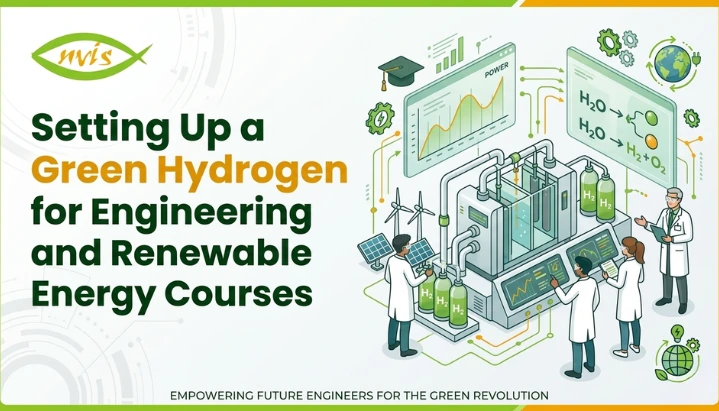
    Setting Up a Green Hydrogen Lab for Engineering and Renewable Energy Courses

    TL;DR:

    • This blog is ideal for engineering students, diploma learners, educators, and institutions looking to build expertise in green hydrogen systems and renewable energy applications.
    • Green hydrogen is a clean fuel produced using renewable energy, making it essential for a sustainable energy future.
    • Setting up a lab with hydrogen generation, storage, and fuel cell systems enables hands on learning and industry relevant skills.
    • A green hydrogen lab supports research, innovation, and aligns with modern renewable energy and EV focused curricula
    • Such labs enhance student employability by preparing them for careers in the rapidly growing hydrogen renewable energy sector

    The increasing need for clean and sustainable energy has put green hydrogen in the limelight as a strong substitute to fossil fuels. It is manufactured with renewable energy sources such as solar and wind, which is important in minimizing carbon emissions and aiding the energy transition in India. With the continued growth of hydrogen renewable energy, it is also creating new career opportunities in the clean energy industry.

    Hands on learning has become essential in engineering education to prepare students for this transition. A green hydrogen laboratory usually consists of a hydrogen generator, renewable energy integration systems, storage units, and fuel cells, which enable students to learn the entire hydrogen cycle, i.e., production to utilisation. This kind of practical exposure can fill the gap between theory and practice, and prepare students to work in the industry in the dynamic area of hydrogen energy systems.

    Related Blogs:

    What is Green Hydrogen?

    Green hydrogen is hydrogen that is generated by renewable energy sources like solar or wind energy, thus it is a clean and sustainable fuel that has zero carbon emissions. It is produced by a process known as electrolysis, in which a hydrogen generator divides water into hydrogen and oxygen using electricity. When this electricity is renewable, the whole process is environmentally friendly and the basis of hydrogen renewable energy systems.

    Hydrogen is usually categorized into three types depending on the way it is produced  green, blue, and grey. Although grey hydrogen is made with the help of fossil fuels and releases carbon dioxide, and blue hydrogen captures carbon to minimize emissions, green hydrogen is the cleanest. It is based on renewable sources and thus is a major part of developing hydrogen renewable energy and creating a sustainable energy future.

    Why Engineering Colleges Need a Green Hydrogen Lab

    The fast development of green hydrogen technologies has resulted in a high demand for professionals in the clean energy industry. Engineers with knowledge of hydrogen production, storage, and utilisation are in demand by industries. Colleges can prepare students with practical skills of systems such as a hydrogen generator by establishing a green hydrogen lab, which will better prepare them to work in the real world in hydrogen renewable energy.

    These labs also assist in closing the gap between theory and practice. They are also consistent with current renewable energy and EV oriented curricula, enabling students to learn about the integration of hydrogen into sustainable systems. Moreover, a green hydrogen laboratory opens up research and innovation opportunities, allowing institutions to play a role in the development of hydrogen renewable energy and create a culture of experimentation and problem solving.

    What Can Students Learn?

    A green hydrogen lab is not merely an equipment display, but a complete scale, hands-on learning experience. By working with systems such as a hydrogen generator, students and researchers can have hands on experience of how hydrogen renewable energy can be applied in real life situations.

    Through structured experiments and training, students can:

    • Understand key concepts such as electrolysis efficiency, fuel cell behaviour, and hydrogen storage in green hydrogen systems
    • Gain hands on experience operating a hydrogen generator and related equipment
    • Perform data analysis and compare performance across different hydrogen renewable energy setups
    • Learn essential safety protocols and emergency handling while working with green hydrogen

    Such labs are also a great place to conduct academic projects, such as undergraduate and postgraduate research, dissertations, and advanced studies on green hydrogen technologies

    Importance of a Green Hydrogen Lab

    Education on hydrogen is quickly leaving textbooks behind. The need to develop expertise in green hydrogen and hydrogen renewable energy is growing in industries, startups, and research organisations with initiatives such as the National Green Hydrogen Mission in India. Today, employers are looking for candidates who are familiar with the entire hydrogen ecosystem, including a hydrogen generator.

    A dedicated green hydrogen lab enables institutions to:

    • Provide hands on training in electrolysis using a hydrogen generator, along with storage and fuel cell systems
    • Encourage research and innovation in hydrogen renewable energy technologies
    • Align courses with future focused sustainable energy programs centered on green hydrogen
    • Build stronger collaborations with government and industry working in hydrogen renewable energy
    • Offer practical exposure to real world applications of hydrogen generator systems
    • Prepare students with industry relevant skills in the growing green hydrogen sector

    In general, a green hydrogen laboratory will enable students to transition between theoretical knowledge and practical skills, becoming the active participants in the future of hydrogen renewable energy in India.

    Step by Step Guide to Setting Up the Lab

    The establishment of a green hydrogen lab is a complex process that needs proper planning and the appropriate mix of equipment and systems. Every step, including setup and testing, is important in the safe and effective operation. The entire process is described in the following steps:-

    Planning and Space Requirements

    The establishment of a green hydrogen lab starts with the appropriate planning of space, layout, and infrastructure. The lab should have adequate room for installing a hydrogen generator, storage systems, and renewable energy units. Safe and efficient hydrogen renewable energy operations require proper power supply and ventilation.

    Equipment Selection

    Selecting the right equipment is essential for a functional green hydrogen laboratory. The hydrogen generator and renewable energy sources such as solar panels should be compatible to ensure smooth operation. The appropriate mix of elements assists in developing a dependable hydrogen renewable energy system to learn in practice.

    Installation and Integration

    In this stage, all components of the green hydrogen lab are connected and integrated. The hydrogen generator is connected to renewable energy sources, and storage tanks and fuel cell systems are installed accordingly. This integration enables the students to see the entire hydrogen renewable energy cycle in action.

    Safety Setup

    In any green hydrogen lab, safety is a priority. Sensors, leak detectors, and emergency shutdown systems installed around the hydrogen generator will guarantee safe operation. Staff and students also need to be trained properly to manage hydrogen renewable energy systems in a responsible manner.

    Testing and Commissioning

    After the green hydrogen lab is installed, preliminary testing and calibration are performed. The performance and efficiency of the hydrogen generator and other parts are verified. This will be done to make sure that the hydrogen renewable energy system is operational and is prepared to be used in academics.

    Experiments and Practical Applications

    A green hydrogen laboratory allows students to conduct numerous practical experiments that develop practical knowledge of hydrogen systems. Among the most important experiments is the analysis of the efficiency of a hydrogen generator in the process of electrolysis, which will allow students to comprehend the efficiency of converting electrical energy into hydrogen. They are also able to research the rate of hydrogen production under various operating conditions which is critical in optimising hydrogen renewable energy systems.

    Moreover, students will be able to test the performance of fuel cells by utilizing hydrogen generated by the hydrogen generator to produce electricity. Demonstrations of converting renewable energy sources into hydrogen further highlight the real world applications of green hydrogen. These experiments give a full picture of hydrogen renewable energy, both in production and utilisation, and learning becomes more practical and industry relevant.

    Conclusion

    The creation of a green hydrogen lab is not just a modernization of infrastructure but a step towards preparing the next generation of engineers for a sustainable future. With the incorporation of systems such as a hydrogen generator and renewable energy sources, institutions will be able to provide students with a comprehensive knowledge of hydrogen renewable energy, including production and practical use.

    With the ever-increasing need for clean energy solutions, these labs are important in closing the gap between the academic knowledge and the industry needs. They not only enhance technical skills and research capabilities but also position students at the forefront of the green energy transition. In the long run, the investment in green hydrogen laboratories will allow institutions to contribute greatly to innovation, sustainability, and development of hydrogen renewable energy in India.

    FAQs

    A green hydrogen laboratory is a realistic learning environment where students can operate systems such as a hydrogen generator to generate and use green hydrogen with renewable energy. It is important because it provides hands on experience in hydrogen renewable energy, preparing students for future careers.

    A hydrogen generator  uses an electrolysis process that separates water into hydrogen and oxygen with the help of electricity. It generates green hydrogen when fed with renewable sources, and thus it is a major element of hydrogen renewable energy systems.

    A typical green hydrogen lab includes a hydrogen generator (electrolyser), renewable energy sources like solar panels, hydrogen storage systems, fuel cells, and monitoring units to study hydrogen renewable energy processes.

    Yes, it is safe to work with green hydrogen provided that the necessary precautions are taken. The hydrogen generator and storage units are combined with safety systems like sensors, ventilation, and emergency shutdown systems to guarantee safe operation.

    As hydrogen renewable energy increases, career opportunities are expanding in such fields as clean energy engineering, fuel cell technology, hydrogen production, and research. Students with knowledge of green hydrogen and systems such as a hydrogen generator have a great edge in this area.

    Tags: radial and ring main distribution system, ring and radial distribution system, ring distribution system

    Load Flow and Voltage Regulation in Radial and Ring Distribution Systems

    TL;DR –

    1. This blog is designed for electrical engineering students, power system engineers, trainers, technical institutions, and industry professionals who want to understand load flow and voltage regulation in a ring and radial distribution system.
    2. Load flow (power flow analysis) determines voltage magnitude, phase angle, active and reactive power flow, and line losses in radial and ring main distribution systems, forming the foundation for efficient network planning and operation.
    3. A well-designed ring distribution system or radial system must maintain voltage variation within ±5% to ensure stable and reliable power supply to consumers.
    4. Radial systems are simple and economical but experience higher voltage drops and lower reliability, while ring systems provide bi-directional power flow, reduced losses, better voltage regulation, and improved reliability.
    5. The Nvis training system enables hands-on analysis and voltage regulation are transforming both radial and ring distribution systems.

    The distribution of electric power is the final and most important stage in delivering electricity from generating stations to consumers. While transmission networks carry bulk power over long distances, distribution systems deliver safe, reliable, and quality power to homes, industries, and commercial facilities. The most popular configurations include the ring and radial distribution system, which have several distinct operational features, reliability, and voltage performance.

    Electrical engineers, planners, and energy managers should understand load flow and voltage regulation in radial and ring main distribution systems. Effective load flow analysis is essential for proper network operation, and voltage regulation ensures a stable power supply within acceptable limits.

    This guide explains the structure, analysis methods, voltage behavior, mathematical modeling, comparison, and modern developments in radial and ring distribution systems.


    Related Blogs

    1. How to Use a Programmable DC Power Supply Safely in Student Laboratories
    2. Preparing Future Technicians and Engineers for Smart Energy Management
    3. What Is a Data Acquisition System and How Does It Work?

    Load Flow and Voltage Regulation

    Two basic performance parameters in any electrical distribution network include load flow and voltage regulation. These parameters are analyzed in ring and radial distribution systems to ensure efficient power delivery, stable voltage levels, and minimal losses. A radial and a ring main distribution system require proper analysis of load flow and voltage regulation in order to ensure quality and reliable provision of power.

    What is Load Flow?

    Load flow (or power flow) analysis is the systematic study of how electrical power moves through a distribution network. It determines:

    • Voltage magnitude at each bus
    • Phase angle at each node
    • Active power (kW) flow
    • Reactive power (kVAR) flow
    • Line losses

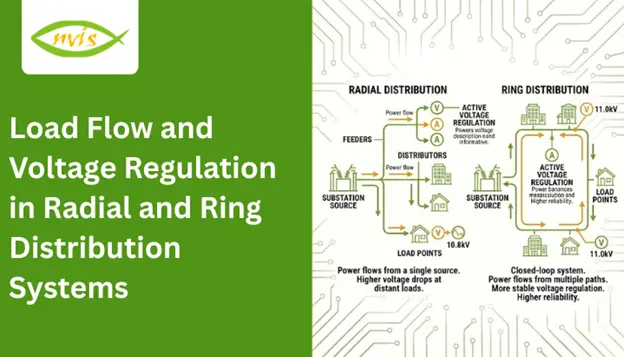
    In a ring distribution system, power may flow in multiple directions due to the closed-loop configuration. In contrast, in a radial system, power flows in only one direction from the source to the load.

    What is Voltage Regulation?

    Voltage regulation measures the change in voltage at the consumer terminal between no-load and full-load conditions.

    Voltage Regulation = (V_no-load − V_full-load) / V_full-load × 100%

    A well-designed ring and radial distribution system should maintain voltage variation within ±5% of the rated value.

    Radial and Ring Main Distribution System

    The Radial and Ring Main Distribution System training setup is designed to demonstrate the operating principles of both radial and ring main electrical distribution networks. A distribution system is an essential component of the electric power system, which connects high-voltage transmission networks to low-voltage service points of consumers. These systems should be designed so that voltage variation at consumer terminals does not exceed ±5% of the rated value.

    The Nvis training system provides in-depth practical learning support for manually developing and analytically assessing both ring and radial distribution system designs. Structured experiments and comparative studies help learners clearly understand the performance differences between the two systems.

    The system consists of a built-in DC variable power supply, including sufficient safety controls and digital metrology. The radial and ring main structures are covered in separate sections where students can study each system step-by-step and understand their operational significance.

    Product Features

    • Three digital DC voltmeters and three digital DC ammeters for precise measurement
    • Dedicated connection panels for both radial and ring main systems
    • Built-in DC variable power supply
    • Isolation transformer for enhanced operational safety
    • Exclusive and ergonomically designed control panel
    • Integrated lamp load holders
    • Clear diagrammatic representation for easy circuit connections

    Comparative View: Load Flow and Voltage Regulation

    Parameter

    Radial System

    Ring Distribution System

    Power Flow

    Single direction

    Bi-directional

    Voltage Drop

    Higher

    Lower

    Losses

    Higher

    Reduced

    Reliability

    Lower

    Higher

    Complexity

    Simple

    Moderate

    Load Flow in Distribution Systems

    Load flow, or power flow analysis, evaluates the operating condition of a distribution network. In a ring and radial distribution system, it determines:

    • Voltage magnitude at each bus
    • Phase angle at each bus
    • Active power (P) and reactive power (Q) flow
    • Line losses

    In a radial and ring main distribution system, load flow analysis ensures proper voltage levels, efficient power delivery, and reliable operation. It forms the foundation of effective planning, design, and performance optimization in any ring distribution system.

    Load Flow in Ring Distribution System

    Power Flow Characteristics

    A ring distribution system involves a closed-loop feeder configuration where power flows in both directions toward the load. Unlike the single power path in a radial setup, load current in a ring network is shared between two paths. With current shared between two paths, the current in each section is reduced, resulting in a more uniform voltage drop and lower overall line losses. The multi-path design of a ring distribution system enhances voltage stability and provides a more uniform voltage profile across all load points.

    Mathematical Considerations

    In a ring distribution system, electrical loops are closed. This means that Kirchhoff Voltage Law (KVL) needs to be met around every loop and loop current analysis is necessary. Ring systems require more complex iterative techniques for analysis, whereas radial systems can often be solved using simpler methods to determine voltage magnitude, phase angle, and power flow. The typical methods are the Newton-Raphson method, Gauss-Seidel method, and modified Forward-Backward Sweep method. These methods help in accurate analysis of load flow within a ring distribution system.

    Voltage Regulation in Ring System

    Since the current in a ring-type of distribution flows in two directions, the line current in each piece of the feeder is less. This results in reduced I²R losses and lower voltage drop across the network. Consequently, voltage regulation is better than in radial systems. The improved voltage profile and reliability of ring systems make them well suited for urban and industrial distribution networks where voltage stability is critical.

    Conclusion

    Performance parameters in any distribution network are load flow and voltage regulation which are paramount. Ring and radial distribution systems represent two different design philosophies with distinct operational characteristics.

    Radial systems are cheap, easy, and may be applied in sparsely populated regions but have greater voltage drops and reduced reliability.

    In contrast, the ring distribution system offers:

    • Improved voltage regulation
    • Reduced losses
    • Better reliability
    • Enhanced operational flexibility

    The choice between radial and ring main distribution systems depends on cost, load density, reliability requirements, and operational complexity.

    With the advent of smart grids and renewable integration, distribution systems are becoming intelligent, adaptive networks capable of maintaining excellent voltage profiles and efficient load flow performance.

    FAQs

    A ring and radial distribution system refers to two types of power distribution networks. A radial system has a single path from source to load, while a ring system forms a loop that allows power to flow in two directions.

    Load flow analysis helps calculate voltage levels, power flow, and line losses in a radial and ring main distribution system, ensuring safe and efficient operation.

    Voltage regulation is the change in voltage between no-load and full-load conditions. A good ring distribution system maintains voltage within ±5% of the rated value.

    A ring distribution system is more reliable because power can reach the load from two directions, reducing the chance of complete supply failure.

    Radial systems are commonly used in rural or low-load areas because they are simple, economical, and easy to maintain.

    Tags: radial and ring main distribution system, ring and radial distribution system, ring distribution system

    Request a Callback

    Please enable JavaScript in your browser to complete this form.

    No spam. Just a quick call.