






TL;DR
- This blog is for engineering students, freshers, and anyone curious about how electricity reaches homes and factories without cutting off during repairs. It explains ring main distribution systems in plain language, starting from basics.
- A ring main system connects distribution points in a closed loop instead of a single dead end line, so power can reach every point from two directions.
- If one section of the loop develops a fault, engineers isolate just that section while the rest of the loop keeps running normally.
- India’s DISCOMs are actively modernizing distribution networks under the RDSS scheme, with SCADA monitoring, digital substations, and, where applicable, smart Ring Main Units and SF6-free switchgear being deployed as part of network upgrades.
- Understanding ring main systems opens doors to real careers in power distribution, smart grid technology, and utility engineering, with fresher salaries typically starting between 3.5 LPA and 7 LPA in India.
Also read,
- Battery Management System in EV: Complete BMS Guide
- How Lithium-Ion Batteries Work in Electric Vehicles: A Complete
- EV Battery Life Cycle Explained: Factors That Affect Lifespan
Picture a city with only one road leading into it. If that road gets blocked for repairs, nobody gets in or out until it reopens. Now picture the same city with a ring road circling it, connected at multiple points. Block one section, and traffic simply flows around it through the other side. Nobody is stuck.
That is essentially the idea behind a ring main distribution system, just applied to electricity instead of traffic. It is one of the most important concepts in power systems engineering, and if you are studying electrical engineering or just curious about how lights in your hostel room stay on even when a utility crew is working nearby, this is a topic to understand.
In this guide, we will build up concepts from scratch. No assumed knowledge, no jargon dropped without explanation. By the end, you will understand what a ring main distribution system is, how it actually works, why it matters more in 2026 than ever before, and what career paths open up if this field interests you.
What Is Electricity Distribution, and Why Does It Need a “System” at All?
Before getting into ring main systems specifically, let’s zoom out for a second.
Power plants generate electricity far away from where most of us live. That electricity travels through high voltage transmission lines over long distances, and then gets stepped down through substations before it finally reaches your street, your building, and your switchboard. This last stretch, from substation to your actual plug point, is called a distribution system.
Now here’s a question every distribution engineer has to answer: how do you lay out wires connecting substations to hundreds or thousands of consumers, in a way that is reliable, cost effective, and doesn’t leave everyone in the dark every time something goes wrong?
There are a few ways to design this layout. Two most common ones you’ll encounter as a student are the radial system and the ring main system. Understanding the radial system first actually makes the ring main system click much faster, so let’s start there.
Radial System: Simple, but Fragile
Think of a radial distribution system like a tree. There’s one trunk (substation), and branches spread out from it to reach different areas. Power flows in a single direction, from source outward, with no loops or alternate paths.
This design is genuinely appealing on paper. It’s simple to plan, cheap to build, and easy to understand. For a small town or a rural area with modest power needs, a radial layout does the job well enough.
But here’s the catch. Because there’s only one path from source to any given consumer, a fault anywhere along that path cuts off everyone downstream from it. If a cable snaps two kilometers from the substation, every consumer beyond that point loses power immediately, and stays without power until the fault is physically located and repaired.
This is exactly the “one road into the city” problem we talked about earlier. It works fine until something breaks, and then it breaks badly.
Ring Main Distribution System: What It Actually Is
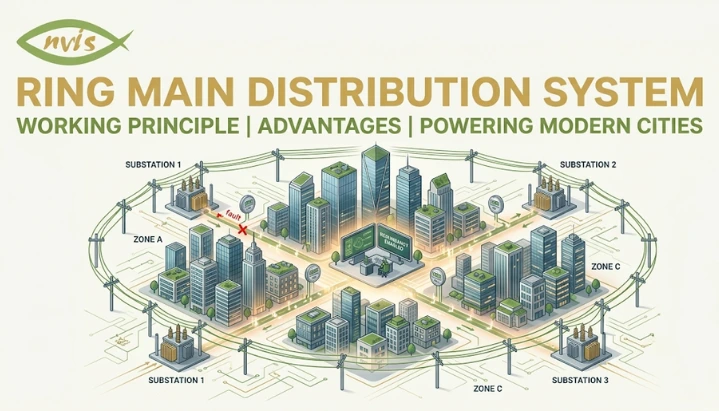
A ring main distribution system solves the radial system’s biggest weakness by doing something clever: instead of ending the distribution line at the last consumer, it loops it back to the starting point (or connects it to another substation), forming a closed ring.
In more technical terms, a ring main distribution system is a distribution network where a feeder starts from a substation, passes through various load points or distribution transformers, and returns to the same substation bus (or an adjacent one), forming a continuous loop with no dead end.
Every distribution transformer or tap off point along this ring is now connected to two sides of the loop, not just one. This means each point can receive power from either direction. If a fault occurs anywhere in the ring, engineers can isolate that specific faulty section using switches and circuit breakers, and the rest of the ring keeps supplying power normally, just from the opposite direction.
This single design choice, the closing loop, is what makes the ring main system so much more reliable than the radial system, and it’s the reason many urban and industrial distribution networks in India use some form of ring main configuration today.
How a Ring Main System Actually Works: Step by Step
Let’s walk through the working principle slowly, because this is where most explanations either skip steps or drown you in terminology too early.
Step 1: Power leaves substation in a loop. Instead of one feeder cable running in a straight line, the feeder cable leaves the substation, travels through the service area, and comes back to the same substation (or connects to a neighboring one). This closed path is “ring.”
Step 2: Distribution points tap into the ring. At various points along this ring, distribution transformers are connected. These transformers step voltage down further so it’s usable for homes, shops, and smaller industrial loads. Each transformer is connected to the ring from both directions, allowing supply to be restored from the alternate side if one section is isolated.
Step 3: Switches and circuit breakers sit at key points. This is the part that makes fault isolation possible. Circuit breakers and switches (often bundled together in a compact unit called a Ring Main Unit, or RMU, which we’ll cover shortly) are installed at strategic points around the ring. These devices can open or close specific sections of the loop on command.
Step 4: A fault occurs somewhere in the ring. Let’s say a cable fault develops between two tap off points. Protection relays detect abnormal current flow almost instantly and trigger nearest circuit breakers to open, isolating just that faulty section.
Step 5: After the faulty section is isolated, supply to the healthy sections is restored either automatically through network automation systems or manually by utility operators, depending on the level of automation. Because every load point had two supply paths to begin with, the moment a faulty section is isolated, the unaffected part of the ring continues delivering power, just fed from the opposite direction. In modern automated systems, this rerouting happens within seconds. In older manual systems, a technician would locate faults and physically operate switches to restore supply to healthy sections.
Step 6: fault gets repaired, and ring is restored. Once a faulty cable section is fixed, isolated switches are closed again, and the ring returns to its normal closed loop operation.
That’s the entire working principle. No single point of failure can take down the whole network, because every load point was never dependent on just one path in the first place.
Ring Main Unit (RMU): Component That Makes It All Work
You’ll hear the term “Ring Main Unit” or RMU constantly once you start reading about ring main systems, so let’s clear this up properly.
An RMU is a compact, factory built, sealed switchgear unit that combines switches, circuit breakers, and protection devices needed at each tap off point on the ring, all inside a single enclosure. Instead of installing separate switches, breakers, and protection relays as individual pieces of equipment, utilities install one RMU that does all of it in a much smaller footprint.
In India, RMUs are typically used in the 11kV to 33kV range, which covers most secondary distribution networks in cities, industrial parks, and large residential complexes. A standard RMU usually has two ring feeder units, connecting to either side of the loop, and one transformer feeder unit that supplies local distribution transformers.
RMUs matter for a practical reason: they make ring main systems genuinely deployable in dense urban areas. Since RMUs are compact and can be installed both indoors and outdoors with minimal maintenance, they’ve become standard building blocks for ring networks in Indian cities where space is always at a premium.
Advantages of Ring Main Distribution System
Now that you understand how it works, advantages should already make intuitive sense. Let’s go through them properly, because these show up frequently in exams and interviews alike.
Higher reliability through redundancy. This is a headline advantage. Since every load point has two possible supply paths, a single fault doesn’t cause a widespread blackout. Only a specific faulty section gets isolated, and it can serve a very small area, sometimes just stretching between two RMUs.
Better voltage regulation. In a radial system, consumers far from substation often experience noticeable voltage drops, especially during peak load hours. In a ring system, because loads are fed from both directions, voltage stays more stable across the entire network. Ring main systems generally provide better voltage regulation than comparable radial systems because loads can be supplied from multiple directions, which is a meaningful improvement over comparable radial setups.
Reduced power losses. Ring main systems can reduce voltage drops and, in some network configurations, lower distribution losses through improved load sharing. However, the actual reduction depends on network design and operating conditions, which translates to better overall efficiency.
Easier maintenance without full shutdowns. Maintenance crews can isolate a specific section of the ring for planned work while the rest of the network stays live. This is enormously valuable for industries and facilities that cannot afford any downtime, like hospitals, data centers, pharmaceutical plants, and continuous manufacturing lines.
Scalable for future growth. As a city or industrial area expands, new distribution transformers and tap off points can be added to existing rings without redesigning the whole network. This modularity is a major reason ring systems are preferred for growing urban centers and industrial parks.
Disadvantages You Should Also Know
No system is perfect, and exam questions love asking about limitations just as much as advantages.
Higher initial cost. Building a closed loop requires more cable length, more switchgear, and more protective devices compared to a simple radial layout. redundancy that makes ring systems reliable also makes them more expensive to build.
More complex protection scheme. In a radial system, fault current only flows in one direction, so protection design is relatively straightforward. In a ring system, fault current can arrive from either side, which means protection relays need to be directional, and coordinating them correctly across the whole loop takes careful engineering.
More components mean more potential failure points. Ironically, while ring design reduces impact of any single fault, it introduces more equipment (breakers, RMUs, relays) that could individually fail. Good design and maintenance practices are essential to keep this from becoming a real problem.
Planning and design complexity. Laying out an efficient ring, especially one connecting multiple substations, takes more careful planning than a straightforward radial layout. This isn’t usually a dealbreaker, but it does mean more engineering hours upfront.
Ring Main vs Radial Distribution System: A Quick Comparison
| Aspect | Radial System | Ring Main System |
| Supply path | Single path from source to load | Two paths available for every load point |
| Reliability | Low; one fault can black out everyone downstream | High; faulty section isolates without affecting rest |
| Voltage regulation | Poor at far ends of feeder | Better across entire loop |
| Initial cost | Lower | Higher, due to extra cabling and switchgear |
| Protection complexity | Simple, unidirectional | More complex, needs directional relays |
| Best suited for | Small towns, rural areas, low density loads | Cities, industrial parks, critical facilities |
Ring Main Systems in India: 2026 Update
Here’s where things get genuinely current, and this is worth paying close attention to if you’re a student trying to understand where this field is heading.
India’s electricity distribution sector has been undergoing a massive modernization push under the Revamped Distribution Sector Scheme (RDSS), a Government of India initiative launched in 2021. Under the scheme, distribution infrastructure projects worth over ₹2.83 lakh crore have been sanctioned, including ₹1.53 lakh crore for loss reduction infrastructure and ₹1.31 lakh crore for smart metering. The loss reduction works include feeder segregation, substation augmentation, new substations, distribution transformer upgrades, and SCADA/DMS systems for real-time monitoring. These investments are modernizing distribution networks across the country, with technologies such as Ring Main Units (RMUs) being deployed where appropriate to improve reliability and operational efficiency.
The numbers here are worth sitting with for a moment. India’s Aggregate Technical and Commercial losses, a measure of how much power gets lost or unaccounted for in the distribution network, dropped significantly over recent years due to a combination of infrastructure upgrades, improved metering, network modernization, and operational reforms. That is a meaningful improvement, and ring main upgrades are one of several factors contributing to these improvements, alongside better metering, feeder segregation, and distribution automation.
On the technology side, RMUs themselves are evolving fast. Traditional RMUs used SF6 gas as an insulating medium, but SF6 has a very high global warming potential, and industry is actively shifting toward SF6 free alternatives using solid dielectric or vacuum based insulation. Schneider Electric has already run pilot projects using SF6 free “AirSeT” technology in Mumbai and Delhi, reporting significantly lower carbon footprints compared to traditional gas insulated units.
Smart RMUs are also becoming standard in new installations. These units go beyond basic switching by integrating remote monitoring, automated fault detection, and communication with SCADA and Distribution Management Systems. In practice, this means faults that once took a technician driving to a site and manually operating switches can now be detected and isolated remotely within seconds, dramatically cutting outage times.
For a student entering this field today, this matters because the main system you learn in your textbook is no longer purely mechanical and manual. The version being deployed on ground right now is increasingly digital, automated, and connected, and that shift is only accelerating.
Applications of Ring Main Distribution Systems
Ring main systems aren’t just a theoretical concept confined to textbooks. Here’s where you’ll actually encounter them in the real world.
Urban and city power distribution. Many urban areas in India use ring main networks, particularly in commercial districts, industrial areas, and high-reliability distribution zones, particularly in dense commercial and residential zones where reliability expectations are high.
Industrial parks and manufacturing facilities. Factories running continuous processes, especially in sectors like pharmaceuticals and food processing, depend on ring systems to avoid costly production stoppages from power interruptions.
Large commercial complexes. Office towers, shopping malls, and IT parks with multiple zones and varying load profiles benefit from load balancing and reliability that ring systems provide.
Critical infrastructure. Hospitals, data centers, and telecommunications facilities, where even brief outages can have serious consequences, are prime candidates for ring main deployment.
Renewable energy integration. As solar and wind installations become more common, RMUs are increasingly used to connect these distributed energy sources into the grid, since their switching flexibility helps manage variable power flows more effectively.
Career Opportunities: Why This Topic Matters for Your Future
If you’ve made it this far, you might be wondering how understanding ring main systems actually translates into a career. Here’s an honest picture.
Power distribution is a genuinely stable, in demand field within core electrical engineering, and it’s only growing as India continues its grid modernization push. Roles you could realistically target after graduation include Distribution Engineer, Substation Engineer, Protection and Control Engineer, and Grid Automation Engineer, working either directly with state DISCOMs (like UPPCL, MSEDCL, or BESCOM) or with equipment manufacturers and engineering firms such as Schneider Electric, Siemens, ABB, and various power system consultancies.
On the salary front, fresher roles in power distribution engineering in India typically start somewhere between 3.5 LPA and 7 LPA, depending on company, location, and whether the role is with a utility, an OEM, or an EPC contractor. With a few years of experience, distribution and power systems engineers commonly move into the 7 LPA to 12 LPA range, and specialized roles involving SCADA, protection coordination, or grid automation can push well beyond that.
skills that matter most here are a solid grasp of power system fundamentals (exactly what we’ve covered in this article), familiarity with design and simulation tools like AutoCAD and ETAP, and increasingly, comfort with SCADA and Distribution Management System platforms as the sector digitizes. If you’re preparing for competitive exams like GATE, SSC JE, or state AE/JE recruitment, ring main systems and their comparison with radial systems are recurring, high yield topics, so effort you put into understanding this concept deeply pays off twice: once for your exams, and once for your actual career.
Conclusion
The ring main distribution system exists because of one simple engineering insight: a network with only one path to every destination is fragile, and closing that path into a loop creates redundancy that pays for itself the moment something goes wrong. From that single idea flows everything else we’ve covered, better voltage regulation, easier maintenance, higher reliability, and a genuine ability to scale as cities and industries grow.
What makes this topic worth your time right now, in 2026, is that it isn’t a static, settled concept. India’s distribution sector is actively rebuilding itself around smarter, more automated versions of exactly this technology, backed by serious government investment and real infrastructure targets. Whether you’re studying this for an exam, a project, or because you’re seriously considering a career in power systems, understanding ring main systems properly gives you a foundation that connects directly to what’s happening in the Indian power sector today, not just what’s printed in a decade old textbook.
FAQs
A radial system has a single path from substation to each consumer, so a fault anywhere along that path cuts off everyone downstream. A ring main distribution system loops the feeder back to the source, giving every load point two possible supply paths, which means a fault only affects a small isolated section instead of the whole network.
An RMU is a compact, sealed switchgear unit that combines switches, circuit breakers, and protection devices at each tap off point on a ring main system. It allows operators to isolate faulty sections of the ring, connect distribution transformers, and maintain supply through alternate paths, all from a single, space efficient enclosure.
Reliability comes from redundancy. Because every point on the ring can be fed from two directions, isolating a fault in one section doesn’t interrupt supply to the rest of the network. This is fundamentally different from a radial system, where any fault downstream of a break leaves every subsequent consumer without power until repairs are complete.
In India, ring main systems and their associated RMUs are most commonly used in the 11kV to 33kV range, which covers secondary distribution networks serving cities, industrial areas, and large residential or commercial complexes. This falls within India’s medium voltage classification under CEA regulations.
SF6 gas has traditionally been a standard insulating medium in RMUs due to its excellent insulating properties, but because it has a very high global warming potential, industry is actively moving toward SF6 free alternatives using solid dielectric or vacuum based insulation. Utilities and manufacturers, including pilot projects in Indian cities like Mumbai and Delhi, are already deploying these greener alternatives.
A strong grasp of ring main systems is directly relevant to roles like Distribution Engineer, Substation Engineer, Protection and Control Engineer, and Grid Automation Engineer. These roles exist both within state DISCOMs and at private companies like Schneider Electric, Siemens, and ABB, with fresher salaries in India typically starting between 3.5 LPA and 7 LPA and growing steadily with experience and specialization.