






TL;DR
- This blog is for ECE, EEE, and CSE students, freshers, and GATE/SSC JE/RRB JE aspirants who want to understand what an ARM Cortex M microcontroller actually is and how its architecture works, from first principles.
- This blog explains what Arm means in the context of microcontroller design and examines the Cortex-M architecture step by step, helping beginners understand the role of each major component rather than simply memorizing terminology.
- This post builds concepts step by step: what ARM in a microcontroller means, how core, registers, memory, and NVIC fit together, and how M0, M3, M4, and M7 variants differ in real numbers.
- A worked numerical example on interrupt latency shows exactly how to calculate real time response time, the kind of calculation GATE and SSC JE papers expect you to solve.
- The post closes with India specific employer and salary context, exam relevance, and a comparison table so you leave with both conceptual clarity and exam ready facts.
Also read,
- 8051 Microcontroller: Architecture, Pins, Working & Uses
- STM32 Microcontroller Guide: How It Works, Programming, and Applications
- Swinburne Test of DC Machine: Procedure & Working
What Is ARM in Microcontroller?
Arm develops processor architectures and processor IP, including the Cortex family of CPU cores. Cortex-M is its microcontroller-oriented processor profile. Arm is not a microcontroller manufacturer. Instead, it licenses its architectures and processor IP to semiconductor companies, which integrate Arm-based CPU cores with memory and peripherals to create complete microcontrollers and SoCs.These companies combine Arm processor cores with flash, RAM, timers, GPIO, ADCs, communication interfaces, and other hardware to create complete microcontrollers and SoCs.ARM processors are based on the RISC (Reduced Instruction Set Computing) design philosophy. RISC is made up of a rather limited number of simple instructions that are executed efficiently and quickly. RISC processors usually have fewer and simpler instructions than the traditional CISC processors with their longer, more complex instructions, and the execution is more efficient and processor design is more streamlined.This architecture can be seen in microcontrollers such as the ARM Cortex-M family of processors, including the Cortex-M0, Cortex-M3, Cortex-M4, Cortex-M7 and new Cortex M processors. For example, a Cortex-M4-based microcontroller can provide substantially higher computational performance than many older 8-bit MCUs because it combines a 32-bit architecture with a more capable instruction set, higher processing throughput, and, in many implementations, higher clock frequencies.So, if someone mentions the ARM in the context of a microcontroller, it is usually referring to the architecture or core, and the entire microcontroller is manufactured by a chip maker who adds memories, peripherals, and other hardware to the ARM core.Why Cortex M Family Exists ?
Before Cortex-M became widely adopted, embedded systems commonly ranged from low-cost 8-bit MCUs to more capable 32-bit processors and microcontrollers. Before Cortex-M became widely adopted, embedded systems ranged from low-cost 8-bit and 16-bit microcontrollers to more capable 32-bit processors and microcontrollers. Lower-end MCUs were suitable for simple control tasks, while more capable 32-bit devices were used when applications required greater processing performance, memory, connectivity, or operating-system support. But in between, Arm targeted applications that needed more computational capability than traditional low-end MCUs could comfortably provide, while still requiring low cost and low power consumption.ARM’s response was the Cortex M series. M is for Microcontroller profile, one of three ARM processor profiles, the other two are Cortex A (smartphones and laptops) and Cortex R (real time systems such as automotive braking controllers). Cost-sensitive, predictable and interrupt-driven embedded systems, devices that require predictable and timely responses to real-world events, were the target of Cortex M, which was designed for these applications.This one design choice is the cause of nearly all others in architecture.Many Cortex-M systems combine efficient interrupt handling with low-power features to support responsive operation in resource-constrained embedded applications.Breaking Down ARM Cortex M Microcontroller Architecture
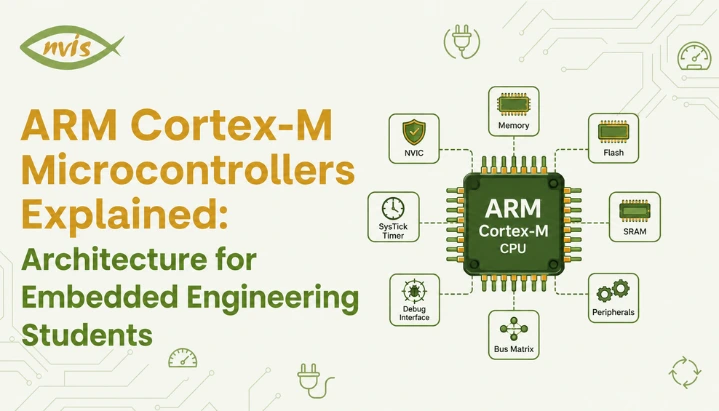
An ARM Cortex M microcontroller is not one single block. It is a small collection of cooperating units, each with a clear job. Picture a compact factory floor: a supervisor giving instructions, workers carrying out tasks, a filing cabinet of short term notes, a warehouse of long term records, and an alarm system that interrupts everyone the moment something urgent happens. That is roughly how pieces of a Cortex M microcontroller work together.Processor Core: Supervisor
processor core is the part that actually executes instructions. It contains an Arithmetic Logic Unit, which performs calculations, along with control logic that decides what happens next. Every instruction your embedded C code compiles down to eventually passes through this core.Registers: Filing Cabinet on Desk
Registers are small, fast storage locations built into the processor and used to hold values that the CPU needs frequently. A Cortex-M core provides general-purpose registers R0 to R12. The SP (Stack Pointer) points to the current stack location, the LR (Link Register) is commonly used to hold a return address, and the PC (Program Counter) holds the address of the instruction being executed or fetched, depending on the processor state. There is also a Program Status Register (PSR) that stores flags like zero, carry, overflow, and negative, which the processor checks when making decisions such as branching on a comparison.Memory: Flash for Long Term Storage, SRAM for Working Space
Flash memory is where your compiled firmware lives permanently. It does not lose data when power is removed, which is why your microcontroller boots up running the same program every time. SRAM, on other hand, is fast but volatile working memory used for variables, stack, and runtime data while a program executes. If Flash is a warehouse where finished records are archived, SRAM is a desk where you actively work on today’s task.Bus Architecture: Delivery Routes
Cortex-M implementations use bus interfaces that can provide separate instruction and data paths, with the exact bus structure depending on the Cortex-M core and the microcontroller implementation. This separation can allow instruction fetching and data access to proceed concurrently. However, the actual performance depends on the Cortex-M core, bus structure, memory system, and microcontroller implementation.NVIC: How Cortex M Handles Interrupts So Well
When it comes to a characteristic of Cortex M architecture, there is one thing that stands out: Nested Vectored Interrupt Controller (NVIC). The interrupt is just a signal to the processor to stop doing what it’s doing and come to attention immediately, and process something else, like a button click, a sensor reading above or below a threshold, an incoming UART byte, etc.Now suppose you were in the kitchen and the telephone rang. The entire recipe is not completed at once. You identify where you paused, respond and then cook from the same point. The Cortex-M exception-handling mechanism automates much of this behavior in hardware. When an interrupt or exception is taken, the processor automatically saves a defined exception stack frame, transfers execution to the corresponding handler, and restores the interrupted context when exception return occurs. The NVIC specifically manages interrupt prioritization, pending status, and interrupt delivery. This removes the need for software to manually save and restore the standard exception-frame registers. No line of manual register saving logic in your code.When an interrupt fires, The Cortex-M processor automatically saves the standard exception stack frame, enters the Interrupt Service Routine (ISR), and restores the interrupted context when the ISR returns through the exception-return mechanism.NVIC supports programmable interrupt priorities, allowing a higher-priority interrupt to preempt a lower-priority handler when the architecture and current interrupt state permit it. This is called nesting and the “Nested” in NVIC is derived from that. Tail chaining is another feature of Cortex M processors, the idea is Tail-chaining allows a pending exception to be serviced directly after another ISR without performing a full exception return and then a separate exception entry sequence, reducing interrupt-handling overhead.Worked Numerical Example: Calculating Interrupt Response Time
This is a useful example of converting processor clock cycles into real-time latency, a calculation that can help with microcontroller and digital-system timing problems so it is worth working through carefully.Problem: A Cortex M3 based microcontroller runs at a clock speed of 72 MHz. For this simplified example, assume an interrupt latency of 12 clock cycles from interrupt recognition to execution of the first ISR instruction. If ISR itself takes 150 clock cycles to complete, calculate total time in microseconds from interrupt assertion to ISR completion.Step 1: Find the time period of one clock cycle.Clock speed = 72 MHz = 72 × 10⁶ cycles per secondTime per cycle = 1 / (72 × 10⁶) seconds = 0.01389 microseconds (approximately)Step 2: Find total number of clock cycles involved.Total cycles = interrupt latency + ISR execution time = 12 + 150 = 162 cyclesStep 3: Multiply total cycles by time per cycle.Total time = 162 × 0.01389 microseconds = 2.25 microseconds (approximately)So the entire interrupt handling process, from interrupt signal being raised to ISR finishing its job, takes just about 2.25 microseconds on this Cortex M3 system. An older 8-bit architecture may have a different interrupt-entry sequence and instruction timing, so its latency can be higher or lower depending on the specific MCU. The key point is that Cortex-M provides a standardized and efficient hardware mechanism for exception entry and interrupt handling because the processor may need to finish a multi cycle instruction before it can even begin saving context. This kind of predictable and efficient interrupt handling is one reason Cortex-M devices are widely used in real-time applications such as motor control and sensor processing.Cortex M0, M3, M4, and M7: How Family Actually Differs
Every Cortex M core shares the same basic philosophy, but they are tuned for different jobs, the same way a scooter, a hatchback, and a highway coach are all vehicles built for very different journeys. Here is how most widely used variants actually compare, using real specifications rather than vague labels like “better” or “faster.”| Feature | Cortex M0/M0+ | Cortex M3 | Cortex M4 | Cortex M7 |
| Architecture | ARMv6 M | ARMv7 M | ARMv7 M | ARMv7 M |
| Pipeline stages | 2 | 3 | 3 | 6 (superscalar) |
| DSP instructions | No | No | Yes | Yes |
| Hardware FPU | No | No | Optional (single precision) | Optional (single and double precision) |
| Hardware divide | No | Yes | Yes | Yes |
| Typical use case | Simple sensors, basic control | General embedded control | Motor control, audio, signal processing | High speed real time processing, advanced HMI |
| Example MCU | STM32F0 series | STM32F1 series | STM32F4 series | STM32H7 series |
ARM Cortex M in Indian Embedded Industry
ARM Cortex M is no ordinary study content for engineering students in India. It’s a family of chips that are actually installed in products created by companies you can expect to interview with. The STM32 series, one of the most popular and utilized Cortex M families in Indian engineering colleges, drives projects ranging from student project boards to industrial controllers.Embedded engineers are recruited in the government tied and defence organizations such as ISRO, DRDO, BEL and HAL for working with microcontrollers based on ARM for subsystems in satellite, radar and communication equipment. The initial roles for freshers in embedded systems are around 3.5 to 6 LPA in an organization such as Bosch, Continental, L&T Technology Services, Tata Elxsi, Sasken, Honeywell and NXP and with 2-3 years experience in a particular field, the pay scale can be from 8 to 14 LPA. Generally, Engineers with fresher experience are hired for 3.5 to 6 LPA in hubs such as Bangalore and increased to 7 to 12 LPA after two years, and for jobs in the automotive and RTOS specialization, they are paid 12 to 20 LPA.With India’s expanding electronics and semiconductor ecosystem, embedded and firmware skills are receiving increasing attention. Engineers who understand microcontroller architecture at a deeper level can have an advantage over candidates whose experience is limited to using high-level development environments such as the Arduino IDE. Embedded positions in the automotive industry, such as those for engine management systems, battery management systems, and in general when dealing with embedded systems, can pay between 7 and 35 LPA, depending on experience, and Automotive embedded roles can offer strong compensation, particularly for engineers with experience in areas such as AUTOSAR, functional safety, embedded C/C++, automotive protocols, and RTOS-based development.GATE, SSC JE, and RRB JE Exam Relevance
Microprocessor and digital-system concepts are relevant to GATE ECE preparation, but the exact syllabus classification and question patterns should be checked against the current official syllabus, and questions on interrupt handling, register architecture, and instruction execution timing are common numerical problem types. Microprocessor, microcontroller, and digital-system concepts have appeared in GATE over the years, but their frequency and marks vary from paper to paper, and Questions may use concepts that are also relevant to modern Cortex-M-based systems, even when the specific processor architecture is not named.For SSC JE and RRB JE electronics and electrical papers, microcontroller architecture questions tend to focus on conceptual understanding: what registers do, how interrupts are prioritised, and practical difference between RISC and CISC design. A worked example earlier in this post, calculating total interrupt response time from clock speed and cycle counts, is a template you can reuse directly, since these exams frequently rephrase the same underlying calculation with different clock speeds and cycle counts.A practical exam strategy is to master register sets (R0 to R12, SP, LR, PC, PSR) cold, understand NVIC’s priority and nesting behaviour conceptually, and practice cycle to time conversions until they become automatic. These three areas cover several important microcontroller-architecture concepts that are useful for GATE, SSC JE, and RRB JE preparation.Building a Career Around ARM Cortex M Skills
If you are early in your engineering degree, the most useful thing you can do is get hands on with an actual Cortex M development board rather than only reading about architecture. STM32 Nucleo boards and similar Cortex M4 based development kits are inexpensive, well documented, and directly relevant to what Indian embedded employers expect from freshers.ECE engineers in embedded systems and VLSI roles typically reach 10 to 18 LPA at mid level, with three to five years of experience, and embedded specific specialisation tends to compound this further. Semiconductor firmware roles working close to silicon level, including Cortex M based firmware, are among higher paying segments within embedded systems, with mid to senior engineers at semiconductor companies earning 15 to 35 LPA.A skill progression that consistently works for Indian embedded freshers looks like this: start with Embedded C fundamentals, move to bare metal Cortex M programming using register level code before relying entirely on vendor libraries, then layer in an RTOS like FreeRTOS once fundamentals are solid. Employers consistently value candidates who understand what is happening underneath the abstraction layer, not just candidates who can call a library function.Conclusion
ARM Cortex M microcontrollers earned their dominant position in embedded systems by solving a real problem:delivering 32-bit processing capabilities while targeting the cost and power constraints of many embedded applications with an interrupt handling system fast enough for real time applications. Understanding this architecture means going beyond memorising terms like NVIC or PSR and instead grasping why each piece exists and how they work together, from the register set that provides the CPU with fast access to frequently used values, to bus architecture that lets instruction fetch and data access happen in parallel.For Indian engineering students, this knowledge pays off twice. It builds conceptual foundations that GATE, SSC JE, and RRB JE numerical questions test directly, and it builds practical skill sets that embedded employers, from STMicroelectronics and Bosch to ISRO and DRDO, actually hire for. Start with a Cortex M4 development board, work through register level programming before jumping to abstraction libraries, and practice interrupt timing calculations until they feel automatic. That combination is what turns textbook knowledge into an actual embedded systems career.FAQs
Arm is a company that develops processor architectures and CPU designs and licenses them to semiconductor companies, who then build complete microcontrollers around that design by adding memory, timers, and peripherals. When people ask what ARM is in microcontroller terms, they are really asking about processor core design inside the chip, not the finished product itself.
Cortex-M is Arm’s microcontroller-oriented processor profile, while Arm also develops Cortex-A and Cortex-R processor families for other types of systems. ARM also offers Cortex A profile for application processors used in smartphones and Cortex R profile for real time systems, so Cortex M specifically refers to the microcontroller focused branch of ARM’s designs.
An ARM M4 microcontroller adds DSP instructions and an optional Floating Point Unit that a Cortex M3 does not have, which matters for signal processing and motor control projects. For pure learning purposes, either core teaches the same fundamental register and interrupt concepts, so beginners can start with whichever development board is more easily available.
Cortex M processors balance computing power, low power consumption, and cost in a way few alternatives match, which is exactly what battery powered IoT sensors need. scalability across M0 to M7 variants also means a single ecosystem of tools and knowledge covers products ranging from simple sensors to advanced edge devices.
GATE ECE includes microprocessor, digital-system, and computer-architecture concepts. The exact processor families and question emphasis vary across papers and years, but interrupt handling, register architecture, and cycle-time calculations are useful concepts to understand, register architecture, and cycle time calculations, all core Cortex M topics, are directly testable regardless of which specific processor family a question references. Practicing clock cycle to time conversion shown in this post prepares you for this question type regardless of exact architecture named.
Embedded C is the dominant language for Cortex M firmware development in industry, often supplemented with a small amount of ARM assembly for startup code or highly time critical routines. C++ is increasingly used as well, particularly in larger projects that use an RTOS like FreeRTOS or Zephyr.
STMicroelectronics, Bosch, Continental, L&T Technology Services, Tata Elxsi, Sasken, and NXP are among private companies hiring for Cortex M based embedded development, alongside PSUs and defence organisations like ISRO, DRDO, BEL, and HAL. Compensation varies by employer, location, role, and experience, with specialized skills such as RTOS and automotive protocols potentially improving a candidate’s opportunities.